
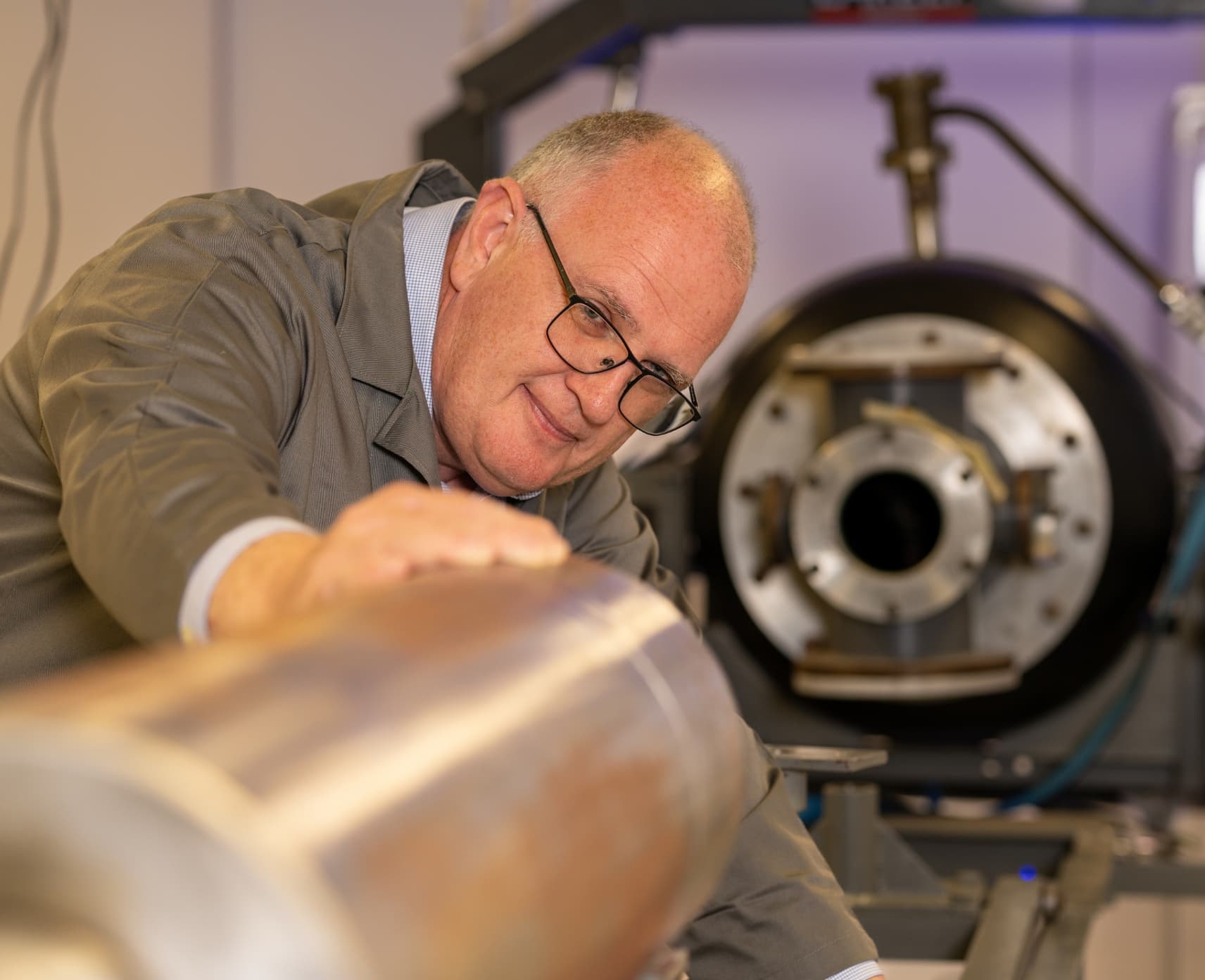
All fired up: how the original shock tunnel came back to ANU
When Professor Sean O’Byrne was asked to dismantle the machine he’d built his career on, he had other ideas. Twenty years later, the T2 free piston shock tunnel is back at ANU and back in business.
Article by:

Kathryn Vukovljak
Contributing writer
In a small lab tucked away in The Australian National University’s (ANU) School of Engineering, there is a machine that looks an unlikely hero.
Made up of a long metal tube, a compressor from a scuba diving shop and using steel diaphragms hand-scored with a cross that open like a flower when the tunnel fires, the T2 free piston shock tunnel recreates, for a fraction of a second, the conditions a spacecraft experiences when it enters a planet’s atmosphere at hypersonic speed – extreme heat, pressure and velocity.
And it’s back in action after more than 20 years in storage.
Recommissioned in April by Professor Sean O’Byrne from the ANU College of Systems and Society’s School of Engineering, the high-performance shock tube can test aircraft technology and aerodynamics at supersonic speeds.
When it fires, for approximately 350 microseconds, the T2 generates temperatures up to 6,000 degrees Celsius, pressures nearly 280 times that of the atmosphere, and gas that moves at eight times the speed of sound.
Based on a concept developed by Professor Ray Stalker in the early 1960s, the T2 was built at ANU in 1964 and in use for 38 years, described by O’Byrne as “the first operational shock tunnel used for serious research”.

A young Sean O’Byrne arrived at ANU as a masters student in the 1990s and learned the tunnel’s rhythms in his research on laser diagnostics – precisely tuned laser beams that measure temperature, velocity and gas composition in the flow without disturbing it.
“Using the tunnel is kind of like loading a cannon from the 1700s. You get a push rod and push the piston back onto the launcher. You get a diaphragm, you put it in, you put the thing back together, turn all the screws, evacuate everything, fill it with gas, fire it, and then go through the whole process again,” he says.
An elegant and revolutionary idea
The tunnel’s story starts decades before O’Byrne first set foot in the lab.
Professor Ray Stalker was a postdoc at The Canadian National Research Council in the early 1960s, working on a way of researching flight at very high speeds, or “hypervelocity aerodynamics”.
His free piston design was elegant in hindsight and revolutionary at the time: a piston driven by high-pressure air compresses noble gases so rapidly that it bursts a steel diaphragm, generates a shock wave that heats the flow behind it and then accelerates that hot gas through a nozzle to hypersonic conditions.
“Stalker built the first one here at ANU, when the rest of the world didn’t think it was possible.”
The T2 was the first operational facility anywhere built on that principle and around it gathered, almost by sheer luck, a constellation of ANU talent.
Professor Hans Hornung, an aerodynamicist who would go on to lead the renowned Graduate Aerospace Laboratories at Caltech, brought deep expertise in flow physics. Professor John Sandeman, a British-born physicist whose work on light and matter was already attracting international attention, developed the spectroscopic measurement techniques that allowed researchers to see inside the flow for the first time, and with Associate Professor Frank Houwing pioneered the laser diagnostic systems that would become central to the field.
“When Stalker first published his results, international researchers couldn’t believe the speeds the T2, and the subsequent larger T3 tunnel commissioned in 1972, were capable of achieving,” O’Byrne says.
“Now there are more powerful shock tunnels with larger facilities in the United States, Europe and China, and the larger ANU T3 facility has been recommissioned at Oxford University as its T6 shock tunnel.
“But Stalker built the first one here at ANU, when the rest of the world didn’t think it was possible.”
Eventually, the key group moved on from ANU. Stalker went to the University of Queensland in 1977, where his team would go on to graduate 130 PhD students in hypersonics and position Australia as a world leader in the field. Hornung went to Caltech. Sandeman stayed at ANU and shifted his focus to gravitational wave research. When Houwing retired due to health issues, there was no one left at the University to carry the tunnel forward.
When the T2 was decommissioned in 2004, it was O’Byrne’s job to help dismantle it.
Rather than see it scrapped, he arranged for the tunnel to be packed up and moved with him to UNSW, where he had taken up a position continuing his research.
“I wanted to make sure that the capability didn’t leave Australia,” he says.
When the opportunity came to return to ANU in late 2023, O’Byrne knew exactly what was coming with him.
Bringing it back
While he was thrilled to have found a new location to set up the T2, O’Byrne says the rebuild wasn’t straightforward. Parts had been lost and a new piston had to be made from scratch. New vacuum pumps, electronic measurement systems and many small components had to be sourced and built in. But when it finally fired again in November 2024, it worked first time.
“I’d spent 20 years telling people this thing still worked, so it was definitely a relief to find out I was right,” he laughs.
The formal recommissioning took place 61 years after the tunnel first ran. But for O’Byrne, the focus is on what comes next.
He’s working with ANU Rocketry students on the next generation of sensors, with a first experiment planned on board a high-altitude balloon with Japan’s space agency JAXA – a first step, he hopes, towards putting instruments like these on rockets that actually fly.

He is quietly matter-of-fact about why he spent 20 years making sure the T2 didn’t disappear.
“I wouldn’t say I was a sentimentalist or anything. I just hate to see effort erased,” he says.
“Some people tinker on motorcycles in their spare time. I like shock tunnels. If I hadn’t found a place for the T2 at ANU I probably would have set it up in my garage at home – if my wife would have allowed it!”
He says the T2 gives ANU researchers access to conditions and phenomena that are unavailable any other way at that scale and cost.
“The T2 allows you to understand flows at very high speed, and to see things that nobody else has seen – I just find it incredible.”
Top image: Professor Sean O’Byrne. Photo: David Fanner/ANU.
You may also like
A museum heist 70 years ago is still causing a flutter in butterfly science today
Would you steal a butterfly? How one man's bold butterfly heist has had lingering impact on science - and our understanding of biodiversity today.
The ceremonial heart of ANU: A first look inside our newly restored University House
University House represents both an intellectual and a social home for many in the ANU community. After five years of complex restoration, it opens again.
ANU spin-out Liquid Instruments secures $70 million to advance AI-driven tech
Canberra-based technology company Liquid Instruments has secured major investment to accelerate the commercialisation of its platform that is reshaping how engineers interact with complex systems.