
Could we see a Pauline Hanson-led government in 2028? It’s not so far-fetched
Honorary Fellow Dr Simon Copland unpacks Australia’s shift towards right-wing politics, lessons learnt from the Reform UK party, and what One Nation’s recent success at the polls could mean federally.
Article by:

Dr Simon Copland
School of Sociology
After gaining polling swings in 2025, early 2026 provided its first electoral tests for Pauline Hanson’s One Nation Party. It has passed with flying colours.
In South Australia (SA), a state that has historically been weak for the party, One Nation charged into second place, winning 22.9 per cent of the vote. Then, in early May the party easily won the Farrer by-election, in a vote that saw the Liberal-National Coalition – the two parties who have historically held this seat – receive just over a combined 20 per cent of the primary vote.
The reverberations are already being felt. The latest Roy Morgan poll, released after the Farrer by-election and the Federal Budget, saw One Nation take a national lead for the first time.
Liberal Leader Angus Taylor, in his budget reply speech, directly targeted migrants, in language that could easily have come from Pauline Hanson’s mouth. The Liberals are clearly scared, with Taylor doing whatever he can to claw back voters.
Despite this, many are still downplaying the possibility of One Nation performing well at the next Federal Election. Some downplayed the party’s win in SA, pointing to the poor conversion to seats in the state, and the fact that 60 per cent of people voted against the party in Farrer.
Others have pointed to the historical volatility of One Nation, predicting it is unlikely to be able to last until 2028, when the next Federal Election is predicted to be held. Commentators like Bernard Keane for Crikey are claiming that the party has hit its polling roof and cannot go any further.
I think, however, we should take the rise of this party far more seriously. There is a real possibility we could end up with a Pauline Hanson-led Federal Government in 2028.
The factors driving One Nation’s growing popularity
I have been studying the rise of the far-right movement globally for close to ten years now.
In recent years, I have frequently been asked the question ‘what about the far-right in Australia’? My answer was always the same: the social conditions for far-right movements to flourish in Australia had not yet been laid. This was in large part because Australia was somewhat shielded from the worst of the economic hit of the Global Financial Crisis, particularly compared to the United States and Europe. Conversely many of the culture wars that have plagued these places have not yet arrived at our shores with the same intensity.
Yet, I have always warned, we are not immune to global trends and cannot be complacent. A shift was, sadly, likely inevitable.
I admit, I was surprised by how quickly this has occurred in the past year. The 2025 Federal Election result, which saw Peter Dutton get absolutely creamed by the Labor Party, was heralded as Australia rejecting Trumpian politics. We, alongside Canada, who had a similar result last year, were supposed to be the bulwarks against the rise of the right-wing movement. Now, exactly twelve months after Labor’s election win, Australia has shifted to embrace right-wing politics.
The early stages of Hanson’s renewal in popularity was forged in the depths of far-right movements following the 2025 election. Post-election analyses argued whether Dutton should’ve become more moderate or not, with some Liberal Party politicians arguing that the Liberals in fact needed to embrace Trump-style right-wing politics even more. Many right-leaning voters were extremely dismayed at the election of Sussan Ley to the Liberal leadership and, feeling absolutely no loyalty to the party, began leaving in droves.
This gave One Nation an immediate and sizeable bump in popularity, enough for media outlets to start taking it seriously, and for news coverage to increase dramatically.
The Australian media has always been fascinated with Hanson and quick to give her coverage across her career. With this polling bump the media jumped on board as fast as they could.
The past year has seen continued and increased economic pain for many Australians, driven by a housing crisis, stubborn inflation, increasing interest rates, and the Iran War and subsequent fuel crisis. Aided by news outlets desperate to cover whatever the party says, the far-right has been far better at responding to these crises than the left.
Their message has been simple: immigrants are to blame for our economic woes, a story they repeated ad nauseum. They particularly hammered this message through The March For Australia rallies held nationwide, which started in August last year, and had many One Nation supporters participating.

Hence, by the start of 2026, immigration had become the big issue for the right, and the Liberals started to take notice, dumping Ley for Angus Taylor.
By this stage, however, it was too late. Enough people had jumped ship, the media had already declared Hanson to be formidable, and the right’s trust of the Liberals had declined to new lows.
An unstoppable force?
The question is: can One Nation continue to ride the wave of momentum it’s experiencing?
While the party is cannibalising the Liberal and National vote in rural, regional and some suburban areas, it is unlikely to have enough support to win a Federal Election just yet, even though it is now, at least in one poll, within the margin of effort.
One Nation cannot, at this point in time, take enough urban seats to form a majority government, with former moderate Liberal seats still going to Teals, and Labor holding on in their traditional strongholds.
But this does not mean we should rest on our laurels. Evidence from overseas suggests that far-right parties do not just cannibalise the conservative vote but can eat into the left as well.
It is worth, for example, looking at the rise of the Reform party in the United Kingdom (UK), who in early May had their best-ever results in local council elections, a result that has thrown the Labor Government into absolute turmoil.
Yet, following a landslide victory by the UK Labour Party in 2024, Reform have now shot to the top of the polls. It has done so through leading a charge that One Nation is now following. After destroying the Conservative vote, and pushed by a sizeable media wave, Reform began placing significant pressure on the Governing Labour Party, particularly around their favourite issue of immigration.
Soon Labour began to respond, primarily by bringing out increasingly draconian policies targeting migrants. This not only put off much of their progressive base (who have flooded to an energised Greens Party), but also gave Reform even more legitimacy.
With immigration becoming an agreed ‘ill’ in British politics, more voters have turned to the Reform party, considered the ‘original product’. This has resulted not only in Reform eating into Conservative votes but now taking Labour ones as well.
The Australian Labor Party has been somewhat smarter than its UK counterpart, as seen in the latest Federal Budget. While Labor could easily make immigration the biggest issue to respond to Hanson, it instead began a process of taking on wealthy investors. The party has therefore not engaged in the debate on immigration as much as their UK counterparts, at least for now.
However, as Albanese’s relatively conservative and cautious approach to these difficult economic times continues, resulting in little progress for many Australians, it is likely frustration at Labor will continue to grow.
With One Nation now cemented as an unofficial opposition, both in the eyes of voters and the media, this is where many Australians may look to. By 2028 there is a real chance that this could be a large enough share of the vote to lead them to a federal election victory.
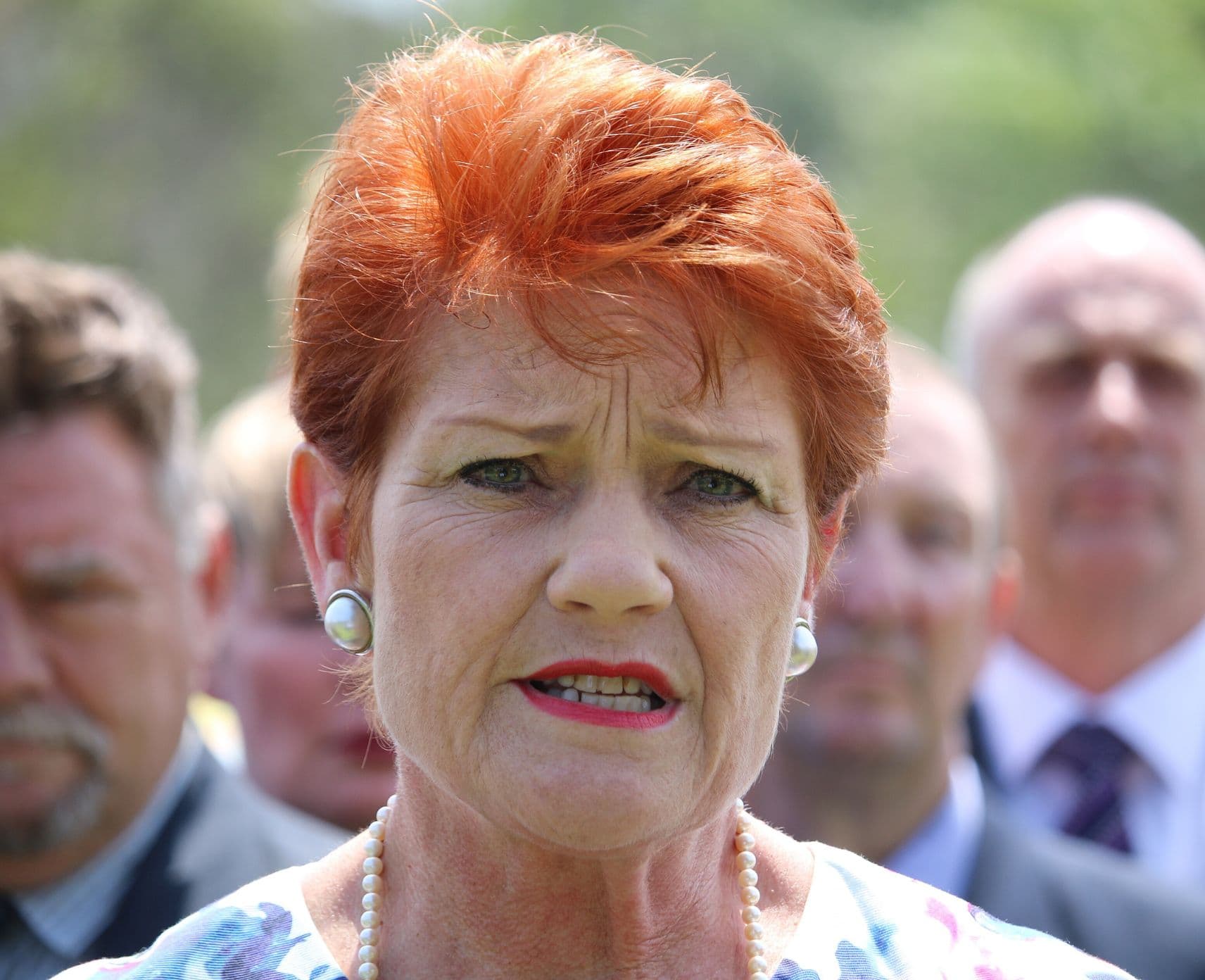
Top image: Pauline Hanson, Leader of the One Nation Party (Australia). Photo: Jfish92/Wikimedia
You may also like
Democracy Sausage: The One Nation vote: a map of government neglect
Redbridge Group director Kos Samaras joins Mark and Marija to unpack the new Australian Resilience Index. It maps the financial, health and social resilience of communities across all 150 federal electorates.

Democracy Sausage: Not here to fix Labor
On this episode, Professor Mark Kenny and Dr Marija Taflaga look at what was behind the Greens' first truly competitive leadership contest. They discuss why personal relationships carry so much weight in a party room that could fit in a minivan, and whether the Greens are really just a privatised left faction of the ALP.


Democracy Sausage: The Alchemy of Leadership
Historian and biographer Paul Strangio joins Mark to dissect what makes — and breaks — an Australian prime minister, drawing on his newly shortlisted book The Alchemy of Leadership: Seven Australian Prime Ministers in a Turbulent Twenty-First Century.