
Divine tech? Tatiana Bur is marrying science and religion in ancient Greece
Dr Tatiana Bur wants us to view technology the way the ancient Greeks did: as a marvel, not just a tool.
Article by:

Luis Perez
Contributing writer
Before Dr Tatiana Bur became an ancient Greek historian, she felt torn between two worlds.
Growing up in Australia after spending her early childhood in France, she fell in love with classical antiquity in the history classroom, captivated by the comedies and tragedies of Greek drama.
But even as the humanities became her intellectual refuge, there was something fascinating about the natural sciences that always nudged her curiosity.
By the time she began her master’s research, Bur was already exploring ways these often held apart disciplines might intersect.
A trip to Greece helped crystallise her ideas.
Standing at the Sanctuary of Asklepios in the city of Epidaurus, she drank in the beauty of one of the best-preserved theatres of the ancient world.
“This fourth-century BCE theatre is attached to a larger site that once served as a sanctuary to Asklepios, the god of medicine,” Bur says.

“The Greeks would go there to practice something known as ‘incubation’, a ritual where they would sleep overnight in the site hoping the god would heal them.”
In this breathtaking enclave, ancient pilgrims carved inscriptions into stones and plaques –testimonies of miracles, cures, and therapies that transformed their lives and that today enrich our understanding of ancient medicine, and of ancient religion.
Witnessing these historical remnants was a eureka moment for Bur: a realisation that her passion for classical culture and her interest in science could, in fact, coexist.
“It helped me see that there was no division in antiquity between these things. The divide between science and humanities is such an artificial construct of the European university system,” she says.
Her latest monograph, Technologies of the Marvellous in Ancient Greek Religion, is the culmination of that journey combining two worlds.
In the book, the Australian National University (ANU) researcher explores how Greek gods were not distant figures perched on Mount Olympus but active presences in daily life through awe-inspiring, technological devices.
Awe-inspiring is no exaggeration. Millennia before modern robotics, self-moving machines were already a thing, acting as bridges between heaven and earth.
God from the machine
In film, deus ex machina is a plot device where a huge problem with no solution gets suddenly fixed in the most unexpected (and often disappointing) way.
Long before this technique powered some of Hollywood’s most iconic scenes – such as Dorothy clicking her ruby slippers to return to Kansas in The Wizard of Oz – it was used by the ancient Greeks, who coined the term.
In Greek theatre, it described the timely appearance of a god to resolve a story plot, typically saving the protagonists from an ill-fated destiny.
This marvellous effect was achieved thanks to a crane that would hoist an actor dressed as a deity into view.

“My book traces this phenomenon of having the divine manifest through technological means, especially mechanical ones,” Bur says.
“I argue that the deus ex machina and other ancient technologies – mirror illusions, automata, etc – were genuine modes of epiphany.”
Bur notes that while modern thinking often pits technology against religion, the ancient world didn’t draw such stark lines. Back then, tech was far more inclusive.
“In ancient Greece, the word we get technology from, technē, actually meant art or craft. It covered everything from music and sculpture to mathematics, astronomy, even hunting and divination,” she says.
These technological artforms were used to enchant the audiences, establishing a deep, religious connection with them.
Imagine a ‘vending machine’ that dispenses holy water when you insert a coin; or an automatic temple door that opens itself after a fire sacrifice is offered at the altar.
“There was intent behind the inventions to inspire wonder and awe in the viewer. Technology was used to animate stories that served as the backbone of religious conceptions,” she says.
“Mechanics and pneumatics allowed the divine to be present in much the same way a cult statue did – as a god in its own right, not merely a representation of it.
“We’re very comfortable with the Greek gods being depicted in sculptures. Why not also through mechanical means?”

Viewed through a Judeo-Christian lens, making a god ‘from the machine’ might seem blasphemous. But in Greek antiquity it wasn’t. Technology was a legitimate way to connect with the divine realm.
This perfect symbiosis between technology and religion wasn’t always candid, though.
Bur’s research also explores what happened when divine tech fell into the wrong hands.
“There were fake prophets who used mechanics to dupe worshippers into believing in their cults,” she says.
“In such cases, technology was not put to the service of religion – it was threatening it by falsifying, fabricating and imitating the gods.”
Bur’s work is a timely reminder that, across the sweep of history, technology has always been a double-edged sword.
Redefining technology
Do a quick Google search and you’ll find ancient Greek engineers credited with everything from analogue computers to alarm clocks and even robots.
For Bur, while those claims aren’t entirely off base, they are superficial.
“There is a Silicon Valley, tech-obsessed rhetoric that’s desperate to see ourselves reflected in the Greeks and Romans,” she says.
In a recent episode of ABC’s No One Saw it Coming podcast, Bur discusses the Antikythera mechanism, an ancient Greek device capable of tracking the paths of the Sun, Moon and planets with astonishing precision.
This gadget, which cameoed in the latest Indiana Jones movie, is frequently hyped by mainstream media as the first-ever computer.
“This is not just anachronistic, but it’s actually quite damaging. Calling it a computer puts it in a box where people assume it does what a modern computer does,” Bur says.
“It’s not only historically inaccurate, but it also glosses over some of the most exciting bits of the mechanism, which combines astronomical knowledge from the Greeks, Babylonians and Egyptians.”

Bur wants her research to push us to look more critically at the technologies we celebrate today – and to appreciate that ancient innovation wasn’t a means to a capitalistic end, but a cultural product meant to delight, entertain and showcase humanity’s wild ingenuity.
Recently, she launched Fulcrum, a network that brings together fellow Australasian scholars working on science and technology before 1500.
Through this initiative, she hopes to find ways to keep widening the space where the humanities and sciences meet, co-creating solutions to real-world problems.
“I want classics and pre-modern scholars to be intervening into bigger debates that are happening outside our field and to show the perspective of what ancient world studies can bring,” she says.
“Science in antiquity is philosophy. Today, these two disciplines sit in different colleges, but the beautiful blurring of the two is part of the fun. It allows my research to speak to more than humanities and history academics.”
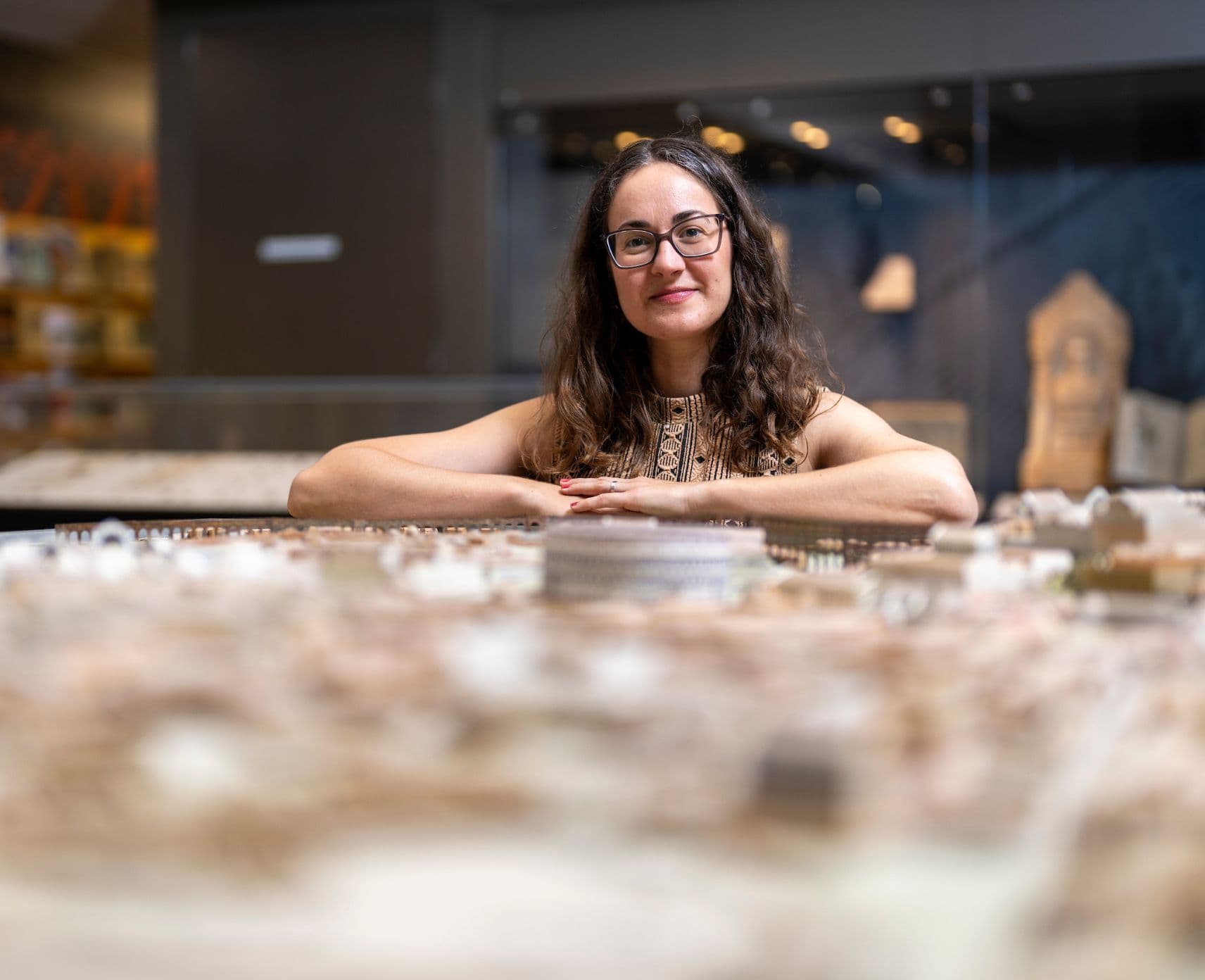
Dr Tatiana Bur. Photo: Jamie Kidston/ANU
Related tags:
You may also like
The ANU Classics Museum is viewing the past with new eyes
The ANU Classics Museum is bringing new life to its collection with the help of contemporary artists.
The real life Muses that shaped Roman literature
Learned slaves played a major role in Roman literature, composing, revising and maybe even improvising on the work of their famous captors.

Hail Caesar or heil Hitler? Why politicians hijack classical culture
Pictures are worth a thousand words – our leaders know it. But how much of their visual identity is 'borrowed' from the Roman Empire?