
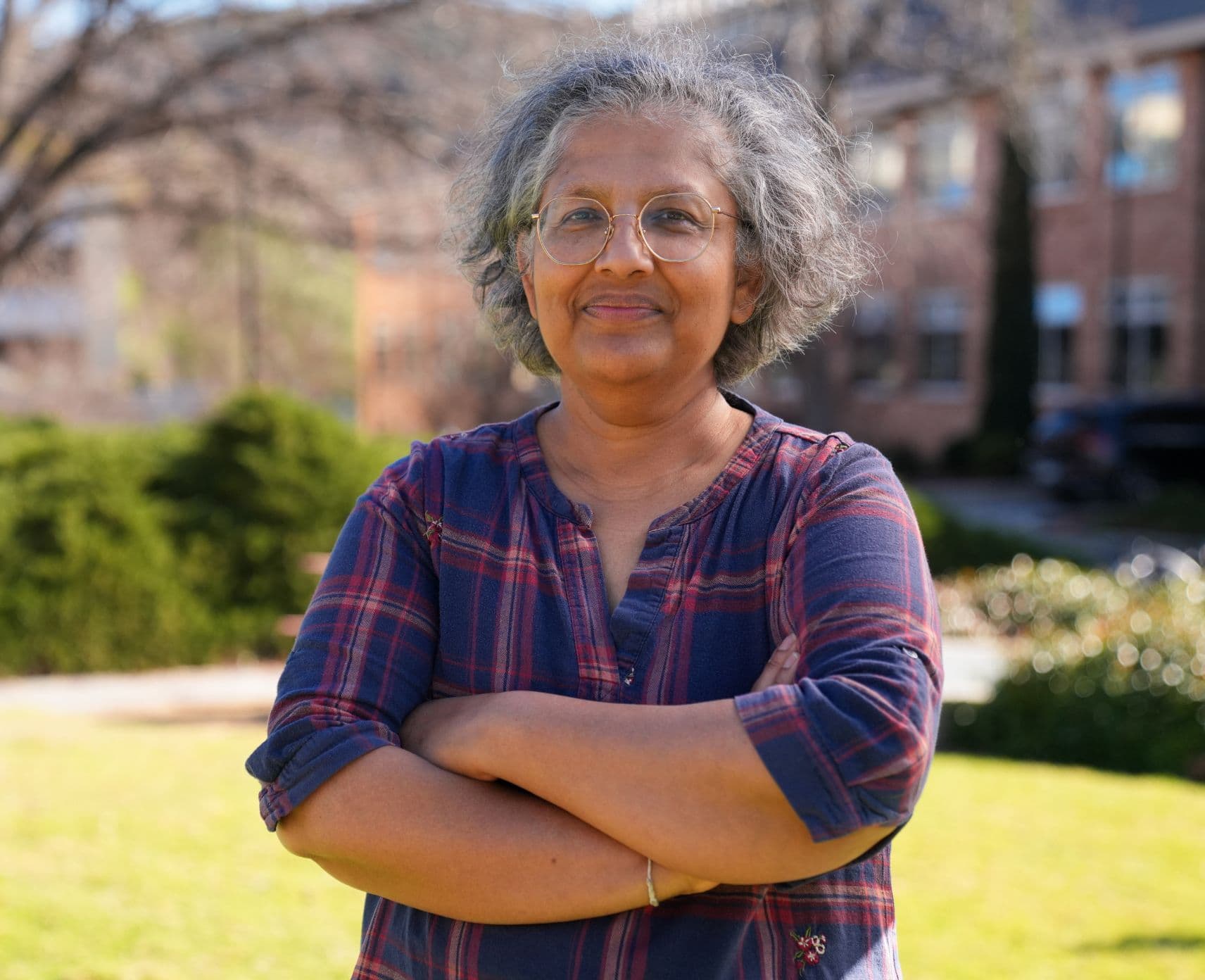
Help where you can: Professor Kamalini Lokuge on why research must serve humanity
From the Ebola outbreak to the COVID-19 pandemic, Professor Kamalini Lokuge has been driven to provide humanitarian health care wherever in the world it may be needed.

“Don’t come home married to a Taliban.”
These were the words from a terrified mother to her daughter as she embarked on her first trip with Médecins Sans Frontières (MSF or Doctors Without Borders) to Afghanistan. The 26-year-old Kamalini Lokuge boarded the plane, thinking she was having a break before choosing her medical specialty. Instead, that trip changed the direction of her life and those of many others.
A need to be of service to others, and help where you can, is a core value for Professor Kamalini Lokuge OAM,instilled in her by her parents. The type of help she seeks to provide, however, was shaped by her patients.
When Lokuge touched down in Taliban-run Kabul in 1996, what awaited her was a malnutrition program on the frontline next to the war zone followed by a cholera outbreak.
“It really was when I went to MSF that I saw that trying to treat someone when they’re sick is so limited, when a lot of disease can be prevented,” Lokuge recalls, sitting surrounded by books in her home office.
In an effort to develop the skills to better advocate for her patients and communities in an evidence-based way, Lokuge returned to Canberra and started a PhD at the ANU National Centre for Epidemiology and Population Health (NCEPH).
After graduating in 2005, Lokuge went back into the field with MSF, working in areas devastated by conflicts and diseases, one of which was an Ebola outbreak, one of the world’s deadliest infectious diseases.
When asked “were you scared?” she paused. “I mean, it’s hard, and that’s partly why I haven’t had kids, because I think it’s a hard ask, to ask your family to worry about you while you go and do things like this.”
“It’s really meaningful work and you meet the most amazing people, both your patients, their communities – even more so – your colleagues.”
During an Ebola outbreak in 2007, Lokuge met an 18-year-old health worker called Kadija.
“She had just finished nursing training, been kicked out of her home because her family was scared,” says Lokuge.
Yet Kadija had stayed when everyone else had left or died, working without gloves or standard PPE in an old Tuberculosis (TB) ward.
“I asked her once, ‘Why did you stay?’ And she said, ‘Oh, I knew help would come. It was really important for me that when people like you came, that you knew there were people from our community that had stayed.’”
These words drove Lokuge throughout her career back into outbreak zones.
“You don’t get on a plane thinking, ‘Oh, this is going to be fun,’ but I think there probably is a Kadija waiting for help.”
Support where it’s needed
In 2012, Lokuge became a researcher at the ANU, leading the ANU Humanitarian Health Research Initiative (HHRI) to support those in greatest need around the world. Her position allowed her to conduct two humanitarian missions a year, which were possible only because others, especially her supervisor Distinguished Professor Emily Banks, understood the value of the work and supported it.
Above all, being in the heart of an Ebola outbreak is one of the biggest risks you can take as a researcher. But ANU accepted the institutional risk and approved her secondments with MSF as time and again, Lokuge went back into Ebola hot zones.
While there, she would spend her days with patients, trace contacts, support and educate families to ensure safe burial practices and improve behaviours around sick people, as well as train others to monitor those who were in contact with an infected person. This was part of the broader goal of gaining community trust and with that, stopping transmission and ending the outbreak.
However, reintegration was one of her biggest challenges – arriving back home came with an irrational fear that she would get sick and infect others with Ebola, a fear that kept getting worse with each outbreak.
She sought advice from an ANU staff advisor who suggested that she stay with the people who understand this disease. So then after each outbreak, Lokuge worked remotely, staying at an MSF house in Amsterdam with peers from Ebola areas to decompress during the 21-day incubation period before returning home.
“At an individual level, I was valued and supported not because I was bringing in money or glory or direct benefit, but because this was something important. There was a need, and ANU supported me at that level.”

Pandemic-ready expertise
No one foresaw that decades of Lokuge’s work would suddenly become relevant at home in 2020. In the space of a few weeks, Lokuge was at the forefront of Australia’s COVID-19 response.
“I was actually in Sierra Leone when there were the first reports from China, and I came back early because my colleagues and I thought that it could be terrible”.
But Lokuge believed that it could be managed, with quick, determined, and evidence-based responses.
At the time, most public health staff in Australia had never managed a high-risk person-to-person infectious disease and individual transmission chain mapping wasn’t a common practice here.
Lokuge was keenly aware that for COVID-19, Australia must base its contact tracing on a comprehensive transmission mapping practice, as was done for Ebola.
Appointed Chief Scientific Advisor, COVID-19 for the Victorian Government, she coined the term ‘upstream contact tracing’ to demonstrate the need for identifying who infected a patient in addition to identifying whom the patient exposed, or ‘downstream’, as seen in traditional contact tracing. The strategy was included in Australia’s COVID-19 Series of National Guidelines, and it has since become standard best-practice.
Lokuge was soon providing evidence for Australia and New Zealand’s COVID-19 surveillance systems, helping health authorities prevent COVID-19 resurgence, being an expert witness in court cases – and, back home at ANU, sharing critical risk management advice as a member of the ANU COVID-19 taskforce.
Research must serve humanity
Lokuge is now ready to pass the torch, training the next generation of humanitarian researchers.
“I don’t want to or need to get on a plane to an outbreak. Right now, it’s the job of young ones, and it’s my job to keep them as safe and supported as I can,” she says.
This includes ensuring there is tailored support so that researchers don’t need to rely on luck or individual champions to pursue important work.
She also created the PhD program she wished she had, allowing people to come to ANU for humanitarian research and ultimately benefit communities whose voices are too often ignored.
“I provide a structure where they can lead humanitarian research that supports communities as safely and effectively as possible. It’s the best thing I have done.”
Top image: Professor Kamalini Lokuge. Photo: Hannah Scott
Related tags:
You may also like

Beyond zero tolerance: what it will take to end sexual harassment in medicine
Drawing on years of global research and testimony, Clinical Associate Professor Louise Stone examines why sexual harassment persists across medical cultures worldwide – and why policy and law alone have never been enough to stop it.
How art uncovers the hidden pain of endometriosis
ANU PhD candidate Susanne Ilschner is combining visual art, patient experiences and laboratory research to better understand the emotional, social and biological impacts of a condition affecting up to one million Australians.
Strong and healthy: How Mob-driven leadership is transforming Indigenous health research
The history of Indigenous health research in Australia is deeply entwined with practices that were often extractive, exploitative and driven by non-Indigenous agendas. Now, Yardhura Walani and the National Centre for Indigenous Genomics are leading the way to change that.