
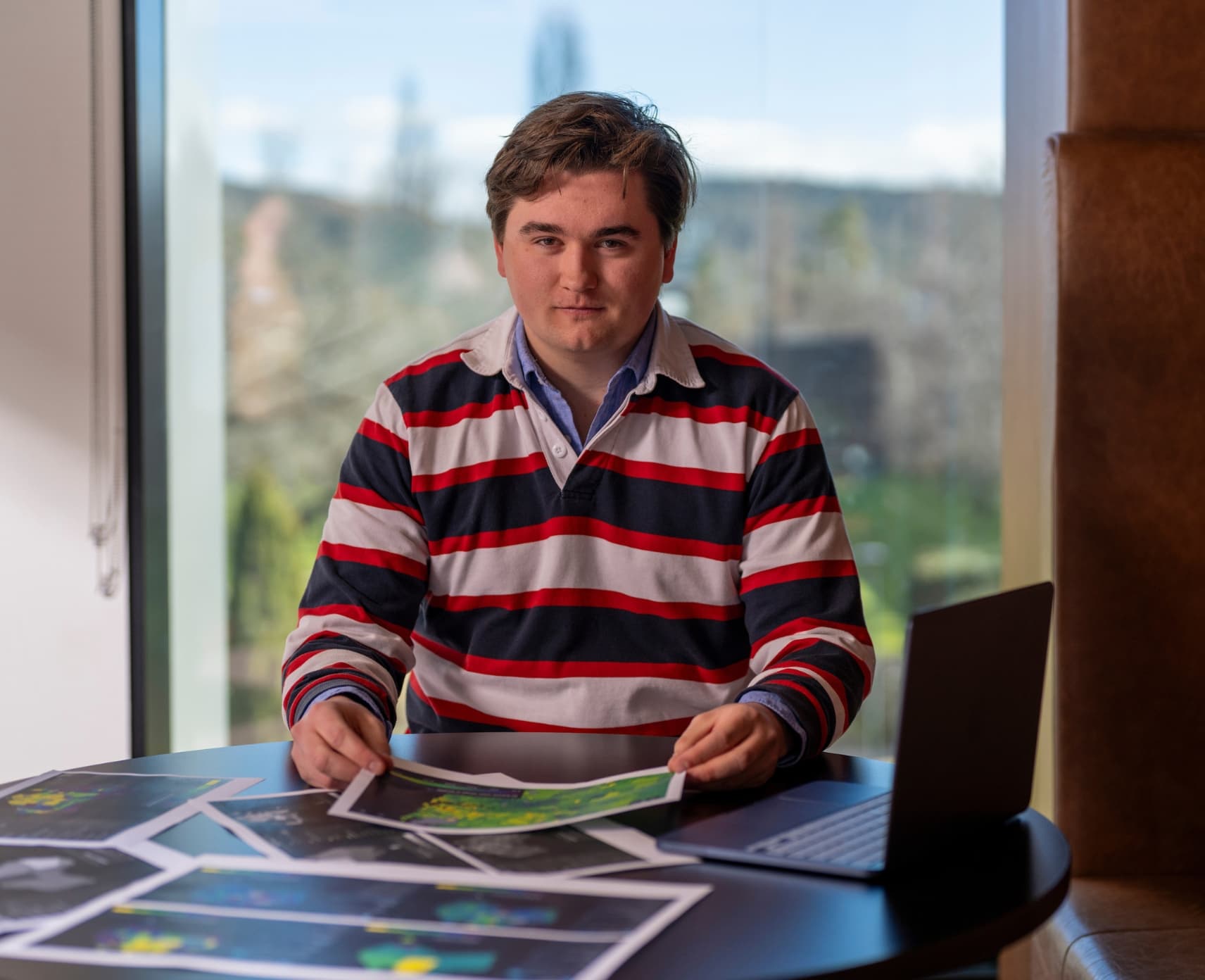
How William is making sense of the census
This student-developed platform opens up Australia’s census data so we can better understand the story of our nation.
Article by:

Katelyn Czubara
Media Assistant
For most university students, spare time is hard to come by. But William Gledhill, a third-year Business Administration and Computing student at The Australian National University (ANU), used his to tackle a longstanding challenge: making Australia’s census data easier for the public to explore.
The result is an interactive mapping platform that transforms complex census statistics into an accessible visual experience, allowing users to explore demographic, social and economic trends through interactive maps rather than spreadsheets and static data tables.
Dr Liz Allen, a demographer at POLIS: The Centre for Social Policy Research, says initiatives like Gledhill’s help give Australians greater access to information that shapes countless decisions affecting our lives.
Using Visual Studio Code and OpenAI Codex, Gledhill developed a platform that draws publicly available data directly from the Australian Bureau of Statistics (ABS) and presents it through an interactive interface.
Gledhill has always enjoyed maps, and the idea stemmed from his own interest in geography and data visualisation, alongside a desire to make census information easier for the public to understand.
“There’s a lot of people who find this stuff interesting that otherwise would not be able to access it,” he says.
He had initially been experimenting with a website visualising over a century’s worth of Australian climate data, but after discovering that countries overseas offered interactive tools for exploring census results, he realised Australia lacked a comparable platform and decided to fill that gap.
“It’s something that, to my knowledge, hasn’t been done before,” he says. “So I like being the first to have done this in Australia.”
Gledhill explains visualising census data makes it easier to identify relationships that are difficult to see in spreadsheets. One visualisation highlights that volunteering rates are much higher in rural Australia than in urban areas, providing insights that could inform researchers, community organisations and policymakers.

Gledhill hopes it will prove useful not only for members of the public, but also for journalists, researchers and others seeking to better understand Australia’s changing demographics.
Making public data accessible
Dr Allen applauds Gledhill’s project and its ability to demonstrate how digital tools can make publicly available information easier to interpret.
“Any way that we can make data accessible to the general public is an important and powerful move,” she says.
Although census data is freely available through the ABS, Dr Allen highlights many visualisation tools that help interpret it are commercial products that sit behind paywalls.
“What this student’s work does is provide an ethical and equitable approach to accessing data,” she says. “It is simply making available resources more available, more accessible.”
Dr Allen says improving access to census data helps people better understand the communities they live in and empowers them to make informed decisions.
“Every aspect of our lives is informed some way or another by census data,” she says. “Hospitals, education, transport services, absolutely everything. I like to say that all roads lead to the census.”
Governments rely on census data to plan infrastructure and public services, businesses use it to determine where to invest and expand, and researchers depend on it to understand Australia’s changing population.
“We know what we know about Australia because of the census,” Dr Allen says.
While some countries have experimented with alternatives to traditional censuses, such as utilising administrative records, Dr Allen explains Australia still relies on its five-yearly collection because it remains the most reliable way to understand the nation’s population.
“The census is an investment,” she says. “We need to have data on the population, where we live, how we live, and the socioeconomic circumstances of our lives. If we don’t have that, other countries have shown that basically policy and practise is operating blind.”
She says declining census quality disproportionately affects disadvantaged and minority communities, and Australia does not yet have the data infrastructure required to replace a traditional census with administrative records.

More than numbers
For Dr Allen, Gledhill’s project reflects the broader purpose of the census by helping governments, businesses and individuals better understand Australia’s changing communities and make more informed decisions.
“His work is a novel approach to data accessibility,” she says. “They’ve identified an area in which they can contribute their expertise as a service for free.”
As Australia prepares for the 2026 Census, Dr Allen hopes more people will reflect on its significance.
“The census reflects the story of us as a nation,” she says. “It enables us to have conversations about what it means to be Australian, what information we collect, what information is lacking… and I just think that is a powerful way to unify a country.”
Rather than viewing the census as simply a government process, Dr Allen believes it should be seen as a shared national exercise that helps ensure every community is counted and represented.
“Information and evidence is power,” she says. “It’s our data after all.”
Explore the interactive mapping website at Visual Census.
Top image: William Gledhill. Photo: Jamie Kidston/ANU
You may also like
Democracy Sausage: The One Nation vote: a map of government neglect
Redbridge Group director Kos Samaras joins Mark and Marija to unpack the new Australian Resilience Index. It maps the financial, health and social resilience of communities across all 150 federal electorates.

Democracy Sausage: Not here to fix Labor
On this episode, Professor Mark Kenny and Dr Marija Taflaga look at what was behind the Greens' first truly competitive leadership contest. They discuss why personal relationships carry so much weight in a party room that could fit in a minivan, and whether the Greens are really just a privatised left faction of the ALP.

Democracy Sausage: The Alchemy of Leadership
Historian and biographer Paul Strangio joins Mark to dissect what makes — and breaks — an Australian prime minister, drawing on his newly shortlisted book The Alchemy of Leadership: Seven Australian Prime Ministers in a Turbulent Twenty-First Century.