
Plants reveal hidden survival strategy for hotter, drier climates
Article by:

Natalia Burgess
Media and Communications Officer
Researchers at The Australian National University (ANU) have uncovered a mechanism that helps plants continue photosynthesising under extreme heat and dry air conditions – a finding that could improve how scientists predict the impacts of climate change on crops and ecosystems.
The study is the first to successfully separate the effects of heat and air dryness on photosynthesis across different carbon dioxide (CO2) levels, which could have significant practical implications for agriculture, helping to improve crop management strategies and strengthen food security.
The research shows plants can coordinate multiple internal processes to stabilise the amount of CO2 reaching the chloroplasts even during stressful environmental conditions.
Lead researcher Dr Xingyu Hu from the Research School of Biology said the findings challenge long-held assumptions about how plants respond to climate stress.
“Scientists have traditionally believed that dry air suppresses photosynthesis mainly because plants close their stomata, which limits the amount of CO2 entering the leaf,” Dr Hu said.
“Our research shows the important but long-overlooked role of another process inside the leaf in buffering the effects of heat and air dryness on the CO2 environment at the site of photosynthesis.
“Mesophyll conductance responds to heat and air dryness in a different direction from stomatal conductance, and this coordination helps maintain a relatively conservative CO2 environment inside the chloroplasts.”
The study focused on three common crop species – cotton, sunflower and dwarf bean – and examined how their photosynthetic systems responded to changing temperatures, air dryness and CO2 levels.
Researchers found plants could partially offset the impacts of climate stress by adjusting how CO2 moves through leaf tissues and how efficiently it is used during photosynthesis.
Co-author Suan Chin Wong from the Research School of Biology said the discovery could help scientists build more accurate climate and agricultural models.
“As climate change increases the frequency of hotter and drier conditions, understanding the separate effects of heat and air dryness on photosynthesis under different CO2 levels becomes increasingly important for improving predictions of photosynthesis and water use under future climate conditions,” Wong said.
The researchers also found that plants appear to finely balance two major biochemical processes involved in photosynthesis around current atmospheric CO2 levels, helping maximise efficiency without wasting resources.
Distinguished Professor Graham Farquhar said investigating CO2 diffusional and biomechanical processes is an important basis for understanding the mechanisms underlying plant responses to climate change.
“These findings give us a clearer picture of how different processes are coordinated,” Farquhar said.
“They also highlight the importance of coordinated stomatal, mesophyll and biochemical components in supporting plant climate resilience and efficient resource allocation.”
The study helps advance our understanding of how different physiological processes enable plants to better cope with climate stress and use resources more efficiently.
The study is published in the Proceedings of the National Academy of Sciences.
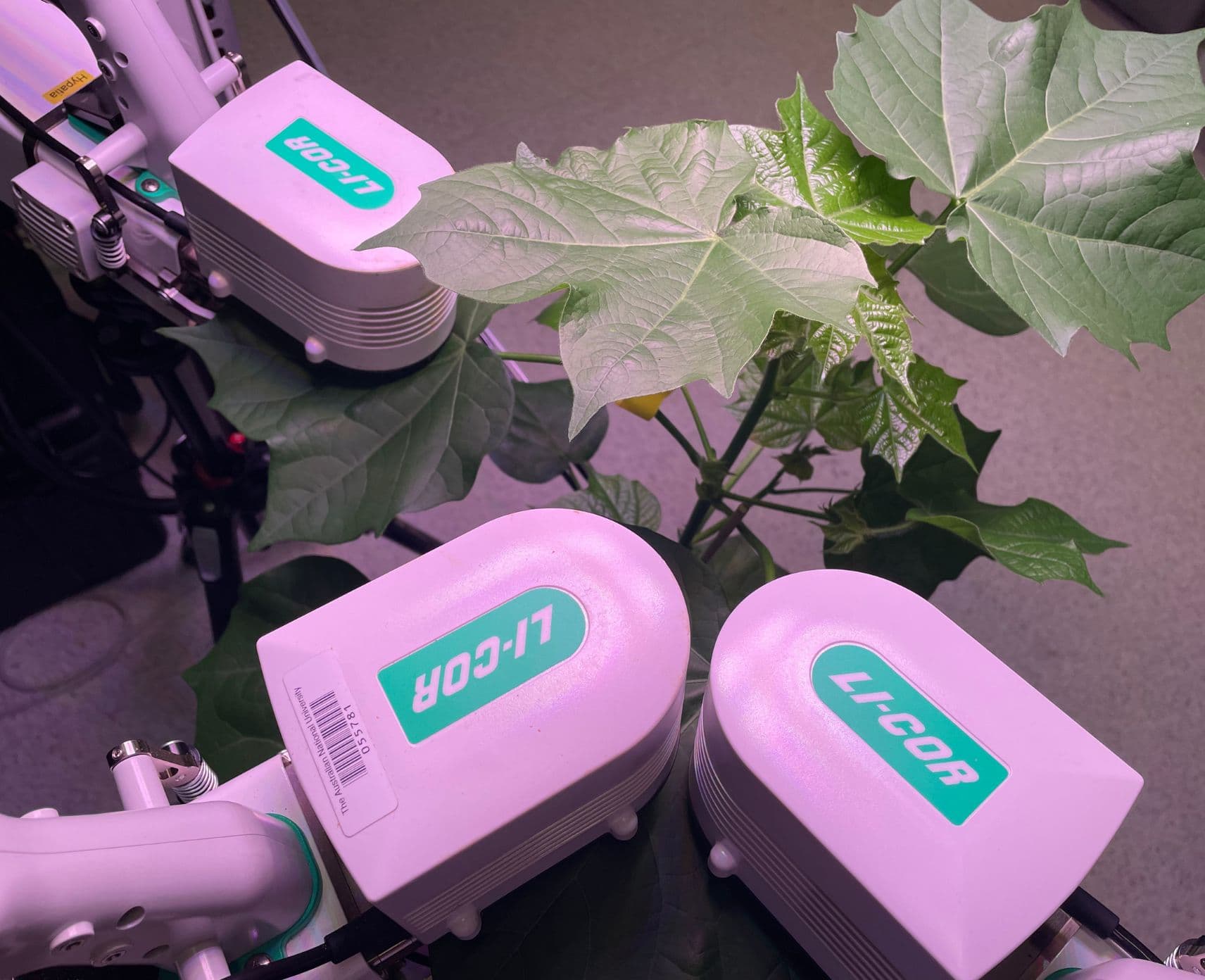
Top image: Simultaneous gas-exchange and chlorophyll fluorescence measurements on cotton leaves using LI-COR portable photosynthesis systems (LI-6800s). Photo: Dr Xingyu Hu.

Contact the media team
You may also like

Aṉangu knowledge and western science unlock desert plants’ survival secrets after record-breaking hot drought
New research combining Aṉangu knowledge and science reveals how some culturally significant desert plants survive extreme drought and heat.

High-tech forest maps predict the ecological traits of Amazon birds
New ANU-led research reveals how forest canopy diversity shapes bird communities in the Peruvian Amazon, offering new insights to guide biodiversity conservation.

Tiny atomic tweak makes plastic-eating enzymes more powerful
A new approach that changes just one atom in plastic-degrading enzymes could help make them more efficient while maintaining their stability, according to new research from The Australian National University (ANU).