

Strategic and defence excellence: A national asset marks 60 years
For 60 years, the Strategic and Defence Studies Centre has been asking the pertinent questions about Australia’s use of military force, security role in the region, and place in the world as a middle power.
Article by:

Cecilia Millar-Rakisits
Contributing writer
From the Cold War era and regional engagement last century to evolving alliances this century, the Strategic and Defence Studies Centre (SDSC) has attracted and shaped generations of security thinkers and influenced world affairs.
Looking back on the impact of the Centre he founded in 1966, Dr TB (Tom) Millar wrote:
“I can only wonder at the size and strength of the oak that has sprung from the acorn we then planted.”
That remark came 25 years after SDSC’s establishment. Now, 60 years after, the Centre remains a leading voice in Australia’s thinking on strategy, defence and international affairs and the nation’s largest body of scholars dedicated to the analysis of the use of armed force.

A mission was born
The year 1966 marked a pivotal moment in Australia’s history. As the Vietnam War escalated and Cold War tensions increased, Australia’s place in the world was being tested.
“SDSC was established in 1966 for a mission very similar to that of The Australian National University in 1946: to help understand Australia’s region and, at a time of conflict, to help government avoid another great surprise and inability to respond,” says Associate Professor Andrew Carr.
From its inception, the Centre’s mission has been to further public and scholarly insight and understanding of Australia’s own capacity and contributions to a changing region.
Today, SDSC sits within the Coral Bell School of Asia Pacific Affairs in the ANU College of Asia and the Pacific.
Asking questions that matter
SDSC was established to bridge the gap between scholarship, policy and public debate.
For Professor Hugh White, former Head of SDSC, the question at the heart of Millar’s vision remains strikingly relevant today.
“Millar understood the profound long-term challenges that Australia faced in 1966 and still faces today in defining a place for itself in a fast-changing region,” White says.
“Thus, for him, the key question then, as it is for us now, is ‘Can Australia defend itself?’”
That concept would become central to SDSC’s work.
Once established, SDSC was eager to engage beyond academia, a characteristic which helped it to stand out from other research centres in Australia at the time.
Throughout the 1970s and 80s, SDSC scholars including Millar, Robert O‘Neill, Desmond Ball, Ross Babbage, Peter Hastings and Jol Langtry were at the forefront of debates reshaping Australian defence policy and influencing government.
Another influential thinker included former SDSC Head Paul Dibb, who was a defence intelligence leader and now emeritus professor with the Centre. Dibb authored a 1986 review of Australia’s defence capabilities that would reshape defence planning.
Publications such as The Defence of Australia: Fundamental New Aspects and Rethinking Australia’s Defence, also made significant contributions to the development of policies that would later end up in the 1987 Defence White Paper, a long term defence strategy by the Australian Government.
The influence of SDSC extended internationally as well. During the Cold War, Ball advised US President Jimmy Carter against nuclear strikes on Soviet targets. Carter later credited Ball’s “cautionary advice and deep research” with having contributed to avoiding nuclear war.

More important than ever
The strategic impact of issues facing Australia today is not dissimilar to those faced in the early decades of the Centre. Current Head of SDSC Associate Professor Amy King says the Centre’s purpose has never been more relevant.
“Today, the foundations of Australia’s strategic environment are being profoundly shaken by a global and regional order transition that requires a major reorientation in Australia’s strategic and defence policy,” says King.
“SDSC’s mission [is] to provide ‘real world’-focused strategic studies that is research-led and world-class, educate the next generation of strategic leaders in Australia, Asia and the Pacific, and to contribute toward a better-informed standard of public debate remains not only vital, but more important than ever.”
The research topics covered by the Centre today span alliance management, deterrence, military history, regional security, economics and security, and emerging technologies – which continues to advise government and influence policy.
Since 2019, SDSC has delivered an executive education program for the Department of Defence on ‘Strategic Policy for the Asia-Pacific in Transition’. The Program has trained more than 300 participants, most of them Australian Defence officials, including PhD candidate Tommy Chai.
Chai says working with mid-to-senior Australian defence officials taught him how to translate complex research for policymakers, experience he later drew on while lecturing to the Singapore Armed Forces.
“If I had to put it simply: SDSC gave me the intellectual orientation, the mentorship, and the policy-facing culture that made my work possible.”
Australian Army officer Thomas McDermott has also applied his PhD research directly to his military service.
“The PhD journey has undoubtedly made me a better military officer, at a time when it couldn’t be more important.”
Looking ahead, King hopes SDSC will continue to harness the collective energy and talents of its people to pioneer new knowledge for Australia and the region, educate and inspire others, and serve as a public commons for imagining alternative futures.
Sixty years after Millar planted that acorn, the Centre continues to grow, asking the difficult questions that shape Australia and its place in the world.
Author’s note: The author’s grandfather, Dr TB (Tom) Millar, founded the Strategic and Defence Studies Centre in 1966.
Top image: Hedley Bull Building. Photo: ANU
Related tags:
You may also like
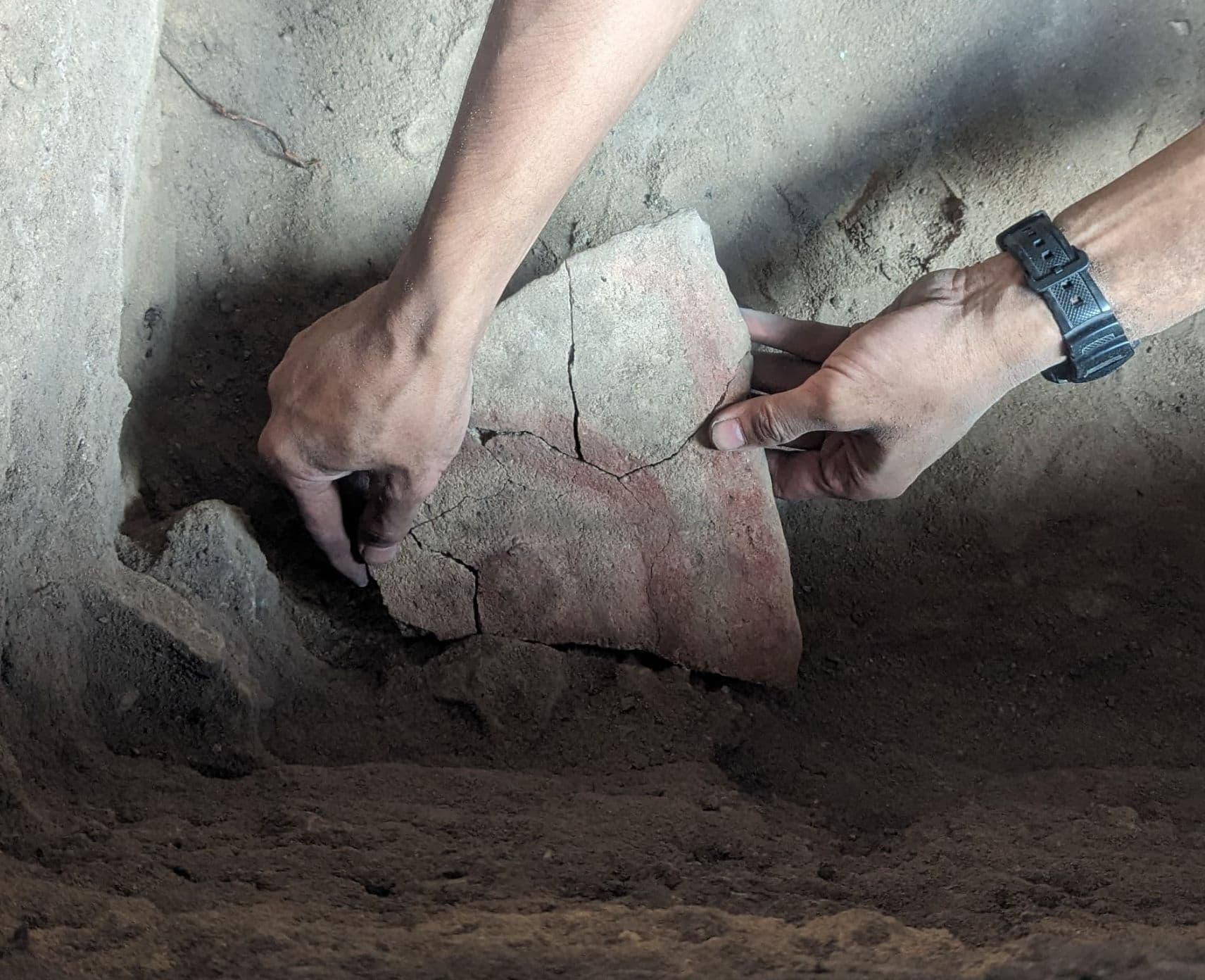
Ancient maritime voyagers carried symbolic art 4,000 years ago
A 4,000-year-old painted stone plaque discovered on a remote Indonesian island is the first known example of portable art belonging to the Austronesian Painting Tradition (APT), providing a rare glimpse into the symbolic world of some of history’s greatest maritime voyagers.

Australian cave discovery shows grass was burned for magic, healing and cursing for 25,000 years
Perfectly preserved ‘phytolith’ plant crystals reveal that Indigenous Australians took grasses into a cave for ritual burning since last Ice Age.

The fuel crisis has hit the Pacific hard. The region is responding – but tough choices lie ahead
The fuel crisis poses a bigger challenge to Pacific Island countries than many other nations.