
A battle on two fronts: Chris Taylor’s fight for climate and life
“I’m a student of life, a student for life.” Time is running out for Chris Taylor, but that is not stopping him from working to leave a better world behind.

Dr Chris Taylor makes time for everyone. Time for friends, time for family, time for work, and seemingly always, time for another degree.
But time is something he knows he may not have much of.
Taylor has stage four bone cancer.
“If you’re not learning, you’re dying.”
Sitting in his chair on his farm in the Northern Rivers, Taylor chats to me about life, study and the legacy he hopes to leave when his time does run out.
He’s had 14 surgeries in the past four years, but that did not stop him from completing another degree at The Australian National University.
Facing death head on, Taylor keeps starting projects that require a future.
This time, it was a Master of Climate Change at the Crawford School of Public Policy, giving him a qualification after two decades in the renewable industry.
“That’s where the degree started, but where it ended is that I look at the world completely differently.”
“I knew if I started it, I would have to finish it, and that would keep me alive for another 18 months,” he told me.
He completed his degree online, mostly from a hospital bed as he endured treatment after treatment in a bid to extend his life. He says he used the quiet of the hospital away from his three young children wisely.
He always tried to complete his work, including his entire thesis, ahead of schedule, in case his health failed him. “I never had an extension through my entire degree,” he told me proudly.

The risks of not listening to the warning signs
Taylor says the Master of Climate Change also showed him the parallels between the challenges of climate change and his own personal life.
He told me the heartbreaking story of his wife’s best friend. He urged her to get screenings after his diagnosis, as his cancer had been picked up by chance.
Taylor paused, taking a deep breath before continuing.
“She didn’t, and ended up with bowel cancer that had metastitised to her liver. She was given a few months to live; in that time she got married and died three days after the wedding.”
He says that this is a great analogy for how we need to approach climate change.
“If you are not going to listen to the signs, take preventative initiatives, then chances are it will be too late to do something,” he explained.
“I am fighting something that is determined to do what it wants, just the same as climate change. We need to be fighting with everything we have got.”
Making the most of every moment
With time ticking, and Taylor now living in three-month blocks between scans and oncology appointments, there is no certainty he’ll be able to walk the stage at graduation next February.
The Crawford School of Public Policy, not wanting him to miss the milestone, organised a dedicated graduation ceremony for him this August.
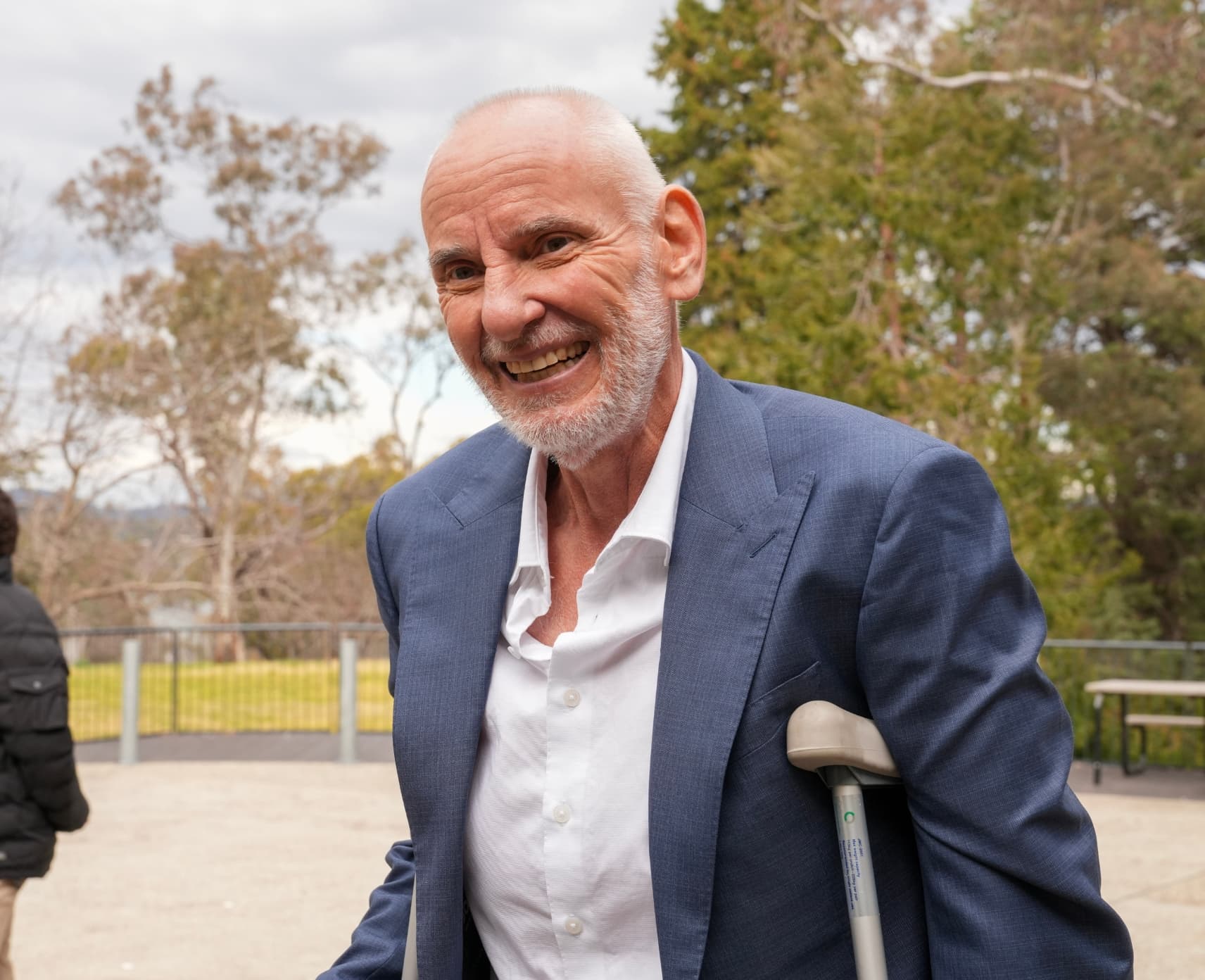
Taylor walked into the room, standing remarkably tall in the face of everything; the crutches – a requirement after his femur was removed – being one of the only outward signs of his illness. He turned up wearing his funeral suit, telling the room he wanted to get some use out of it first. To his credit, it is a nice suit.
Taylor’s lecturers, friends and former students gathered with his testamur officially handed over by the Acting Dean of the College of Law, Governance and Policy and Director of the Crawford School of Public Policy, Professor Janine O’Flynn.

Taylor spoke about his dad, and the legacy he left behind as a ‘good bloke.’ His friends in the room mentioned his father’s kindness and compassion but also talked about how Taylor’s PhD ‘The Good Bloke in Contemporary Australian Workplaces’ or effectively what makes a good bloke a good bloke was in honour of his father.
“There’s not a day that goes by that I don’t think of him, that I don’t thank him,” he says.
His father died before Taylor had children, so he explained that he used his PhD to bridge a gap between his dad and his kids.
What is clear to everyone who knows Taylor is that he too is a good bloke.
“I am uncomfortable with all the fuss,” he told me that afternoon.
Living for a legacy
Bone cancer is slowing his walk, but not his mind. Unsurprisingly, Taylor is now plotting another PhD, this time on resilience and cancer. He thinks he’ll complete it in two years.
“That’s all the time I’d need. I’m a student of life, a student for life,” he quips.

A second PhD would also make an even 10 qualifications; adding to his one undergraduate, seven Masters degrees and a PhD. Three of these were completed after he was diagnosed with cancer.
His dedication to learning is showing his children that they can always have a love for knowledge.
Like every parent with young children, he wishes for more time with his family to share his stories and resilience, and for some extra to implement what he was taught.
“It would be a tragedy if I dropped off the perch tomorrow,” he says. But when that time does run out, he hopes that he leaves a legacy for his three boys, much like his father did for him.
“I hope they see regardless of when I pass on that I tried, and I didn’t give up, I was tenacious.”
Top image: Dr Chris Taylor. Photo: Hannah Scott/ANU
You may also like
Help where you can: Professor Kamalini Lokuge on why research must serve humanity
From the Ebola outbreak to the COVID-19 pandemic, Professor Kamalini Lokuge has been driven to provide humanitarian health care wherever in the world it may be needed.

Talking from the heart: how a former pilot is advocating for Fiji on the global stage
After seeing the devastating impacts of cyclones that hit his community in Fiji, Laurie Singh took his lived experience of the climate crisis to COP30 in Brazil.
“Universities must not walk away from discomfort”: Gordon de Brouwer on trust, leadership and the power of knowledge institutions
As Dr Gordon de Brouwer steps into the role of Chancellor at his alma mater, he reflects on what it means to be a national institution at this time in history: “truth and knowledge still matter.”