
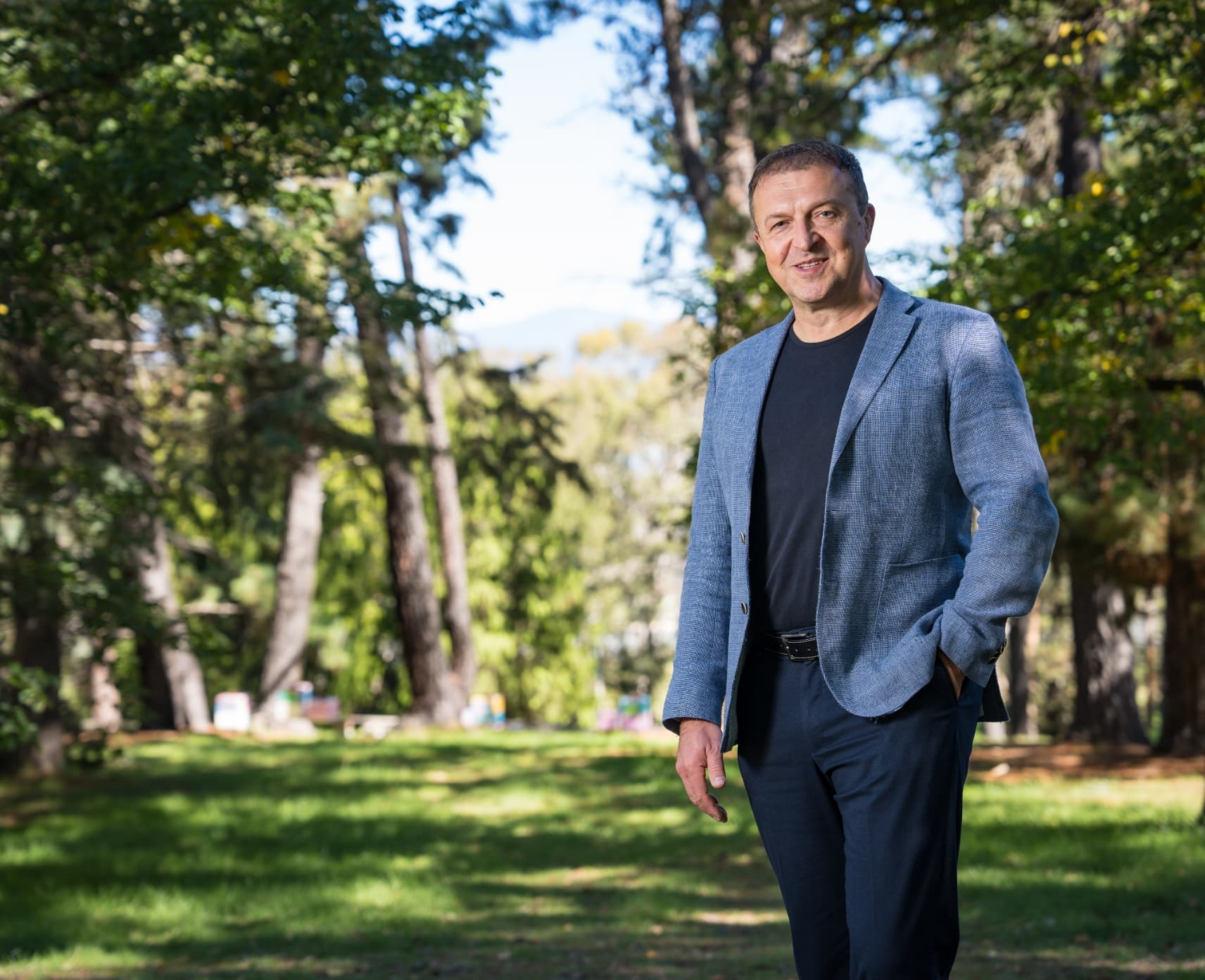
An ANU researcher’s journey from the centre of Earth to Mars and beyond
Professor Hrvoje Tkalčić is helping unlock clues about Earth's deep interior and other planets such as Mars and the Moon.
Article by:

Amanda Cox
Contributing writer
Professor Hrvoje Tkalčić FAA is on a mission to inspire the next generation of scientists.
The Australian National University (ANU) researcher has just begun his Australian Laureate Fellowship to lead a research group on deep Earth and planetary seismology.
With over $3.8 million in funding from the Australian Research Council and significant support from ANU, this is important recognition of the value of curiosity-driven research.
“It’s exciting because of the trust placed on the research directions that I want to pursue,” says Professor Tkalčić from the ANU Research School of Earth Sciences.
“The fact that curiosity-driven research is valued at the national level, with significant investment, means that I will be able to pursue fundamental questions without the usual constraints of incremental funding.”
The project aims to uncover more about the elusive properties of the Earth’s deep interior.
“In a way, the Earth is like a big lab that we can use for investigation,” he explains. “We can then use the results to learn about other worlds.”
The other worlds ready for investigation using geophysical methods include Mars and our Moon. Giving us a greater understanding of the secret life of Earth in the early stages of our solar system.
“Mars is a much smaller and simpler planet because it cooled down so quickly. It didn’t have plate tectonics like Earth does, so those traces of the early phase of the planetary system haven’t been erased,” says Professor Tkalčić.
Understanding the Martian interior, its rocks, its layers, and its general structure helps us understand the Earth’s geological history as well.
“This is because compared to Earth, Mars is like an object frozen in time, helping us understand Earth at an early stage of its evolution.”
As an accomplished geophysicist, Professor Tkalčić’s project will use seismology to understand how seismic waves move through the Earth’s interior.
“I study large globally distributed earthquakes as a source of seismic waves.”
Using a medical analogy, it’s like the Earth is undergoing a gigantic CAT scan, with signals from the seismic waves providing a glimpse of what is happening inside.
“It’s paradoxical because earthquakes are so destructive, but studying their seismic waves helps us understand the composition of the Earth’s interior.”
The plate tectonics that drive earthquakes and volcanic activity are also thought to be necessary for the development of complex life on Earth, due to their roles in nutrient cycling and climate stabilisation.
But hidden within the Earth’s interior is the source of another geophysical process critical to our survival: the Earth’s magnetic field.
This invisible shield is generated by molten elements within the Earth’s outer core and extends into space, where it deflects harmful solar radiation. When the solar wind hits this magnetic field, it triggers spectacular auroras, as charged particles interact with atmospheric gases near Earth’s poles, producing colourful glowing light.
Without a magnetic field, Earth’s atmosphere could erode away, and living organisms would be exposed to significant levels of harmful radiation.
“One of the aims of my research is to understand the role of planetary cores in the generation and maintenance of the magnetic field,” says Professor Tkalčić.
“Which is part of a bigger philosophical question about the planetary conditions that are needed to sustain life, and whether life could develop on other planets without a magnetic field operating.”

Professor Tkalčić says that it’s a great time to showcase the importance of STEM education and outreach, as Earth scientists are now well primed to become planetary scientists.
“When I was a kid, planetary seismology meant studying the Apollo mission data,” he says. “Four of the seismometers installed by Apollo missions between 1969 and 1972 were operating and sending data until 1977.
“The Moon is a very small planetary body, but it’s surprisingly active. These instruments recorded more than 12,000 moonquakes.”
Despite the recordings, Professor Tkalčić says that we don’t understand the nature of moonquakes very well. That is set to change.
NASA and international partners are planning to deploy new, advanced seismometers to the Moon to map its interior and detect moonquakes, via a new Lunar Environment Monitoring Station.
“Australia is actually sending a seismometer to the far side of the Moon,” he says.
Professor Tkalčić is one of the researchers collaborating on the Fleet Space Technologies project which will deploy a small seismic station, affectionately named SPIDER, on the Moon. With support from the Australian Space Agency, the project highlights Australia’s growing capability in space technology.
“It’s exciting because we can get modern data that will enhance our understanding of the lunar interior.”
Importantly, an Australian Laureate Fellowship isn’t only about research.
“It’s an opportunity to give back to Australian society and help raise the next generation of STEM professionals,” he says.
“Mentorship is also a big component of this program, and I want to enhance the experience of postdocs and PhD students who will be part of this research.
“We are planning outreach activities and collaborations with the ANU Tjabal Indigenous Higher Education Centre and the ANU Gender Institute.”
Professor Tkalčić’s fellowship will not only uncover planetary secrets. It will also help shape Australia’s future in science.
“It’s a signal to early career researchers that ANU is a place where curiosity-driven research is not only welcome, but it’s actually supported at the highest national level.”
Still curious about the inner dynamics of our planet? Professor Tkalčić’s latest book When Worlds Quake reveals how quakes can help scientists to understand the mysterious inner architecture and ongoing evolution of our planet, as well as worlds beyond our own.
This article first appeared at the ANU College of Science and Medicine. Read the original article.
Top image: Professor Hrvoje Tkalčić FAA. Photo: Nic Vevers/ANU
Featured experts
You may also like

Scientists react to 80 years of history at ANU
We look back on our 80-year history of STEM research at ANU as scientists react to archival footage.
All fired up: how the original shock tunnel came back to ANU
When Professor Sean O’Byrne was asked to dismantle the machine he’d built his career on, he had other ideas. Twenty years later, the T2 free piston shock tunnel is back at ANU and back in business.

Almost half of Australian adults have used Generative AI
Concerns about personal data and a lack of training and skills are barriers to some Australians using GAI systems.