
Caitlin Figueiredo on growing into questions and building a legacy of change
ANU alumna and social justice advocate Caitlin Figueiredo is focused on using her voice to power for good.
Article by:

Olivia Congdon
Interim Editor
Caitlin Figueiredo wants people to know that life doesn’t just begin after you graduate.
“There is magic and beauty to starting before you feel ready,” she says.
Take it from her, because Figueiredo started making a difference in the world of politics early: while she was a student at The Australian National University (ANU).
Figueiredo was the 2024 ACT Young Australian of the Year, and is recognised for her leadership in gender equality, youth empowerment, and inclusive policy reform.
Her perseverance and passion saw her elected as Co-Chair of the Australian Youth Affairs Coalition (AYAC) in 2015, where she revitalised and transformed AYAC and successfully campaigned for better representation for youth in Australian parliament.
She also co-founded a political movement, served on three United Nations (UN) Task Forces and continues to fiercely advocate for social justice issues.
This work led to her name being listed on the ‘Forbes 30 Under 30’, ‘AFR Australia’s 100 Women of Influence’, Michelle Obama’s ‘Global Changemaker for Global Equity’, and the Museum of Australian Democracy’s ‘50 most important changemakers to change the face of Australia’ lists.

Looking back as she delivers the ANU Commencement Address for 2026, Figueiredo recalls one of her life’s most surreal moments: advising the then United States President Barrack Obama over the phone on global health equality issues in 2016.
At the time, Figueiredo was a 21-year-old law and development studies student at ANU and was also working for the UN on gender equality issues. She had been invited to join a White House program in Washington DC as a Changemaker for Global Equity.
It was, Figueiredo explains, an extraordinary time in her life.
She was back in Australia phoning Obama in the wee hours of the morning from “a really crappy hotel room in Sydney”, after winning the Young Leader category of ‘Australia’s 100 Most Influential Women’ at the Sydney Town Hall at a glamourous ceremony the night before.
“I had this juxtaposition of all this power, glitz, glamour, red carpet, and then the next morning, I was back to being a broke university student,” Figueiredo remembers. It was a strange whiplash between worlds.
Suddenly, she was hyper aware of her new voice to power.
But the gift of a seat at the table provided Figueiredo with a unique perspective. Why don’t more people – across all intersections of life – get to share their voice, like me?
That’s why she co-founded the movement known as Girls Take Over Parliament.
“If the doors are kind of shut, then how do we find different ways to bring them open?” Figueiredo asked.
“I wanted to be able to create a platform with other young people, where other leaders can step in, where they can shine, where they can bring their whole authentic selves and they are accepted in the places where I was once accepted.”
“If the doors are kind of shut, then how do we find different ways to bring them open?”
Girls Take Over Parliament is a program designed to increase female representation in politics by setting up young women and girls to shadow politicians from various political parties.
The aim is to show girls that they belong in these spaces.
“If they go into politics – awesome – but they don’t have to because there’s so many different ways to contribute,” says Figueiredo.
Since creating Girls Take Over Parliament, Figueiredo’s had a varied career dismantling and building systems in government, NGOs and the private sector.
But a common thread runs through everything she does: “It’s all about community,” she says.
“It’s all about bringing together, not just young people, but elders too.”
These ideas derive from her upbringing as a Goan-Australian woman growing up in a multicultural household, she says.
For Figueiredo, the deep sense of pride doesn’t come so much from how many important lists she finds herself on – it’s about having built policies or programs that will outlive her for generations to come and make tangible differences to people’s lives.


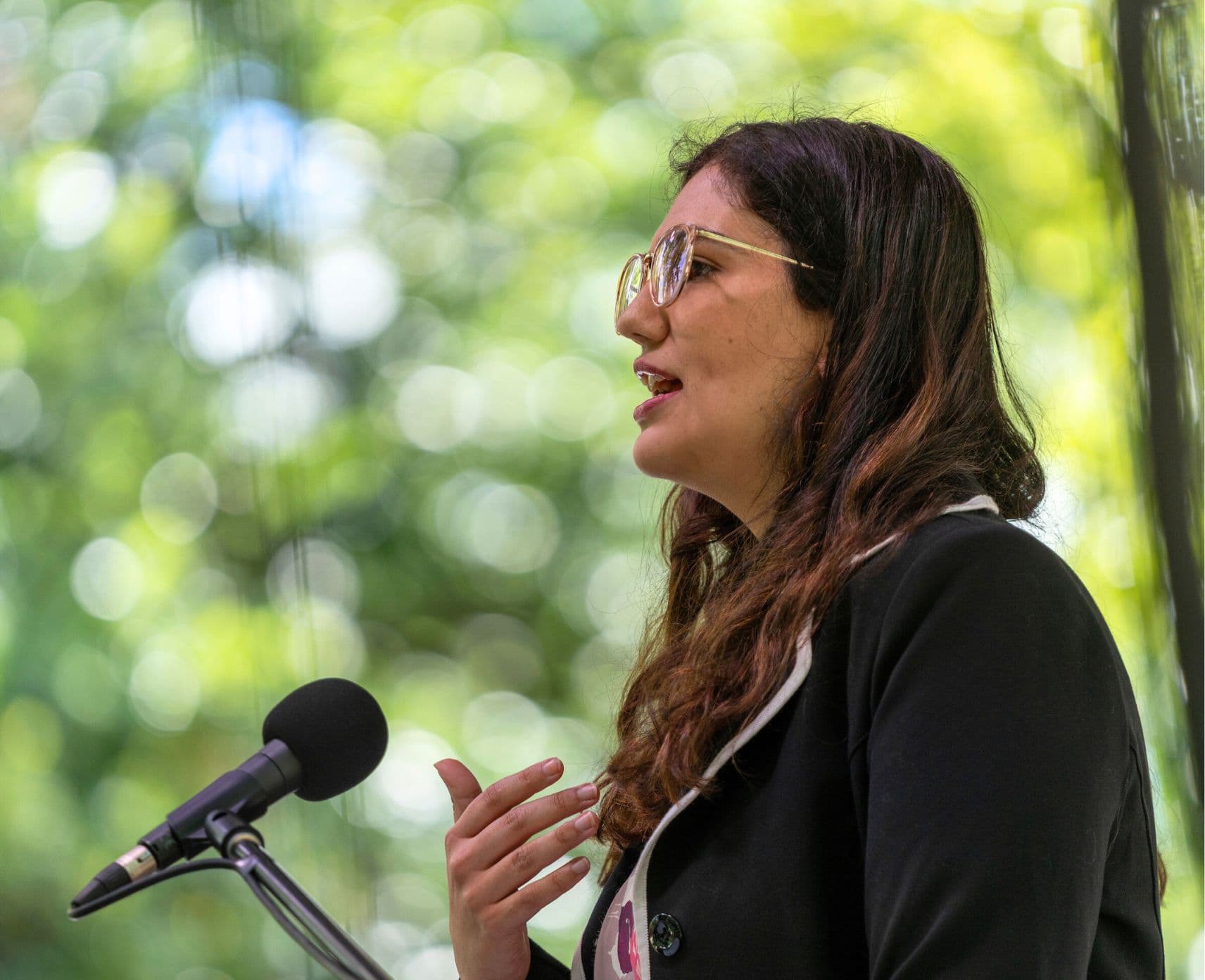
Image: Jamie Kidston/ANU.
Speaking about her Commencement Address to ANU students beginning their 2026 university year, Figueiredo has an admission: “That speech was probably the hardest speech I’ve ever had to write in my life.”
This is coming from a leader whose advocacy and policy work has involved a lot of public speaking over the past decade.
The speech was hard, she explains, because there was just so much she wanted to pack in. She wanted to tell her story, acknowledge the reality of the rising global challenges, and her own personal challenges including burnout and grief. But she also wanted to remind students of the power they each hold to bring about change.
Above all, Figueiredo also wanted students to know how many opportunities, resources and community supports there are to enable you to thrive while you are at ANU.
“ANU gave me something rare: permission to explore, to change direction, to be challenged, and to grow into questions I didn’t yet have the language to ask,” she says.
“And that freedom – more than any title or credential – is what shaped the life I went on to build.”
Image: Caitlin Figueiredo presented the ANU Commencement Address for 2026. Image: Jamie Kidston/ANU
You may also like
Sharing the joy of science: how Lee Constable helps kids become superheroes
Author, TV presenter and ANU graduate Lee Constable is sharing her passion for science with the next generation.
Distinguished alumna Kim Jackson receives honorary doctorate from ANU
Kim Jackson has been awarded an honorary doctorate in a ceremony at The Australian National University (ANU).

Young people passionate about political action, but forging new pathways to change
Young politically engaged Australians care passionately about key issues, but don’t feel represented or listened to by our political leaders, according to a new ANU report.