

Growing up as a neuroqueer kid in regional Victoria was not always easy for Associate Professor Katie Sutton (she/they).
The 1990s, even with their pockets of progress, were still difficult times to live and love freely in Australia.
Sutton remembers attending a small school in the bush, where they never quite felt at ease.
“Some days I would escape to play piano during the lunch hour. It was a way to disconnect from having to deal with the trickiness of social relations,” they say.
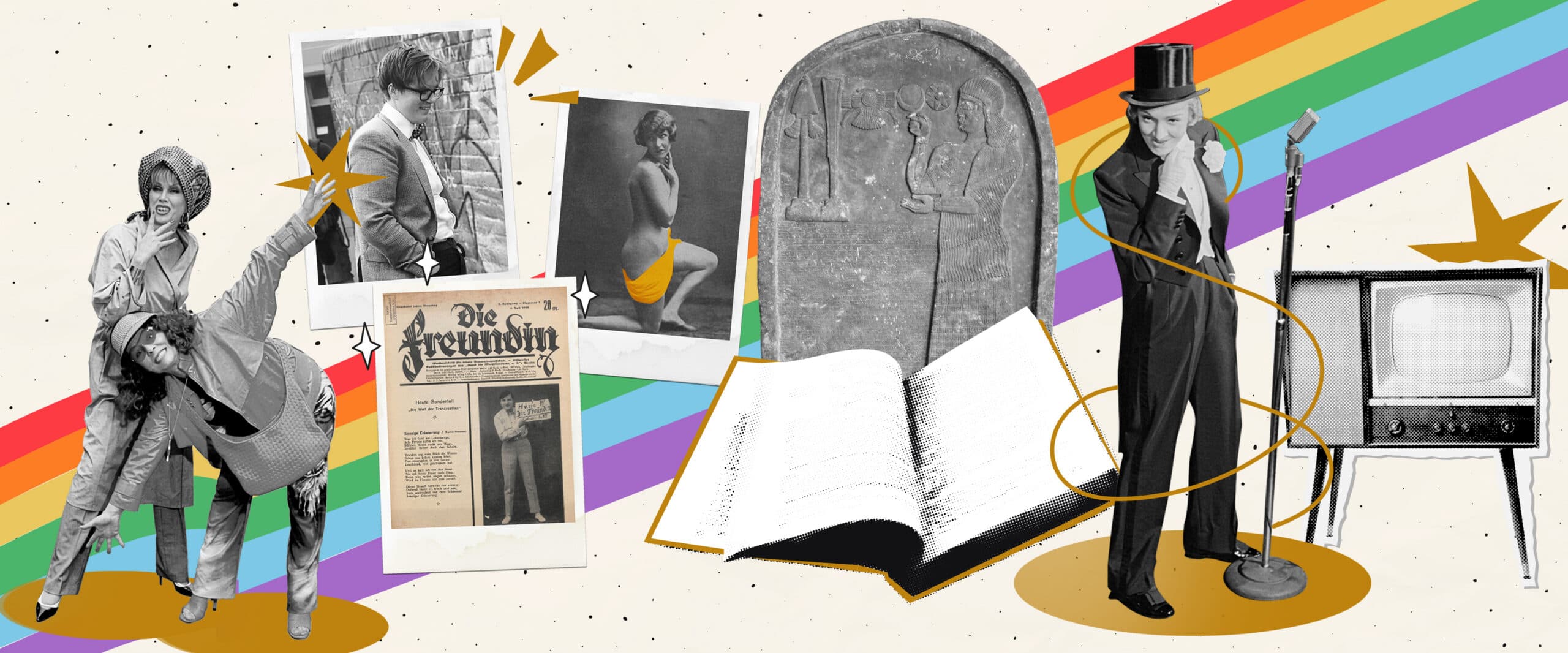
At a time when LGBTIQ+ representation was conspicuous by its absence, Sutton would often find joy watching TV sitcom Absolutely Fabulous.
“Eddie and Patsy were like unconventional role models to me. As a teenager, I was inspired by their strong female friendship, queerness and camp,” she says.
It wasn’t until moving to Berlin, just before commencing their honours year at university, that the shadows of earlier life softened and colour began to fill their world.
“I absolutely relished being in Berlin in the early 2000s, riding my bike around the city and throwing myself into the queer and drag king scene,” they say.
“It was such an important time in my life.”
Between nights of fun, Sutton also found a quieter, intellectual refuge nerding out in the city’s libraries.
It was there they came across queer magazines from the 1920s – remnants of Weimar-era Berlin, when women and trans people were flourishing in sexual and gender freedoms.
“It was a bit of a surprise to see how boldly people were self-identifying as gender-diverse and writing really heartfelt declarations of queer love,” they say.
Leafing through those pages was a career-defining moment.
Today, Sutton is a German and Gender Studies expert at The Australian National University (ANU).
As a leading Australian voice in global discussions on gender, neurodiversity and health humanities, their research is a beacon of hope for the LGBTIQ+ community.

Their place in history
Trans people have and will always exist.
In ancient Mesopotamia, they held positions of power. In medieval Europe, they affirmed their gender without medical help.
Sutton draws our attention to “Maiden Heinrich” – a 17th‑century figure assigned female at birth who lived as a man and was ultimately executed for it.
“This is someone who today would have very likely claimed a trans identity. As historians we need to be careful in how we apply today’s labels to the sources. But that’s no reason to say trans and gender-diverse people didn’t exist,” they say.
With their research, the ANU historian has shifted dominant narratives in the history of gender and sexuality, contesting transphobic beliefs that argue trans identities are a contemporary social trend.
Much of this work centres on interwar Germany: the same short‑lived era of tolerance in which the queer magazines were published.
At the time, doctors and scientists were beginning to understand homosexuality and transgender identity as natural human characteristics, years before fascism violently reversed that progress.
Gender expression was also evolving in public life. In one of their books, Sutton examines the prominence of masculine women in Weimar-era print media.
Think of Marlene Dietrich in a tuxedo and top hat, an instantly recognisable symbol of the time’s subversive glamour.
The resilience and bravery of the Weimar queer community, as evidenced by Sutton’s studies, have long been a catalyst for social change.
“Doctors and scientists in the late 19th and early 20th century didn’t just start exploring queer and trans identities out of the blue, they did so because people in the community were speaking back to the authorities,” she says.
“We owe them a real debt.”
A neuroqueer lens
Each person experiences being LGBTIQ+ differently.
Intersectionality theory helps us understand how race, class, gender and other demographic features combine to shape a person’s journey through privilege and marginalisation.
For many gender-diverse people, that journey also intersects with neurodivergence.
“This is not a quirky coincidence. Many people understand their neurodivergence as informed by their gender and sexual identity and vice versa,” Sutton says.
Only recently has research begun to acknowledge how common this overlap is, after decades of bias in ADHD and autism diagnoses towards middle-class, white boys.
Celebrities like ANU alumna Hannah Gadsby – an Autistic, gender‑queer comedian – are playing a key role in increasing visibility and public understanding.
But, historically, that representation is still missing. Without a past to look at, communities are left without an anchor.
Sutton wants to change this, offering new generations access to a history that fosters identity in rich, complex ways.
“I’m not researching the past to diagnose people with autism or ADHD. Rather, I want to use contemporary understandings with curiosity and openness to create awareness that the past wasn’t as neurotypical as we’ve thought,” they say.
“Many people understand their neurodivergence as informed by their gender and sexual identity and vice versa.”
Sutton is reinterpreting historical sources – from autobiographies and psychiatric case studies to less conventional materials such as film and photography.
“I’ve looked at examples of queer cinema in the 1920s. A character’s lack of obvious emotion or exaggerated expressiveness can hint at certain types of neurodivergence,” she says.
“I’d like to reread familiar films such as Nosferatu or Pandora’s Box through a neuroqueer lens.”

Humanities to the rescue
Recently, the Australian Government announced changes to the country’s National Disability Insurance Scheme (NDIS).
Sutton is worried about how the proposed cuts will impact neurodivergent and disabled people.
“It’s so crucial that any changes are codesigned with the communities whose lives will be immediately impacted,” they say.
Today, as multiple communities are suffering attacks by Trumpism, Sutton’s historical insight is crucial.
Last year, US Secretary of Health Robert F. Kennedy Jr. linked the use of paracetamol to autism.
This is not only disinformation but, according to the ANU researcher, rooted in a darker history of eugenic violence.
“We can trace this across the 20th century, including attempts by earlier fascist regimes such as Nazi Germany to eradicate people who didn’t conform to narrow norms of physical and mental ablebodiedness, of race, gender and sexuality,” they say.
“As humanities scholars, people who see the bigger connections, we need to call out such politicised pseudoscience for what it is: a classic hallmark of fascism grounded in logics of eliminating disability and difference.”
“The health and medical humanities can help us connect these current debates to much longer histories and allow us to see more clearly what is going on.”
As we celebrate Pride Month, Sutton shares a message they wish their younger self had heard.
“Know that your people are out there, even if you haven’t found them yet, and you’ll find strength, inspiration and amazing friends in that politically fierce, caring and quirky community of queer, trans, and neurodivergent folk,” they say.
Top banner design: Crystal Li/ANU
You may also like
One historian, centuries of gossip and a fresh look at Ancient Rome
What did ordinary Romans really think of their rulers? Professor Caillan Davenport’s new book draws on juicy rumours and gossip to reveal the answer.
Forget potato scallops and potato cakes – the Australian National Dictionary is on the hunt for Australia’s hidden regional words
From dardy to turbo chook, ANU is calling on Australians to uncover the colourful local words and phrases that make our regional vocabulary unique.
New national survey asks Australians to help map the nation’s languages
A new national survey is inviting multilingual Australians to help researchers build a clearer picture of the languages spoken and signed across the country.