
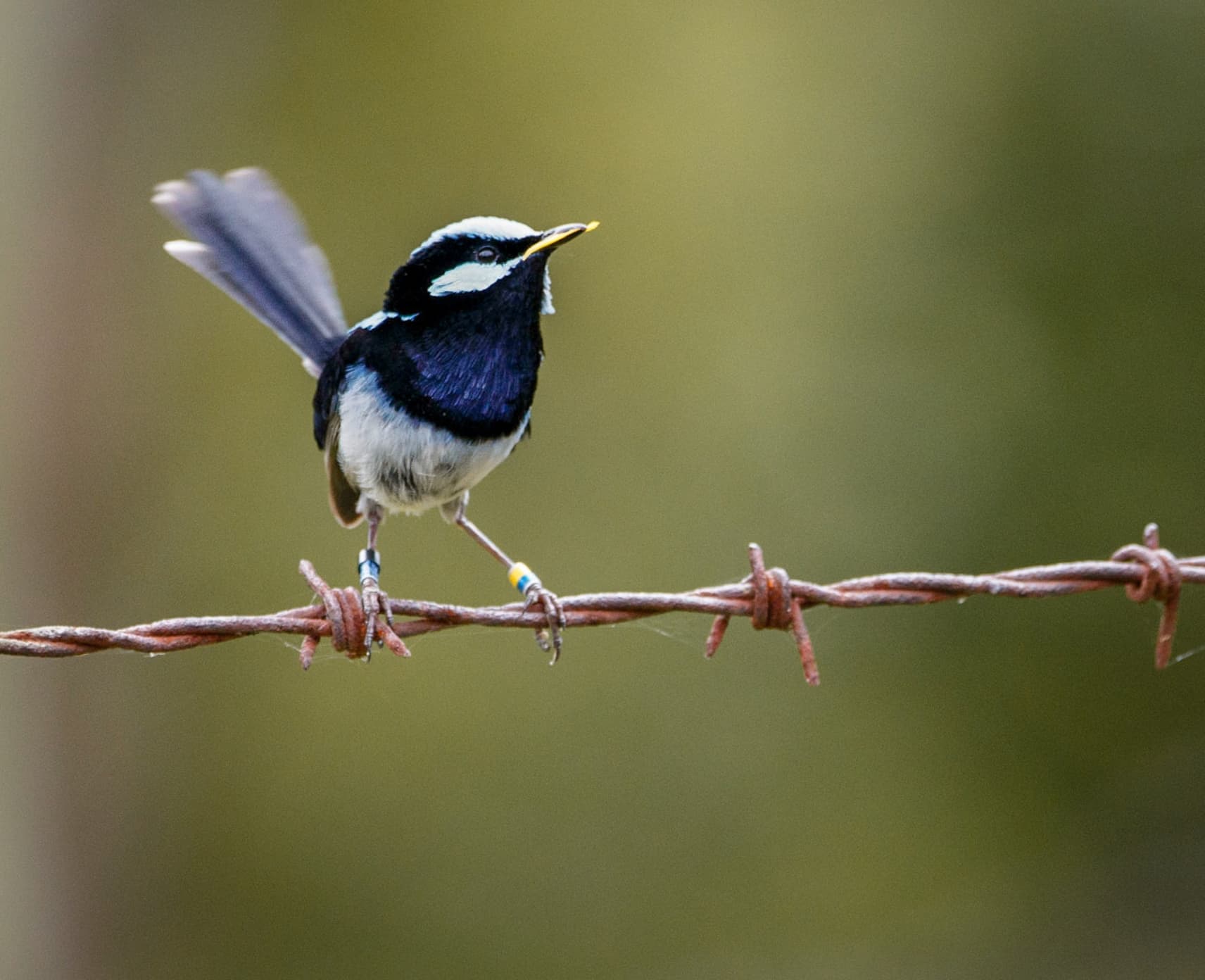
‘Canary in the coal mine’: Superb fairy-wrens in Canberra could go extinct within 30 years
Superb fairy-wrens in Canberra are facing “imminent danger” if we don’t urgently curb greenhouse gas emissions, according to new research involving ANU.
Article by:

George Booth
Contributing writer
Superb fairy-wrens are facing “imminent danger” and a well-studied population in Canberra could go extinct in the next 30 years if we don’t urgently curb greenhouse gas emissions, warn an international team of scientists including researchers from The Australian National University (ANU), James Cook University (JCU) and Hainan University.
That’s according to a comprehensive, decades-long study published in Nature Communications that has tracked a population of fairy-wrens at the Australian National Botanic Gardens in Canberra since 1988.
Led by the ANU Cockburn Group, researchers analysed fairy-wren reproduction, survival and population change data for 12 months of the year, for 30 years; the result is one of the most comprehensive data sets of any bird species collected to date.
“When we started this study in 1988, the fairy-wrens in the Australian National Botanic Gardens were the densest population of the species out of anywhere in Australia,” study co-author and ANU Emeritus Professor Andrew Cockburn said.
According to ANU researchers, fairy-wrens have one of the most “complex social systems” of any bird species.
Using various climate models, the research team modelled the birds’ extinction risk under ‘no further climate change’, ‘low’, ‘intermediate’ and ‘very high’ greenhouse gas emissions scenarios.
Under the low emissions scenario, researchers estimate fairy-wrens in the Australian National Botanic Gardens will disappear by 2080, while under the intermediate and very high emission scenarios, this population of fairy-wrens is predicted to go extinct about 2060.
Only under the scenario that the world has already passed of no further climate change is the population of fairy-wrens expected to survive the century.
“Population extinction is likely to happen within the next 30 to 40 years under the intermediate and very high emission scenarios, except in the unlikely scenario that we can confine greenhouse gas emissions to levels that have already been exceeded,” Emeritus Professor Cockburn said.
“This is a striking realisation given that superb fairy-wrens are very common in a range of habitats and have always had a conservation status as a species of Least Concern (LC), meaning it sits at the safest end of the International Union for Conservation of Nature Red List categories.
“We found that although many individual impacts of climate change on the birds are small or moderate, together they are expected to have a catastrophic cumulative effect, even in the low-emission scenario.”
The researchers found fairy-wren populations suffered low breeding success during dry springs and reduced adult survival following unusually warm winters and hot summers in recent years. These pressures, though individually small, compound over time because of global warming.
The study’s findings echo widespread declines in insect-eating birds across Europe and North America, where species reliant on insects have suffered the steepest losses.
“While some of those declines stem from agricultural intensification and modern insecticides, the superb fairy-wren population we studied lives outside farmland. However, its habitat is warming rapidly and temperature-driven reductions in insect availability may be a key factor,” study co-author, Associate Professor Martijn van de Pol from JCU, said.
Unlike the fairy-wren, most wildlife species have not been comprehensively studied year-round for several decades, meaning these subtle but compounding impacts of climate change on other species over many years may go undetected.
Although this study focuses on a well-studied population of fairy-wrens in Canberra, the findings have implications for fairy-wren populations across Australia.
This has led the researchers to brand the fairy-wren as a “canary in the coal mine” for many lesser-known species facing similar climate change threats.
“The wrens’ decline suggests climate change is reshaping ecosystems in ways that are both pervasive and difficult to reverse. Only long-term, fine-scale monitoring will reveal the true extent of these changes and the risks facing other species,” Associate Professor van de Pol said.
Although ANU researchers have been monitoring fairy-wrens at the Australian National Botanic Gardens since 1988, the data used to inform the results of this study was taken between 1993 and 2022.
Top image: Superb fairy-wrens in Canberra are facing “imminent danger”. Photo: Olivia Congdon/ANU
Contact the media team
You may also like

Tiny atomic tweak makes plastic-eating enzymes more powerful
A new approach that changes just one atom in plastic-degrading enzymes could help make them more efficient while maintaining their stability, according to new research from The Australian National University (ANU).

Australia doesn’t need more gas to meet energy needs, research finds
Pumped hydro and battery storage can enable Australia to meet its energy needs without increasing the use of gas to fuel electricity plants, according to a new paper by researchers at The Australian National University (ANU).
Mapping the shadows: scientists predict the ‘hidden highways’ of Mexico’s illegal wildlife trade
Researchers have mapped the hidden routes of Mexico's illegal parrot trade, using almost 30 years of data to predict trafficking hotspots.