
Codebreakers tackle cancer drug resistance with machine learning
Dr Eli Niktab is building a genome atlas to tackle chemotherapy resistance – and is attracting significant global funding.
Article by:

Marion Rae
Using the latest machine learning, genome researchers aim to tackle chemotherapy resistance and reduce excruciating treatment time for cancer patients worldwide.
That’s the mission of an international research collaboration led by The Australian National University’s Dr Eli Niktab, who is Principal AI Engineer at the National Centre for Indigenous Genomics (NCIG).
“The real biological data to teach AI what causes chemotherapy resistance does not exist, and that is what we are generating,” he says.
“Instead of trying to develop yet another drug, we are using AI to crack the code of the complex biology that underpins drug resistance, ensuring the best possible outcome for each patient and minimising the unnecessary treatment toxicity and suffering inherent in current trial-and-error practice.”
Importantly, there are guardrails.
“If a patient’s tumour biology falls outside what our model was trained on, the AI doesn’t guess,” he says.
“It flags it as ambiguous and explicitly abstains, deferring entirely to clinician judgment. This is not an oracle tool; it is just helping the oncologist have the evidence they need to make the best decision.”
The models will be trained onshore on Gadi, Australia’s national supercomputer at the National Computational Infrastructure (NCI) in Canberra.
The project brings together NCIG and the The John Curtin School of Medical Research (JCSMR) node of the Joint Mass Spectrometry Facility at ANU; the Resistant Cancer Cell Line collection at the University of Kent; Canberra Hospital; PacBio; the Victorian Cancer Biobank; and NCI.
From the lab to the clinic
The models will be developed to run on hospital computers, rather than a supercomputer.
“A tool that is scientifically correct but hard to run, and stays unused by clinics, has changed nothing,” he says.
The team is creating a Cytotoxic Resistance Atlas, an open molecular map of cancer cell lines that have been shown to survive chemotherapy. Using a two-tiered AI engine they can pinpoint the genomic mechanism underpinning cancer resistance in tumour samples for hospitals and pathology labs during routine care.
And that requires a big scale-up from yeast, where the concept began.
Niktab and colleagues used Saccharomyces cerevisiae (baker’s/brewer’s yeast) in a 2019 study in the Munkacsi/Atkinson lab at New Zealand’s Victoria University of Wellington to study genetic interaction networks and drug responses.
“When we first proved this concept in baker’s yeast, it took us around six years of physically removing genes one at a time, even with the use of robots and automated labs,” he says.
“We simply cannot scale to humans without AI.”
A human cell has about 20,000 protein-coding genes, which is roughly four times more than yeast, and testing every comparable interaction in a single human cancer model would take hundreds of years.
And it is much harder to work with human cells in the lab than with yeast.
The alternative is to teach an AI system the underlying rules from carefully chosen experiments, Niktab says.
Combined with recent technical advances that bring far greater accuracy and precision, the models can crunch the numbers across every gene combination.
The Google.org Impact Challenge: AI for Science initiative [link to media release] is backing the project, which was selected from more than 3,000 applicants across 30 countries.
Blueprint for all
Genomics has transformed some areas of cancer medicine, yet it still rarely tells an oncologist which conventional chemotherapy will work for an individual patient.
Resistance differs markedly between individuals and tumours as cells that come under attack from a chemo drug rapidly invent new ways to thwart the treatment.
Research has identified how genetic backgrounds can change the outcome of a drug treatment for individuals.
However, current tests look at a relatively small number of genes, often return no clear answer, and are not developed or tested in people with diverse genetic backgrounds.
“Existing tests have been developed almost entirely using genomic and clinical data from patients of European ancestry,” Niktab explains.
This means the people least represented in genomic datasets, including Aboriginal and Torres Strait Islander Australians, are the least served.
It’s a gap in the data they were built on, not in the underlying biology of resistance.
“Because our model was designed to learn from the full diversity of human genomes, rather than a single European reference genome, it can be applied across diverse ancestral populations and continuously improve as new genomic data becomes available,” he says.
“This makes it readily deployable worldwide, including in historically underserved communities, helping bring precision oncology to every patient, regardless of their ancestry or where they live.”
More than a map
The methods developed by the NCIG and others mean researchers can build pangenomes that capture the diversity of human DNA instead of relying on a single, largely European reference.
“The architecture is population-agnostic: the same engine, pointed at different data, serves a different population,” he says.
“That is the part that makes this a blueprint rather than a one-country tool.”
The mapping, though, is only half the task. Interpreting what it means at the cellular level is key.
“Newly released genomic foundation models now allow us to look at the 98 per cent of the genome that we had to ignore for technical reasons before and interpret it.”
These models, such as AlphaGenome from Google DeepMind and Evo 2, do for DNA what AI models have done for text, images and video: compress them and understand their hidden meanings.
Niktab says they are the translational bridge between a DNA sequence and what it does in the cell.
But these models still need to see the data they must learn from.
The recipients of the Google.org Impact Challenge were revealed at the Google.org EMEA Impact Summit in Dublin, Ireland.
AI for science
“We’re at an extraordinary moment for science, as advances in AI open up new possibilities for discovery that were difficult to imagine just a few years ago,” says Leslie Yeh, Director of Scientific Progress, Google.org.
“ANU is bringing together AI and deep scientific expertise in ambitious, creative ways to address some of humanity’s most important questions,” Yeh says.
“We’re honoured to support their work as they apply AI to solve the challenge of chemotherapy resistance, push the boundaries of scientific discovery and turn breakthrough ideas into real-world impact.”
To share the molecular understanding of how a patient’s cancer is likely to resist chemo, and before more treatment time is lost, the Atlas data, AI models and software will be free to use.
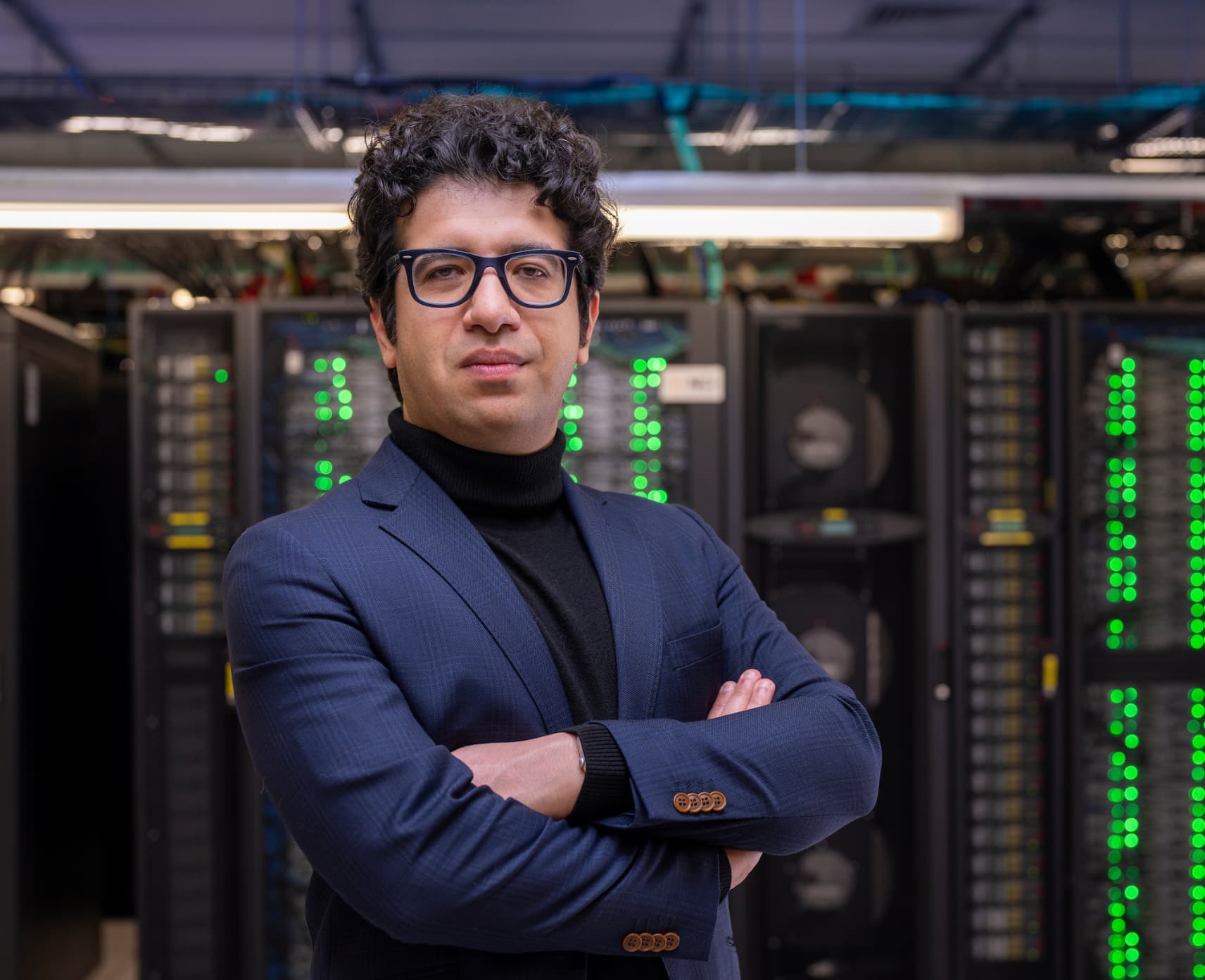
Dr Eli Niktab. Photo: Jamie Kidston/ANU
Related tags:
You may also like
Ultra-precise ANU coatings help power the next generation of gravitational wave detectors
ANU researchers have developed ultra-precise optical coatings for LIGO’s specialised beamsplitters, helping improve the observatory’s ability to detect faint gravitational waves from across the universe.
Bake your PhD: Can you have your doctorate and eat it too?
The tastiest annual tradition has returned in 2026.
We need to chat to our kids about AI chatbots
AI is changing childhood. ANU researchers are talking to children aged 9–12 to understand how AI chatbots affect their wellbeing and friendships.