
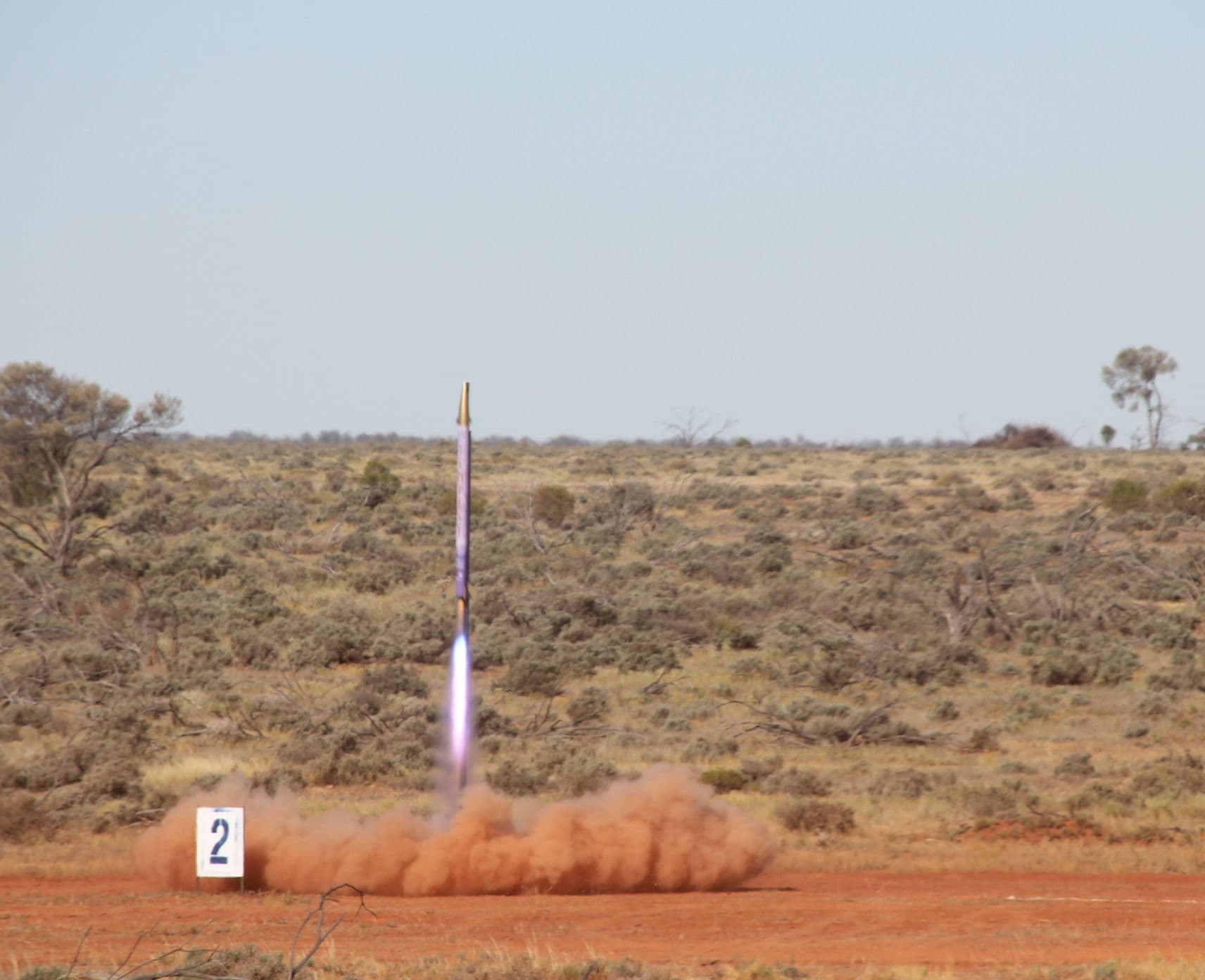
ANU Rocketry reaches new heights with national competition win
After months of design, testing and preparation, ANU students have soared to victory at the 2026 Australian Universities Rocket Competition.
Article by:

Amy Smith
Contributing writer
A 1,000-kilometre journey through dust storms, a tight budget and a worldwide shortage of rocket motors. None of it stopped ANU Rocketry from reaching the top of the podium at the 2026 Australian Universities Rocket Competition (AURC).
The student-led team from The Australian National University (ANU) was named Overall Winner at the competition in White Cliffs, outback New South Wales, from 30 September to 4 October, against university teams from across Australia, New Zealand and India.
It is the first overall AURC title for ANU, achieved in only their second appearance at the competition.
The team also took first place in the 10,000-foot propulsion category with their competition rocket, Project Tempest, which reached an altitude of 9,380 feet.
Hannah Schmidt, ANU Rocketry Chief Engineer, said that the launch brought months of work down to a matter of minutes, “The launch was terrifying in the best possible way. It’s over in minutes, but those minutes represent months of work from so many people.”
“We were proud of what we’d achieved regardless of the outcome, so realising we were coming home with two awards was a huge bonus.”

The road to the launch pad
Getting Project Tempest to the launch pad took months of designing, building and testing. The team also had to navigate a worldwide shortage of rocket motors and a tight budget before making the nearly 1,000-kilometre 10-hour drive from Canberra to the remote competition site.
ANU Rocketry Academic Champion, Dr Juan Felipe Torres, said the students had shown remarkable commitment.
“The students deserve tremendous credit for becoming Australasia’s rocketry champions, and for overcoming so many hurdles along the way, including a worldwide motor shortage and a very tight budget,” says Dr Torres.
“I’ve been deeply moved by their commitment, discipline and, above all, their teamwork.”
The competition brought together university teams for a program of conference and launch days, challenging participants to launch their rockets as close as possible to their target altitude.
Professor Aaron Quigley, Dean of the ANU College of Systems and Society congratulated the team and thanked them for being such exceptional ambassadors for ANU.
“This outstanding achievement reflects the hard work, resilience and teamwork of our students, who competed against some of the best university teams in Australasia,” said Professor Quigley.

More than a rocket
The team’s work extends beyond launching rockets.
ANU Rocketry brings together students from different disciplines, who put their studies into practice across the propulsion, aerostructures, avionics, recovery, dynamics and control, payload, business and operations teams.
Women make up more than half of the team that competed at AURC 2026, proudly showcasing women’s participation in STEM.
ANU Rocketry Operations Director Emily Keane said being part of the team had given her opportunities beyond the classroom.
“Being on a student team like ANU Rocketry has opened doors to experiences I never could have imagined when I started at ANU.
“The team allows you to direct and collaborate across disciplines and, above all, learn to fail without a grade hanging over your head.”
While Project Tempest was built for competition, the technology developed by the team has potential applications well beyond rocketry.
The payload team has been developing a laser-based air speed sensor that measures airflow around a rocket by detecting how water vapour absorbs light.
ANU engineering students recently demonstrated the technology to Pentagon representatives through discussions coordinated by the NSW Defence Innovation Network and ANU Defence Institute, opening possibilities for its use in other settings.
They have also discussed working with the Japan Aerospace Exploration Agency (JAXA) on a high-altitude balloon flight from Alice Springs, using the same laser technology to measure water vapour and CO₂ in the upper atmosphere.
The students are exploring ways to further develop and potentially commercialise their technologies after graduation, alongside their work on future rocketry projects.

The next mission
Project Tempest was successfully recovered – a key consideration in the competition – and remains largely intact, although it will need some repairs before it can fly again.
“Tempest has made its final flight, but it’s not going anywhere just yet,” says Schmidt.
“Back in our workshop, it’ll take on a new role as a showpiece at market days, showcases and future events, giving us a chance to share the work that went into the project.”
“Meanwhile, the team is looking ahead, with our propulsion team making exciting progress towards a bipropellant liquid engine that could enable even more ambitious projects.”
ANU Rocketry first competed at AURC in 2019. As Overall Winner this year, the team will receive $10,000 from Thales Australia.
This achievement reflects the dedication of the students and the wider ANU community who supported the team’s journey, from the workshop to the launch pad.
Photo: supplied, ANU Rocketry
Related tags:
You may also like

Tom Foley on stewardship, trust and the future of the ANU Library
As he steps into the role of University Librarian, Tom Foley reflects on the job he calls “an honour, a custodian role” and what makes a library worth trusting.
Remembering Ernie: the man behind Llewellyn Hall
As Llewellyn Hall marks its 50th anniversary, Emeritus Professor Larry Sitsky reflects on the musician and friend for whom the hall is named.

A battle on two fronts: Chris Taylor’s fight for climate and life
“I’m a student of life, a student for life.” Time is running out for Chris Taylor, but that is not stopping him from working to leave a better world behind.