
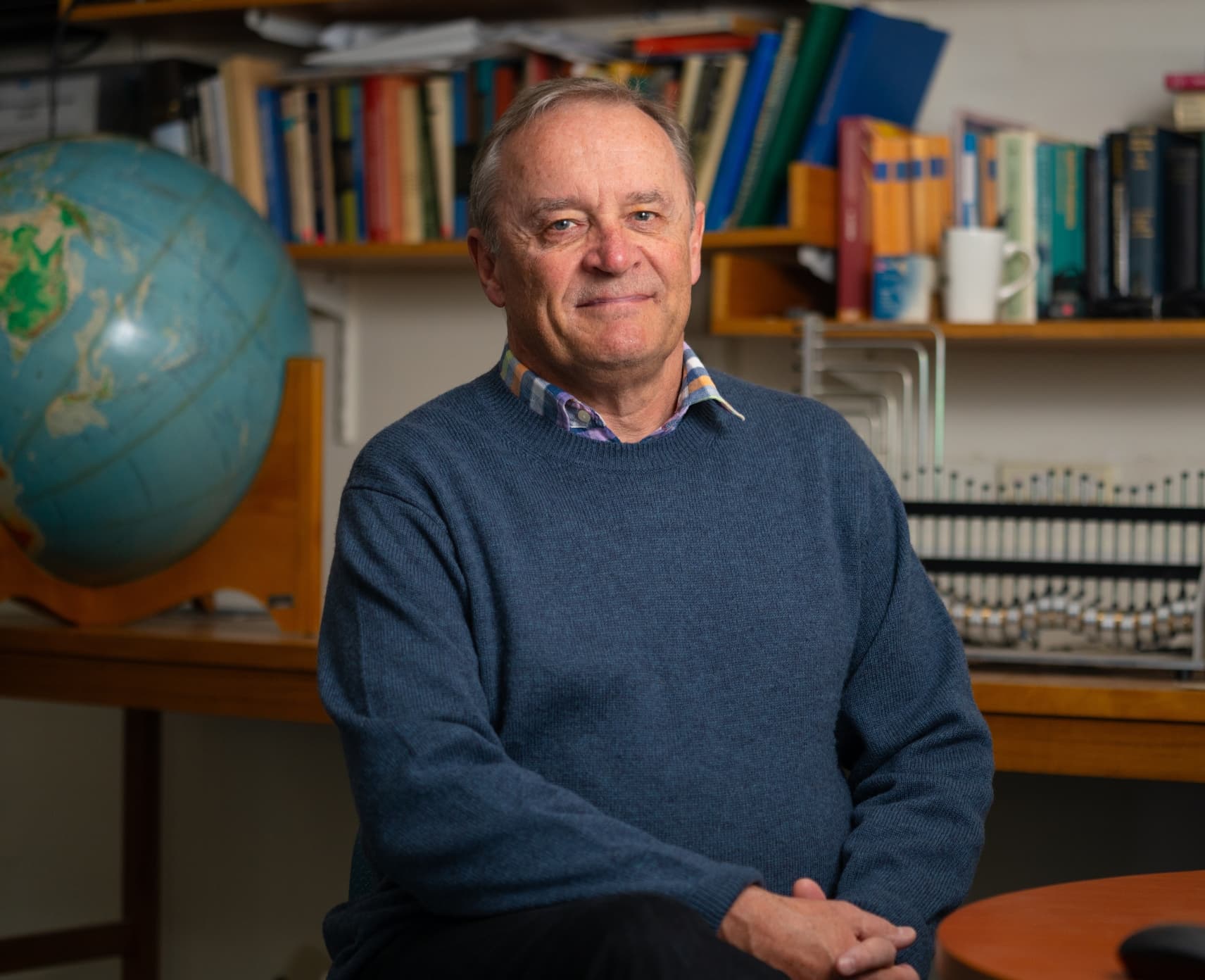
How an impulsive decision led an ANU geophysicist to become one of the world’s most eminent scientists
Emeritus Professor Malcolm Sambridge has a knack for solving the unsolvable. His pioneering work developing mathematical models to solve earth science problems has seen him elected as a Fellow of the Royal Society.
Article by:
George Booth
Contributing writer
Learning from some of the world’s best and brightest minds, Malcolm Sambridge’s journey from postgraduate student to prospective PhD researcher at the University of Cambridge seemed, much like the iconic institution’s Medieval façade, set in stone.
That was until a young Sambridge was presented with a question by one of his teachers, Professor Brian Kennett, that would change everything: “Do you want to follow me to Australia to do a PhD?”
Kennett – who would later become an influential mentor figure and life-long friend of Sambridge – had accepted a position in the seismology group at The Australian National University (ANU) Research School of Earth Sciences (RSES). Kennett was looking for a PhD student to supervise, and seeing potential in Sambridge, sold him on the excitement of the unknown.
As it turns out, it didn’t take much persuasion for Sambridge to uproot his life and emigrate to the other side of the world. Growing up in the UK, the endless possibilities that come with a new life in sunny Australia were too tempting to turn down.
“It was a bit of a spur-of-the-moment decision,” he admits. “I had no hesitation whatsoever, I think it took about five minutes for me to make up my mind.”
“I hadn’t really heard of ANU but I wanted to see Australia. Although I had to persuade my mum that it was a good idea.”
So Sambridge packed up his belongings and relocated to Canberra in 1984 where, under Kennett’s supervision, he began a PhD in seismic imaging at RSES.
Upon completion of his PhD in 1988, Sambridge left ANU to take up research positions in the US and the UK. That was until Sambridge was lured back to ANU in 1992 with a fixed-term postdoctoral position – an offer that was a “no-brainer”.
What was supposed to be a five-year contract has turned into a more than 30-year career at ANU for Sambridge, who is now Emeritus Professor in seismology and mathematical geophysics at RSES.
Solving the unsolvable
A geophysicist with a background in applied mathematics, Sambridge is a self-professed “algorithm nerd” that develops mathematical models to solve earth science problems.
He has transformed how earth scientists extract information from complex data and is internationally recognised as a world authority on inverse problems – the study of how to answer questions with indirect observations.
His work is rooted in developing solutions to mathematical problems, similar to finding two pieces of a jigsaw puzzle that fit together. In 1999, he developed the landmark Neighbourhood Algorithm – a technique that finds the best possible solution to complex, multi-dimensional problems such as locating deep earth structures using seismic data.
At the time of its creation, the technique helped solve inference problems that were previously considered intractable, and the open-source nature of the software means it’s been used by researchers worldwide.
In 2021, Sambridge and his ANU colleagues used the Neighbourhood Algorithm to confirm the existence of a mysterious fifth layer hidden within the deepest parts of Earth’s interior, known as the innermost inner core, by using globally recorded seismic waves that move through Earth’s centre.

Sambridge’s work also focuses on studying Earth’s interior using seismic imaging, which is similar to how medical professionals use x-rays to peer inside the body. Seismic imaging involves analysing elastic waves generated by earthquakes, which penetrate and pass through Earth’s core.
These waves reveal properties of Earth’s interior, including the state and composition of the planet’s mantle and core. Unearthing the secrets of the planet’s interior tells us more about its evolutionary history.
Sambridge’s contributions to the earth sciences over his 40-year career has seen him elected to the Fellowship of the Royal Society, the UK’s national academy of sciences. It is the oldest scientific academy in continuous existence and dates back to the mid-17th century.
Fellows elected to the Society are considered pioneers in their respective fields and their contributions reflect the highest standards of scientific endeavour.
Sambridge’s election as Fellow of the Society sees him join an exclusive club of renowned scientists including Stephen Hawking, Isaac Newton, Charles Darwin, Albert Einstein and Dorothy Hodgkin.
Sambridge, who is also a Fellow of the Australian Academy of Science, describes being so shocked after discovering the news that he had to ask his wife to re-read the letter to him.
“It’s overwhelming. I mean, I’m giddy as a schoolboy. I feel very honoured, but equally I feel humbled and astonished that this has happened,” he says.
“I am so indebted to all my colleagues and the people that have supported me for this nomination, but also for making it such a fun career. No one can achieve these things on their own, particularly me … no one’s an island in this business. We all work together, and I’ve been very fortunate to work with lots of amazing people throughout my career.”
Providing the freedom to grow
As an early career researcher at ANU, Sambridge credits Kennett and others at RSES for encouraging him to think outside the box and giving him the flexibility to pursue his research interests without the pressure to deliver research milestones to appease funding partners.
“My supervisors said ‘do what you want but make sure it’s good’. Rarely these days do researchers have that luxury,” he says.
“The nature of the School provided me with the flexibility to work on research I was truly interested in. It set me on a path of looking at geophysical inversion and inverse problems, which is what I have arguably become most known for.
“It’s an interest that has stayed with me forever and without the freedom given to me by ANU I doubt I would be where I am in my career today.”
Connecting classrooms to the geosciences
In 2012, Sambridge played an instrumental role in establishing the Australian Seismometers in Schools (AuSIS) program, funded by AuScope. The initiative teaches students about earthquakes and the earth sciences while also encouraging them to pursue a career in STEM.
By installing research-grade seismometers in high schools, students can learn about seismic activity generated by local and distant earthquakes, and vibrations caused by human activity.
Since the program’s inception nearly 15 years ago, seismometers have been installed in more than 50 schools across every state and territory in the country.
“The data collected by these seismometers, which are placed in unique locations where you wouldn’t normally place these instruments, continues to be used by researchers around the world and contributes to global scientific collaboration,” Sambridge explains.

After more than 33 years living in Canberra, a place that is well and truly home, Sambridge reflects on his impulsive decision to emigrate as one of life’s fortuitous “sliding door” moments.
“I’ve always been keen on travel, and so when the opportunity arose to do a PhD in Australia, how could I say no?” he says.
Having being part of the ANU community for more than three decades, Sambridge considers himself part of the furniture and has no doubt the decision to emigrate was one of the best he’s ever made.
“My kids say to me ‘Dad, I thought you’d retired?’ And I say, ‘well, when you’ve been paid to do your hobby your whole life, even if you stop getting paid, you keep doing your hobby’,” he says with a wide grin.
Top image: Emeritus Professor Malcolm Sambridge. Photo: Nic Vevers/ANU

You may also like
Bake your PhD: Can you have your doctorate and eat it too?
The tastiest annual tradition has returned in 2026.

We need to chat to our kids about AI chatbots
AI is changing childhood. ANU researchers are talking to children aged 9–12 to understand how AI chatbots affect their wellbeing and friendships.
The universe is full of strange ‘little red dots’. A new study shines light on their real nature
Scientists have found potential evidence of the earliest supermassive black holes. They could hold clues to how stars and galaxies formed in the earliest years of the universe.