
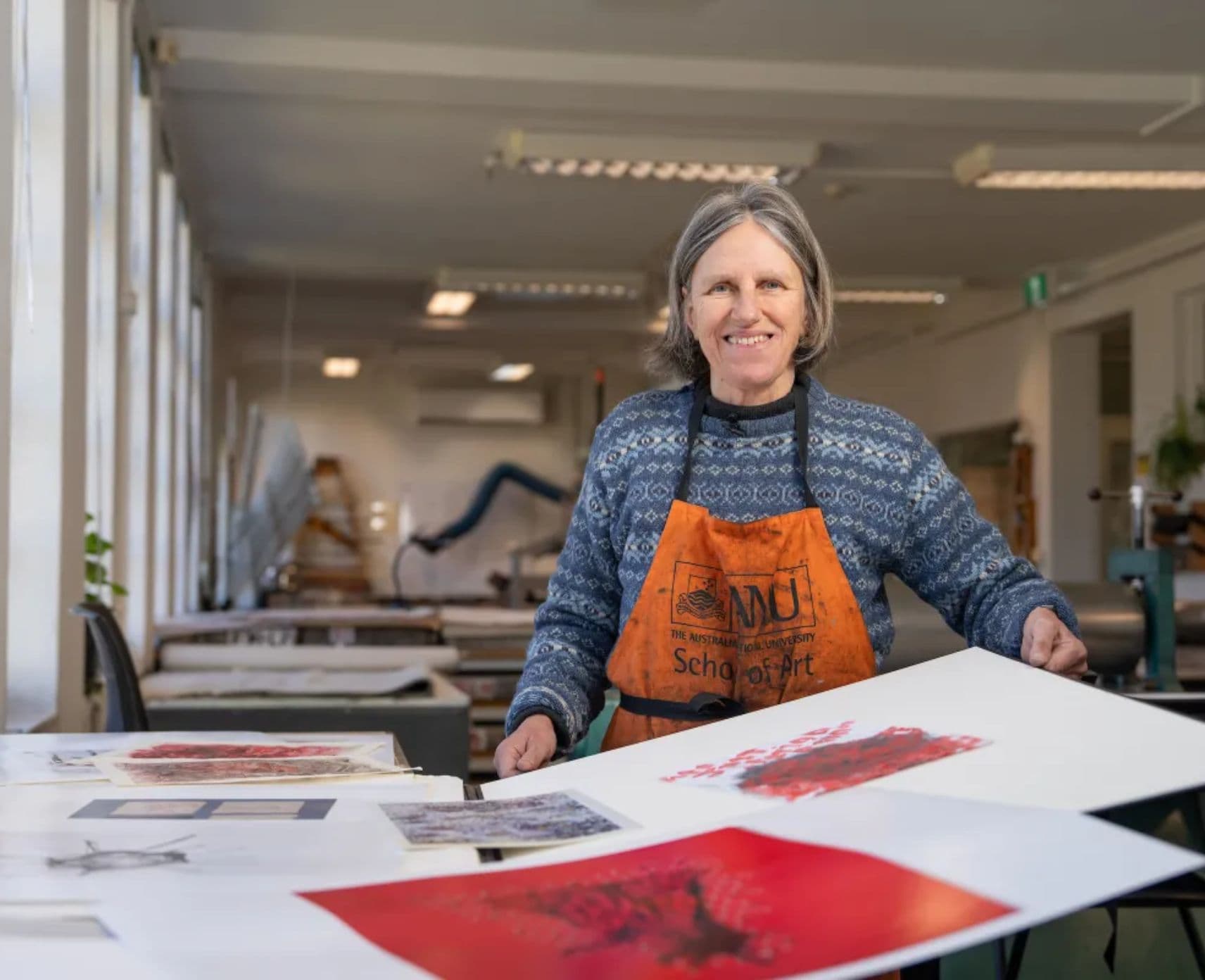
How art uncovers the hidden pain of endometriosis
ANU PhD candidate Susanne Ilschner is combining visual art, patient experiences and laboratory research to better understand the emotional, social and biological impacts of a condition affecting up to one million Australians.

Dr Susanne Ilschner decided to study medicine when she was 14.
“My mum fell ill and died two years later. I wanted to do something with my life that would help prevent or cure these nasty diseases.”
With a family history of constantly coping with loss and moving places, she says, “I see myself as a bit of a wanderer.”
Her education covers music, medicine, and visual art and in 1987 she earned her medical doctorate specialising in visual science.
Ilschner is now a PhD candidate at the School of Medicine and Psychology at The Australian National University, where she pulls together her experience in the lab, clinic, and art to evaluate pathways to and the meaning of an endometriosis diagnosis.
Painting the unspoken pain
Unlike most medical theses, part of Ilschner’s PhD thesis is visual art.
She interviewed 26 women with endometriosis, 13 in Australia and 13 in France. She then asked them to express their personal experiences and emotions surrounding the disease without using words, for example paint.
“I really wanted to eliminate the language differences between participants from different countries.”
She explains that with no words, “people might go back in time and relive a situation that has to do with the impact of endometriosis and just make a record of that emotion through body motion alone.”
“I wanted to see how well we can read the emotion.”
Ilschner says the artworks carried emotional power.
“One woman said she really felt angry when she made her image, and it was just so strongly expressed in her artwork.”
To explore how others connect with these women through painting or other art forms, Ilschner and fellow artists responded to these original ‘Primer’ works by creating new art pieces in ‘Response’.
When Ilschner viewed a work expressing confusion and loss, she decided to respond to it with her art. She noted, “I felt almost in nature, and I really liked how she made the artwork, and I began to understand how she would have felt while she did it.”
She believes that “this type of work can actually encourage people, not just the artists, to look at what people do, how they move, and what they make, try to be sensitive to what they might be feeling, and reflect on what is said in a different way.”
Ilschner says the whole process reshaped her understanding of endometriosis that being ill, especially long-term, is actual work and should be valued as such, rather than being seen as a burden.
“These are whole people. It’s not an object with endometriosis, it’s a whole personal history of a person in their environment of things, processes and other people.
“There are moods, there are family problems, there are community problems.”
Ilschner was told that through these interviews and artwork, participants feel seen by expressing things that they wouldn’t necessarily tell their GP.
What is endometriosis?
Endometriosis is a persistent disease where tissue similar to the lining of the womb grows outside it in other parts of the body. Common symptoms include heavy periods, pelvic pain and sometimes infertility.
In Australia, according to Endometriosis Australia, over 830,000 to 1 million Australian girls, women, and individuals assigned female at birth live with endometriosis.
Susanne’s interest in endometriosis solidified while working in medical data entry, where she was first exposed to vast datasets and clinical discussions surrounding the condition.
Seeing the human reality behind the data deeply affected her.
“I feel very connected to those women.
“The people that have this disease are mostly young women, and I have a daughter. So it could be me, or my daughter.”
Ilschner noted that despite its prevalence, healthcare providers can still misdiagnose it due to the variety of symptoms. One patient Ilschner interviewed was told for years that her complaints were purely psychological after suffering from unusual symptoms such as severe premenstrual rage and depression.

The unseen impact
Beyond misdiagnosis, patients have historically faced systemic dismissal from both the medical community and society at large.
“Historically, the disease was always associated with an image of hysterical women who just can’t cope with anything and complain about pain when really there shouldn’t be any,” Ilschner explains.
While she acknowledges that public awareness has improved, Ilschner believes modern support systems still fall short. Especially when it comes to practical needs and issues like childcare costs and logistics, and career transitions.
“Society still shies away from taking responsibility, not just for the disease and its causes, but also for the impact of the disease,” Ilschner reflects.
“I think there’s not much awareness of how much work is needed. How to prevent disease and support patients is still a grey area.”
Endometriosis impacts many women’s ability to work. A survey from Endometriosis Australia found that one in three women have been passed over for a promotion due to their disease, and one in six have lost their jobs due to their endometriosis.
The science behind the art
Beyond interviews and visual art, the final phase of Ilschner’s thesis was laboratory research—a process she notes was “a lot more costly than all the other parts of the study.”
In the lab, Ilschner examined the body in relation to its environment, specifically focusing on nano-sized vesicles produced by virtually all cells, including bacteria. This subcellular-level research holds strong potential for improving both diagnostic testing and therapeutic treatments for endometriosis.
By combining scientific analysis with the lived human experience, Ilschner gained a far richer perspective on the disease.
During her study years, she learned more about how to look at and listen to a person with endometriosis, not just at endometriosis as a lab result, but to better understand what happens between a person and other factors, and to learn from them as the ‘patient experts.’
“Scientists try to abstract things and get rid of themselves (the researchers) as persons. But when you do art, it’s the opposite. You put yourself into it.”
As a medical doctor and scientist, Ilschner believes, “real life is not just science, statistics, and interpretation,” and that science must be integrated back into comprehensive actual human therapy.
This article was first published by the ANU College of Science and Medicine.
Photo: Nick Vevers/ANU
Featured experts
Related tags:
You may also like

Beyond zero tolerance: what it will take to end sexual harassment in medicine
Drawing on years of global research and testimony, Clinical Associate Professor Louise Stone examines why sexual harassment persists across medical cultures worldwide – and why policy and law alone have never been enough to stop it.
Strong and healthy: How Mob-driven leadership is transforming Indigenous health research
The history of Indigenous health research in Australia is deeply entwined with practices that were often extractive, exploitative and driven by non-Indigenous agendas. Now, Yardhura Walani and the National Centre for Indigenous Genomics are leading the way to change that.
Poor communication in hospitals is putting Australians at risk. Researchers are fighting back
The ANU Institute for Communication in Health Care is on a mission to improve the safety and quality of patient care in hospital contexts.