
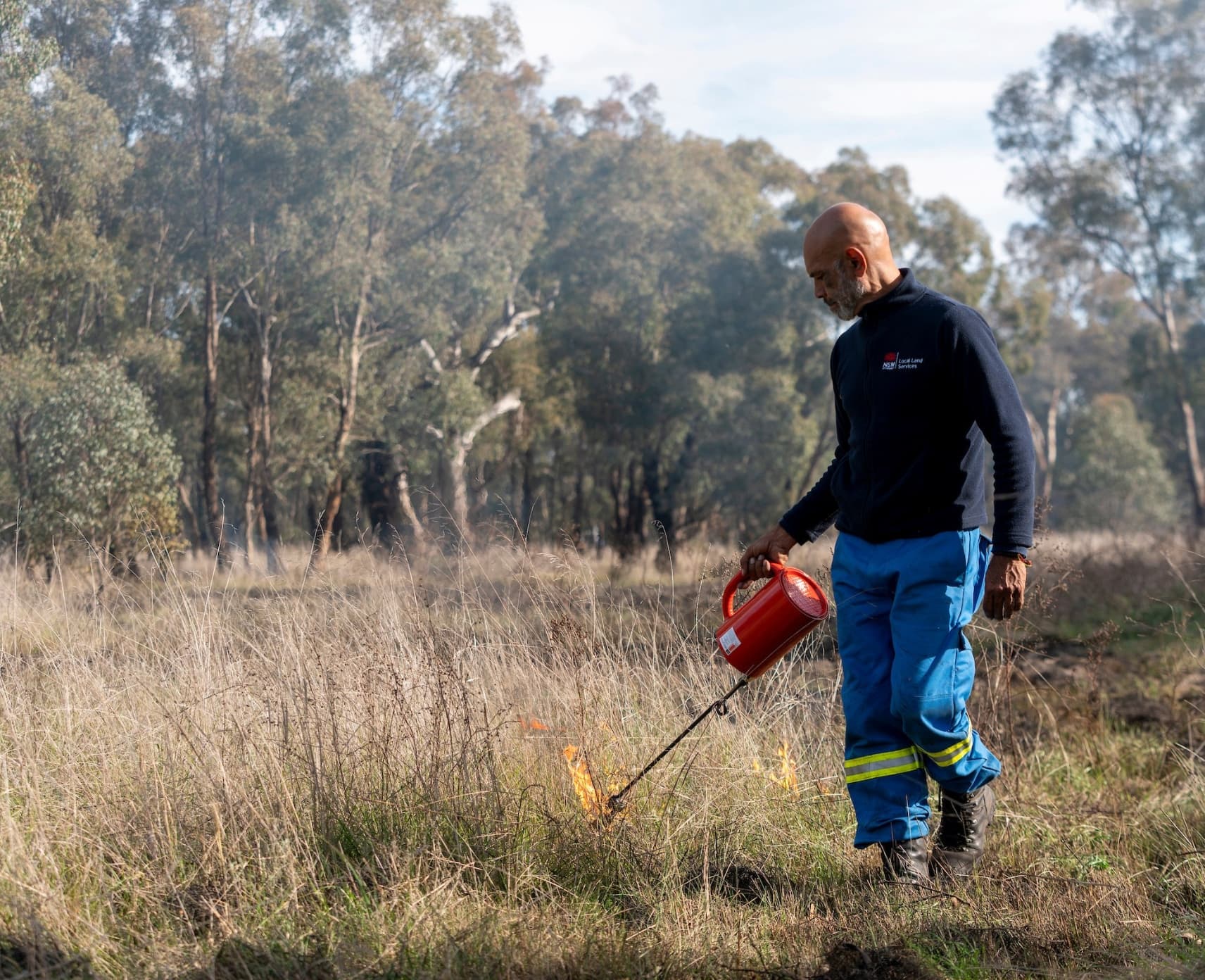
Landscape-scale cultural burning study expands
It’s one of the first landscape-scale trials of cultural burning on travelling stock reserves (TSRs) in NSW in history.
The Australian National University (ANU) has partnered with the NSW Government’s Local Land Services and First Nations communities to expand a successful cultural burning research program.
The re-emergence of First Nations burning in contemporary grassy woodlands project is implementing Indigenous-led cultural burning practices on private and public land and travelling stock reserves (TSRs) on Ngunnawal Country and Wiradjuri Country in central and south-east NSW and in the ACT.
It’s one of the first landscape-scale trials of cultural burning on TSRs in NSW in history.
Central Tablelands, Riverina and South East Local Land Services will work closely with Local Aboriginal Land Councils, the NSW Rural Fire Service and ACT Government, as well as ecologists from ANU and the CSIRO, to deliver the project over four years to study the effects on biodiversity, soil and vegetation.
The project, supported by an Australian Research Council Linkage Program grant, will see 36 burns carried out across the three Local Land Services regions, with the first burns now underway in Tumut and Yass.
The sites fall within the Brungle, Tumut, Wagga Wagga, Young, Cowra and Bathurst Local Aboriginal Land Council areas.
It follows a two-year pilot in the Riverina and South East, where Local Land Services partnered with Local Aboriginal Land Councils and ANU to carry out cultural burns and monitor ecological outcomes in critically endangered box-gum grassy woodlands on TSRs in Wagga Wagga, Young and Yass.
Cultural burns are cool, slow and controlled, trickling through the landscape and allowing native animals to shelter from the flames.
They promote the germination of plants, including culturally important food and medicinal plants.
The results from the pilot, published in the journal Global Change Biology, showed many native plants, including native peas, germinated after the burn – more so than in unburned areas.
Senior Riverina Local Land Services officer and Wiradjuri man, Dean Freeman, led the burns on Wiradjuri Country and said the results were promising.
“We’re learning what part of the fire triggers regeneration – is it the heat, the smoke or the steam? I’ve been doing this for 25 years and it’s very satisfying to see,” Freeman said.
He said the project explored how traditional cultural practices could be incorporated into today’s land management systems to help restore ecological health and reduce bushfire risk.
“Australia is a fire-prone country. There’s a place for all types of land management techniques in caring for Country. We’re using these ancient techniques in a modern society and working together to find the best approach,” Freeman said.
Researchers will continue to monitor the pilot sites in the Riverina and South East.
ANU Research Fellow Elle Bowd said data had never been produced at this scale before.
“The pilot made good inroads, but now we have more time and more resources to dedicate to this important, landscape-scale research into traditional land management tools,” Dr Bowd said.
“We’re also investing in building community capacity and strengthening the interface between traditional and Western land management principles by partnering with the community to achieve outcomes for and by them, as well as for western science and management.”
Top image: Dean Freeman leads cultural burning training on a travelling stock reserve at Wagga Wagga. Photo: Jamie Kidston/ANU
Contact the media team
You may also like
Strong and healthy: How Mob-driven leadership is transforming Indigenous health research
The history of Indigenous health research in Australia is deeply entwined with practices that were often extractive, exploitative and driven by non-Indigenous agendas. Now, Yardhura Walani and the National Centre for Indigenous Genomics are leading the way to change that.
Australian cave discovery shows grass was burned for magic, healing and cursing for 25,000 years
Perfectly preserved ‘phytolith’ plant crystals reveal that Indigenous Australians took grasses into a cave for ritual burning since last Ice Age.
Verses of reconciliation: Elfie Shiosaki’s poetry is helping Australia heal
Noongar and Yawuru scholar Elfie Shiosaki sees poetry as a technology for peace and truth-telling.