
Radio GAGA: Australian astronomers tune in to the Galaxy’s hidden gas
Astronomers from The Australian National University (ANU) have revealed how the Milky Way’s hidden gas moves through space, by using the joint power of two of the nation’s flagship telescopes.
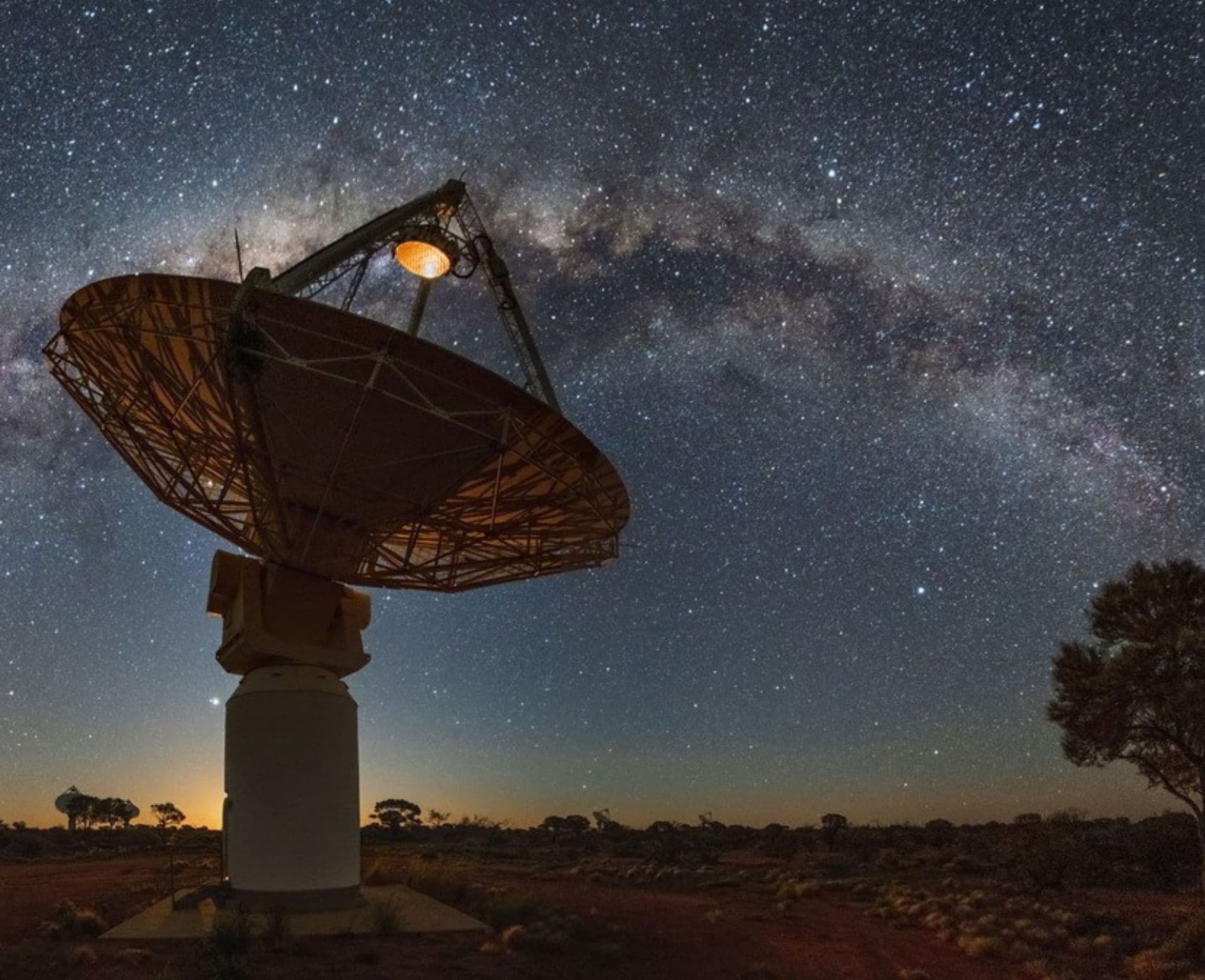
The collaboration, playfully dubbed Radio GAGA, links the Galactic ASKAP (GASKAP) survey, on the land of the Wajarri Yamaji people in Western Australia, with the GALAH survey at the Anglo-Australian Telescope, on the land of the Gamilaraay people in New South Wales.
“We’re using stars as lighthouses shining through the Galaxy’s fog and radio telescopes as giant antennas listening to it,” lead author and ANU astronomer Dr Hiep Nguyen said.
“Combining information from radio and optical telescopes lets us see how and where this gas thickens and becomes the raw material for new stars.”
GASKAP detects hydrogen gas through its faint 21-centimetre radio signal, while GALAH observes how starlight dims when it passes through atoms of potassium. Together, the two reveal that hydrogen and potassium trace the same interstellar clouds at different densities.
“By connecting radio and optical surveys, we’re opening a new window into how our Galaxy breathes – how cold gas flows, clumps, and eventually forms stars. It’s like using both lighthouses and radar to navigate the Galaxy in three dimensions,” co-author Dr Sven Buder said.
According to co-author Professor Naomi McClure-Griffiths, understanding how this cold gas moves and condenses is key to explaining how galaxies recycle material into stars and planets.
“The results highlight Australia’s leadership in large-scale, multi-wavelength astronomy and pave the way for the next generation of these surveys,” she said.
Together, these findings show that the Milky Way’s invisible fog and dust – long known to First Nations Astronomers through the dark clouds and nebulae that form constellations such as the Dark Emu – can now be mapped in unprecedented detail.
The research is published in Monthly Notices of the Royal Astronomical Society.
Partners include Australian institutions ASTRO 3D, Macquarie University, CSIRO, University of Tasmania, Curtin University, and ICRAR, as well as international partners from Italy, Ecuador, Canada, South Korea, Germany, France, the USA, and the UK.
About Radio GAGA
Radio GAGA combines data from the GASKAP (Galactic ASKAP) survey at CSIRO’s ASKAP radio telescope and the GALAH (Galactic Archaeology with HERMES) survey at the Anglo-Australian Telescope.
ASKAP is located at Inyarrimanha Ilgari Bundara, the CSIRO Murchison Radio-astronomy Observatory, on the traditional lands of the Wajarri Yamaji people. The Anglo-Australian Telescope at Siding Spring Observatory operates on the traditional lands of the Gamilaraay people. We acknowledge their continuing connection to sky, land, and culture, and pay our respects to Elders past and present.
Top image: ASKAP radio telescope. Photo: CSIRO

Contact the media team
Related tags:
You may also like
ANU Rocketry reaches new heights with national competition win
After months of design, testing and preparation, ANU students have soared to victory at the 2026 Australian Universities Rocket Competition.

Codebreakers tackle cancer drug resistance with machine learning
Dr Eli Niktab is building a genome atlas to tackle chemotherapy resistance – and is attracting significant global funding.
Ultra-precise ANU coatings help power the next generation of gravitational wave detectors
ANU researchers have developed ultra-precise optical coatings for LIGO’s specialised beamsplitters, helping improve the observatory’s ability to detect faint gravitational waves from across the universe.