
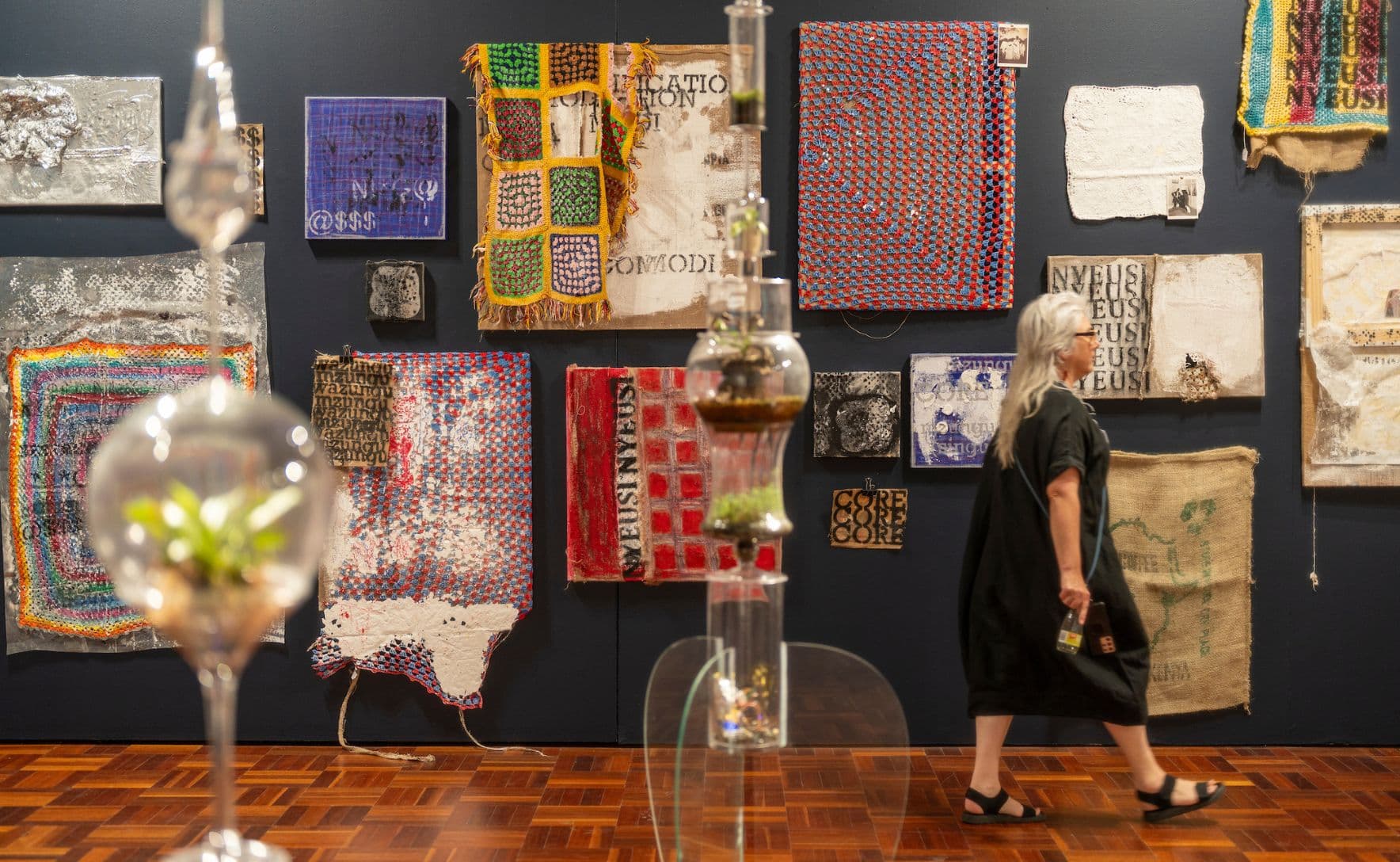

Each year, the ANU Art & Design Grad Show transforms the gallery into a maze of colour, sound and unexpected encounters, a place where materials behave strangely, ideas take on physical form, and students reveal the work that has shaped them.
Here are just four emerging artists that capture that spirit with practices grounded in storytelling, identity and the body: stitched, cast, painted and polished into being.
Olivia Kidston: Soft, Strange and Seen
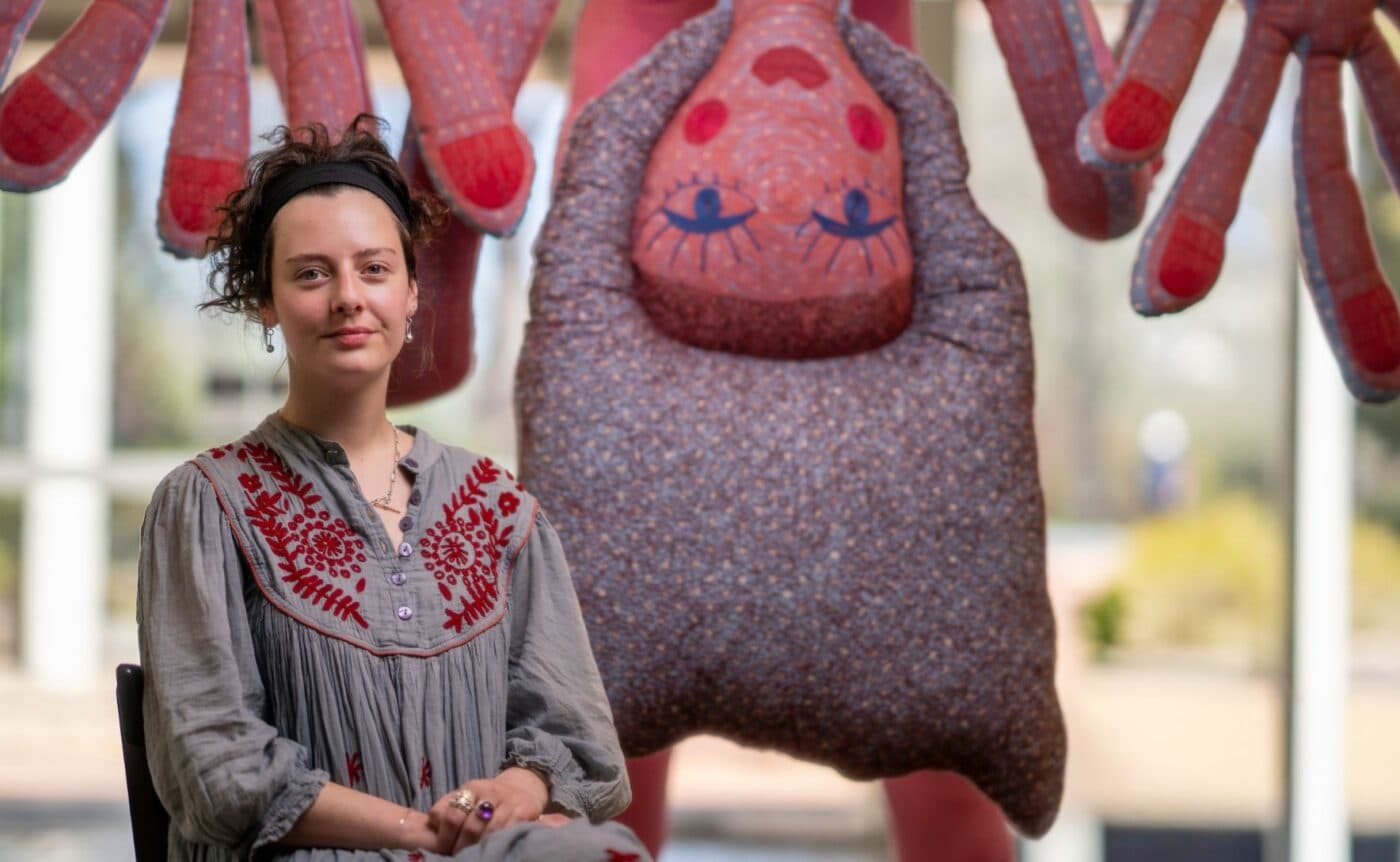
The Bernina Q20 growls. Fabric quivers beneath its needle. Somewhere between pulse and vibration sits Olivia Kidston, translating thought into motion before it can scatter.
“It’s like a language I can’t speak,” she says. “It can only come through stitching.”
Her free-motion embroidery looks delicate from afar; up close it’s a storm. Threads twist and fabric puckers where speed outpaces control.
“They’re all injected with my life experience of ADHD,” she says, pointing out a patch where the tension has pulled so tight it almost sings.
The pink with a red-threaded giant doll that she’s been working on emerged instinctively.
“It was a subconscious choice, suggestive of a body, referencing the soft internal tones of flesh,” she says.
Olivia laughs about changing the bobbin every 10 minutes. Since her last project she’s stitched another one and a half million loops of thought, bringing her total to more than four million. The machine’s been with her for barely a year but already pulses like a second nervous system.
Olivia’s dolls are emotional self-portraits. One has a hand for a head; another headless, a creature hovering between tenderness and defiance.
“It’s leaning into the monstrous feminine,” she says.
“Women in horror movies are usually shown as victims of their own monstrosity, while the monstrous feminine lets that femininity be reclaimed within its construction. I wanted to make myself into this feminine monster that takes up space, vulnerable and afraid, but also defiant.”

Words have always been slippery for Olivia. She is dyslexic, uneasy around rulers, calculators, and spelling. But in thread, she’s fluent.
Recognition has come quickly, winning CAPO’s All Insure Emerging Artist Award, and this year’s ANU School of Art and Design Drawing Prize. Though she still sounds surprised by it.
“I didn’t expect it at all,” she says. “The validation made me feel like I have my space, and it’s valuable.”
But the real drive is internal. “Even though ADHD is a disorder, it can be viewed as a tool for difference.”
Sometimes she sleeps beside her work. In the morning, the dolls travel with her, back to her studio, a 10-minute walk from the School of Art & Design Gallery.
Ira Gold: The Blue Highway

In the Sculpture and Spatial Practice space, Ira Gold leans over a sheet of clear acrylic, scoring waves into the surface until they shimmer.
“Each of these sheets starts flat,” he says. “I take an angle grinder to them, then use a butane torch to flame-polish the surface so it warps naturally, like water.”
The pieces hang low to the ground, suspended with fishing line. When light catches them, they ripple.
“I want people to look across them, like you’re standing at the edge of the ocean, surveying the surface,” he says.
Ira grew up in Mparntwe, Alice Springs, far from the Torres Strait Islands his family comes from. “I wanted to reconnect to my cultural heritage,” he says.
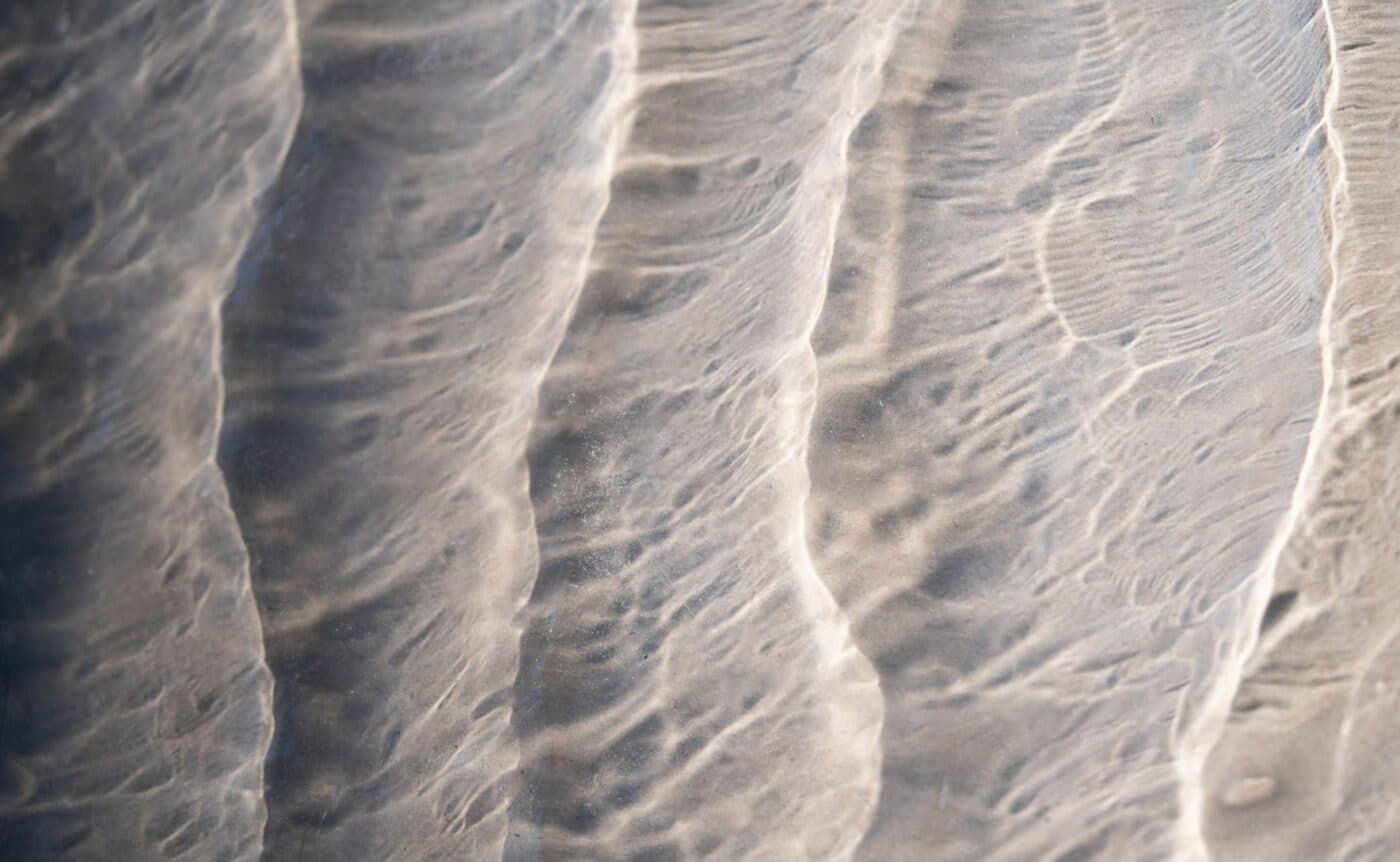
Ira’s series, ‘The Blue Highway,’ takes its name from a cultural passage of water travelled across generations.
“Water is a huge part of my culture, I like to think of these panels as connecting back to Saltwater Country.”
He works in repetition, polishing, heating, refining.
“It’s not perfectly flat,” he says. “You can see where the tool has left its trace. That’s part of it.”
This year, supported by the John and Elizabeth Baker Honours Scholarship and the Kambri Scholarship, Ira travelled to the Torres Strait for the first time.
“It helped me understand where my family is and who they are,” he says. “This work is the beginning of that process.”
Florence Steel: Microcosm–Macrocosm

Florence Steel moves with slow precision, each brushstroke tracing the arc of their arm. Oil glazes pool and shift, catching metallic green across a predominantly blue canvas.
“This piece is about the microcosm–macrocosm analogy,” Florence explains. “Where the human body reflects the cosmos, and the cosmos reflects the body.”
For Florence, painting is a form of inquiry, a way of studying relationships not through language but through form.
“I’ve been really interested in relationships,” they say. “Between people, between bodies, between the smallest part of us and everything out there.”
Their studio practice, grounded in both discipline and intuition, stretches across painting and textile installation, what they call “thinking through making”.
They are completing a degree in Art History and Curatorship and Visual Arts, but it’s in the studio where those ideas take shape. Their figures begin as mock-ups, photographs, sketches, loose outlines, before transforming into something more physical, more embodied.
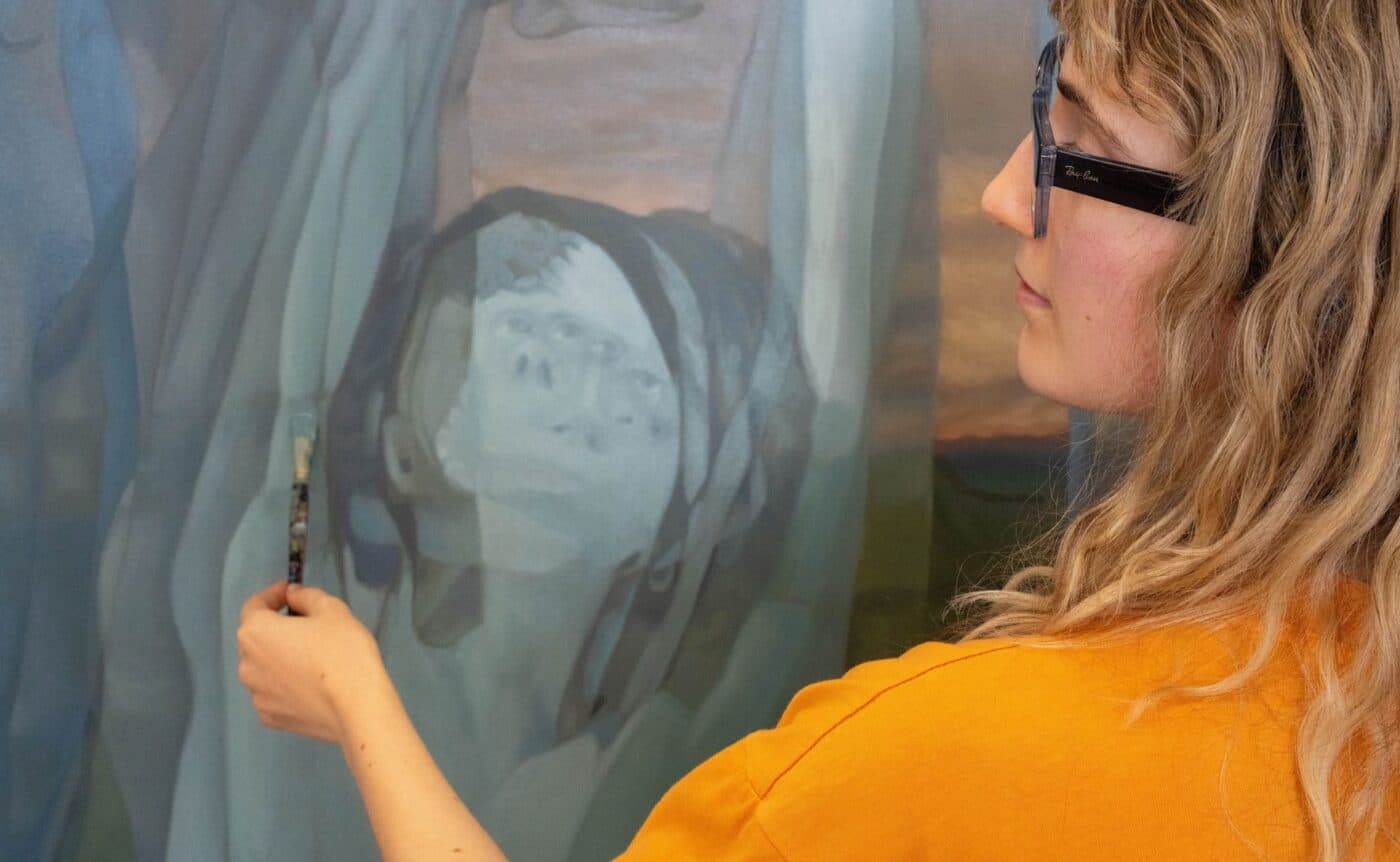
Drawn from their own body and their friends’, the figures hum with symbolism.
“We learn to read the body symbolically,” they say. “It’s one of the most effective ways to communicate feeling.”
The canvas is life-sized. Standing before it feels like approaching a doorway.
“I wanted the bodies to be full scale, so you feel like you’re being pulled into another world.”
Layer by layer, translucent paint accumulates into something luminous and alive, each movement tethered to the movement of their own body.
“It’s a bit of a workout,” they laugh. “The brush moves where my body moves.”
Isaac Kozlovskis: Tender is as Tender Does

In the upstairs part of the School of Art & Design, you can hear what sounds like two voices: “introspective rambling,” Isaac Kozlovskis says.
The name of this multimedia piece,‘inside of you are two wolves’, is about “exploring the grey area between mimicking and critique”.
There’s a distinct vulnerability and humour expressed in Isaac’s art.
“My work is an investigation about perfectionism and optimisation, particularly between the body and exercise as a form of betterment.”
The two videos on display are installed among a glass brickwork Isaac created to accompany the piece.
“When I started practicing these rituals, even lifting weights, I started noticing comparisons between online behaviours with health and how I seek perfection in my own life.”
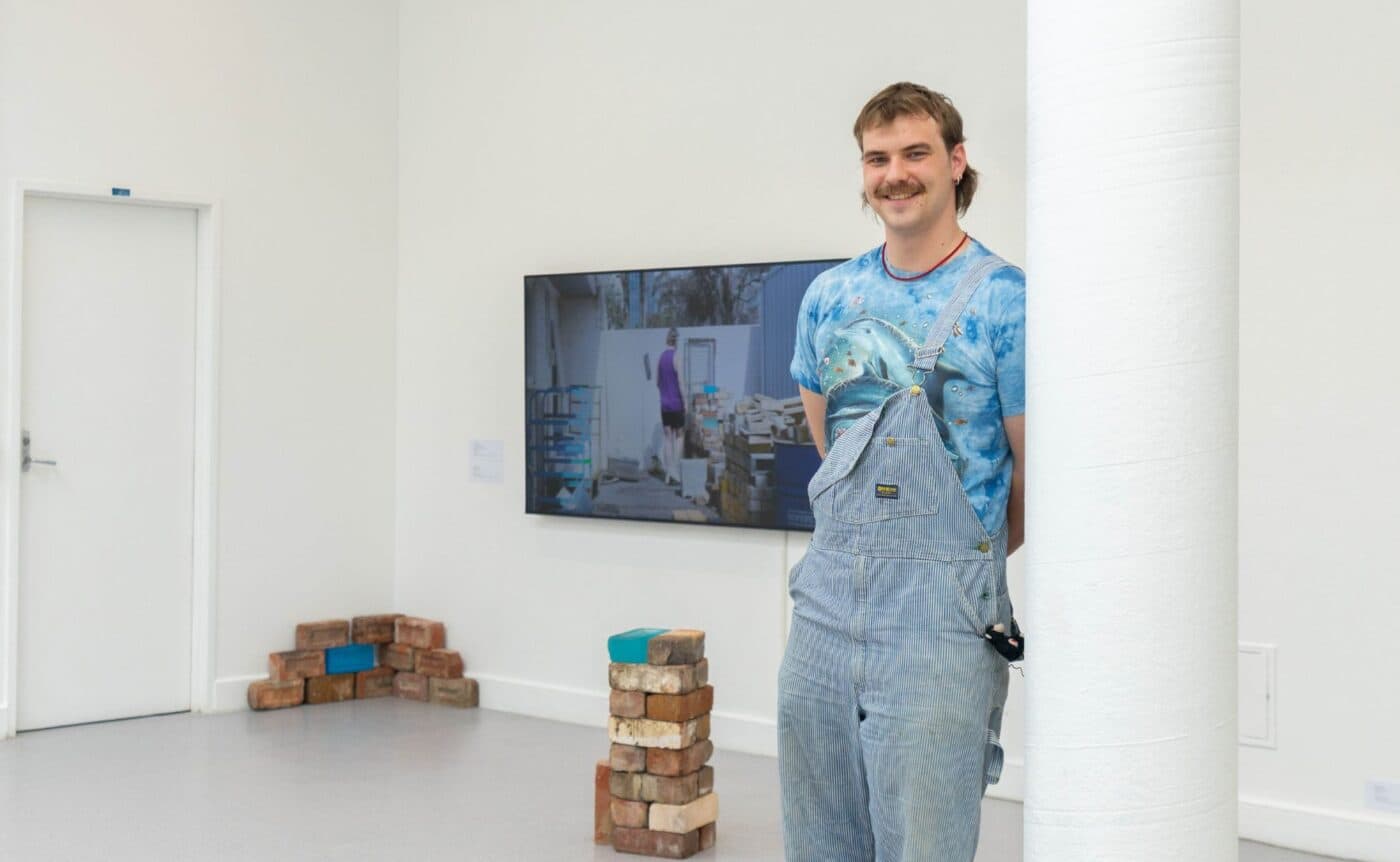
“Just as virtues are things that we gain through repeated behaviour, I’m drawn to brickwork. It has that same quality of being part of a whole,” he says.
“Using an object like a brick and reimagining it in glass creates a kind of magic like queering something so mundane.”
Isaac has desks scattered across ceramics and glass.
“There’s so much creative stuff inside you,” he says. “You’re just trying to put it out in a way that makes sense to someone else.”
“When I’m making video works like making sculptures, things that are everyday can be reimagined as strange in gallery so that maybe when we encounter the everyday we can see the strangeness that was there all along.”
“There are so many incredible artworks coming out of the School of Art and Design, it feels exciting to have such a celebratory grad show come together at the end of a big year.”
Honours, he thinks, will help push his practice further and in 2026 he will travel to the Pilchuck Glass School in Washington State.
The ANU Art & Design Grad Show is now open. Check out our students’ works from Saturday 29 November to Sunday 7 December. Open daily from 10am to 4pm. For more visit: www.gradshow.com.au
Top image: Artwork by Sophie Kihara-Murer. Image: Jamie Kidston/ANU
Related tags:
You may also like
The archaeologist unearthing a new chapter in the history of Southeast Asia
Professor Dougald O’Reilly’s new book breathes life into the prehistoric pasts of Myanmar, Malaysia, Indonesia, Cambodia, Thailand and Vietnam.
Remembering Ernie: the man behind Llewellyn Hall
As Llewellyn Hall marks its 50th anniversary, Emeritus Professor Larry Sitsky reflects on the musician and friend for whom the hall is named.
One historian, centuries of gossip and a fresh look at Ancient Rome
What did ordinary Romans really think of their rulers? Professor Caillan Davenport’s new book draws on juicy rumours and gossip to reveal the answer.