
What are the odds of a volcano erupting through a salt lake?
An experimental study of what happens when volcanoes erupt through salt lakes is rewriting the genesis story on the formation of some iron ore and rare earth deposits.
An experimental study of what happens when volcanoes erupt through salt lakes is rewriting the genesis story on the formation of some iron ore and rare earth deposits.
The Australian National University (ANU) research, published in Geology, looks beyond common assumptions, reconciling decades of research.
The findings indicate that the various proposed mineral formation routes, or genesis pathways, are not necessarily mutually exclusive.
These ore-forming processes may have operated together in deposits around the world, according to experimental geologist Dr Michael Anenburg from the Research School of Earth Sciences.
“Many disagree on how they form,” Dr Anenburg said.
“But what if various forces were at work simultaneously? Imagine an ancient volcano erupting through a salt lake. Neither the volcano nor the lake exists today, but their interaction may have produced valuable mineral deposits.
“These geological events also occurred around the world in different geological times – two million years ago at El Laco in Chile, for example.”
El Laco in the high Andes of the Antofagasta Region in northern Chile is home to massive ore bodies from iron-rich magnetite lava flows and pyroclastic deposits.
As one of the world’s most mined minerals, a greater understanding of the origins of iron ore may assist in future exploration, production and development.
Magma-sediment reactions can provide insights into the long-standing debate over iron ore formation, according to this study.
Annual global production of iron ore is roughly 2.5 billion tonnes, with the world’s top four producers – Australia, Brazil, China and India – contributing over three-quarters.
Most is used to make steel required by the world’s buildings and infrastructure, tools and machinery, the automotive industry and energy systems.
Further, concentrated rare earth metals found in iron-rich volcanic rocks could help meet demand for supplies of rare earth elements for new energy systems, industrial and military use and consumer products.
For decades, geologists have debated how iron oxide-apatite, or IOA-type, deposits form.
Most iron ore is not from IOA types or deposits. However, they could be useful for geographical diversification.
Existing models each describe only one isolated ore-forming mechanism. No single hypothesis has been able to explain all geological features seen in natural deposits.
Even in Europe, where Kiruna and nearby deposits in Sweden dominate the region’s sovereign supply, it is not known how the iron ore deposits formed.
Led by researchers from the Institute of Geology and Geophysics, Chinese Academy of Sciences, in collaboration with the Research School of Earth Sciences at ANU, the study offers fresh insights.
Piston-cylinder experiments were conducted at 0.4 gigapascals (GPa), a pressure close to conditions deep in the Earth’s crust for the formation of commercial-scale iron ore deposits, at temperatures of 1000 to 1200 degrees Celsius.
Their laboratory experiments suggested one integrated system and provided a simple explanation for the common field observation that IOA deposits tend to occur with evaporite and iron oxide-phosphorus-bearing sedimentary rocks.
“Previous experimental work typically tested one ore-forming process at a time,” said lead author Dr Shengchao Yan.
“Our work shows that magmatic immiscibility, salt melts and hydrothermal fluids can all operate together, driven by magma interacting with evaporite-bearing wall rocks.”
This unified framework reconciles conflicting hypotheses for IOA genesis.
It advances understanding of how these critical mineral deposits form and helps to de-risk global mineral exploration targeting IOA systems.
The research is available in Geology.
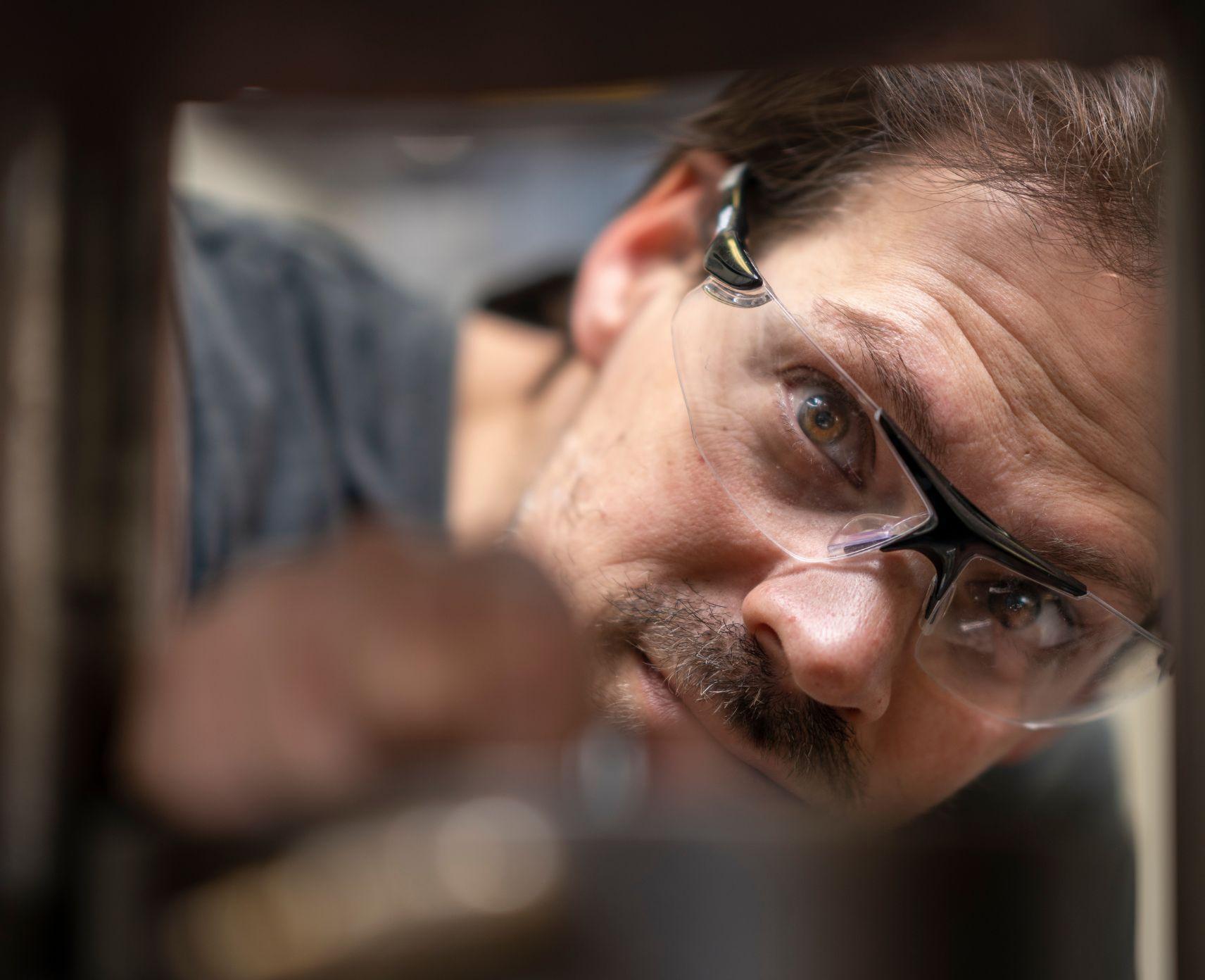
Top photo: ARC Industry Fellow Dr Michael Anenburg’s research focuses on magmatic-hydrothermal processes that lead to the formation of ore deposits. Photo: Jamie Kidston/ANU
Featured experts

Contact the media team
You may also like
Broadband fibre turned earthquake sensor gives sharpest view inside the Alpine Fault
A telecommunications fibre-optic cable has given researchers an unprecedented view inside New Zealand’s Alpine Fault revealing its internal structure.
A biologist’s voyage to protect future seas
Associate Professor Ana Sequeira has spent much of her career tracking ocean giants and leading a global project to reveal where marine megafauna need the most protection. Now her work is set to feature in the finale of Blue Planet III narrated by Sir David Attenborough.
ANU receives Google funding to boost fusion energy research with AI
ANU researchers have secured Google.org funding to use AI and advanced computing to accelerate fusion energy research.