
A biologist’s voyage to protect future seas
Associate Professor Ana Sequeira has spent much of her career tracking ocean giants and leading a global project to reveal where marine megafauna need the most protection. Now her work is set to feature in the finale of Blue Planet III narrated by Sir David Attenborough.
Article by:

Amanda Cox
Contributing writer
The BBC’s latest nature series will feature a scientist from The Australian National University (ANU) and her work mapping migrations of the world’s ocean giants.
“Seeing years of fieldwork and research brought to life on the Blue Planet series is an incredibly rewarding experience,” says Associate Professor Ana Sequeira.
“And to have Sir David Attenborough say my name when narrating my section was something that I never imagined would happen.”
The biologist’s work researching and protecting marine megafauna will feature on Blue Planet III, the latest instalment of the series, produced by the acclaimed BBC Studios Natural History Unit, that first transformed audiences’ understanding of life beneath the waves twenty-five years ago.
It’s a dream come true for Associate Professor Sequeira, whose passion for marine life led her to found MegaMove, an international research collaboration uncovering the hidden highways that ocean giants use to crisscross the globe.
“We are trying to halt human-induced extinction of marine species. That’s one of the main goals,” she explains.
When the final episode of Blue Planet III premieres on 6 December, her passion for marine conservation research will reach millions of people.
“It is great to be recognised at this level and to think about where the episode can take the work that I do,” she says.
The episode featuring Associate Professor Sequeira explores the immense challenges facing our ocean, and the people around the world helping it recover. Before broadcast, it was previewed by delegates at the 2026 United Nations (UN) Climate Change Conference (COP31) in the UK Pavilion.

“It’s fantastic to see our work represented in an episode titled Future Seas because it highlights how much human activities are encroaching on the ocean as well,” says Associate Professor Sequeira, who also has an adjunct position at The University of Western Australia.
“As a global community, we need to think about the living beings already living in the ocean that we need to conserve and protect. It’s encouraging to know that Blue Planet III is going to end with an episode that is dedicated to the future and is creating that awareness.”
This isn’t Sir David Attenborough’s first association with ANU. In 1996, he opened the Gould Wing of the Division of Botany and Zoology, now part of the ANU Research School of Biology, where Associate Professor Sequeira works.
“I think he’s a person that a lot of people look up to and he’s definitely an icon in anything related to nature and the beauty of the oceans, and all ecosystems on Earth,” she says.

Working in the ocean
Associate Professor Sequeira says the BBC Studios Natural History Unit crew share Sir David Attenborough’s respect and admiration for nature.
When working in the open ocean, she says everyone is focused on ensuring the animals can go about their daily lives with as little interference as possible.
Working ethically in this way is also a guiding principle for Associate Professor Sequeira, who has spent a good part of her career working with, and tagging, marine animals.
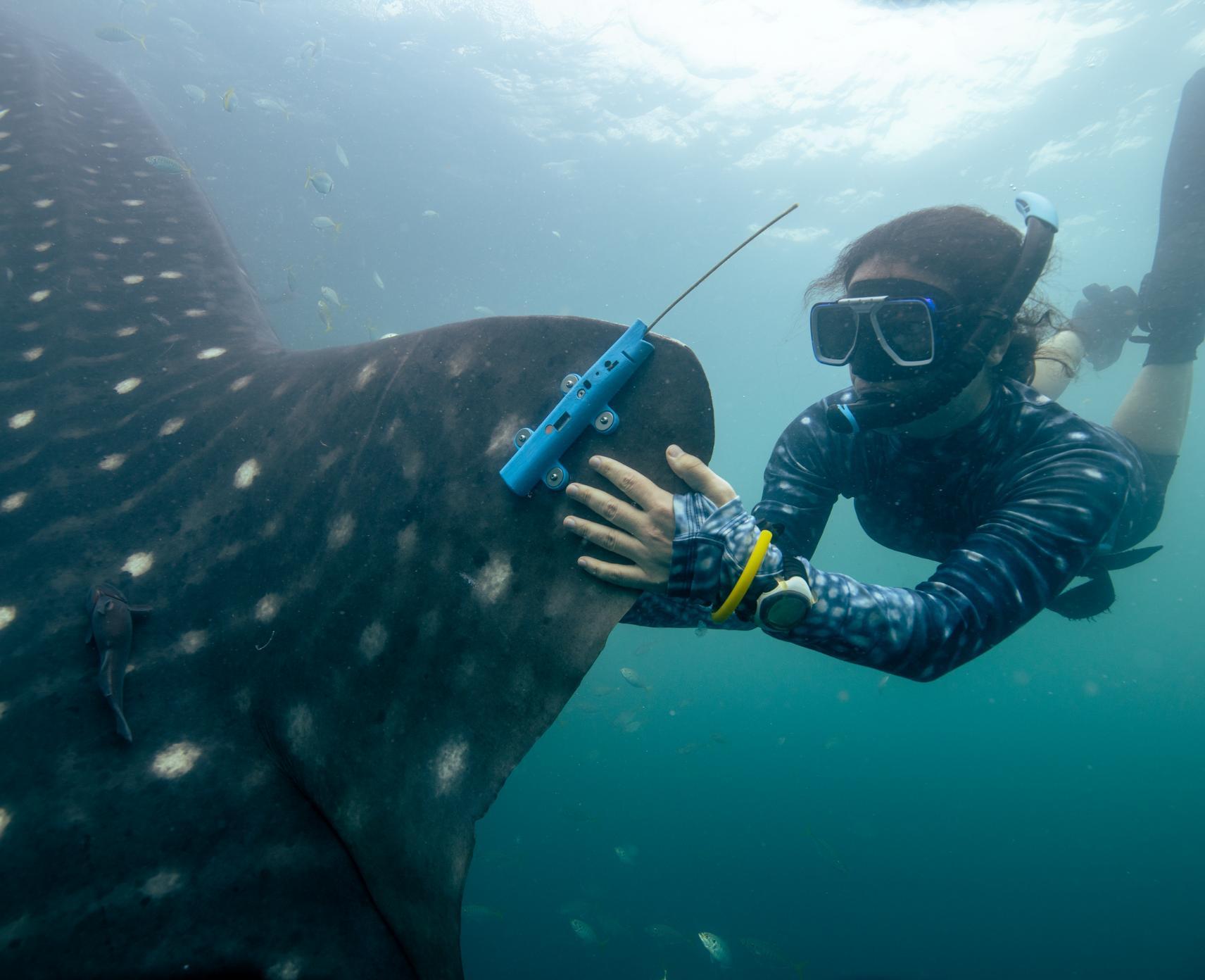
As project director of the Gathaagudu Animal Tracking (GAT) Project, she worked with teams on small boats in Shark Bay, Western Australia, to quickly attach location trackers to sharks, green turtles and dugongs.
“Once the timing is right, we bring the animal close to the boat. Like a pit stop, everyone knows exactly what they’re doing, and we get it done,” she says.

“To do this work in the field, to go out and find these animals, catch them, tag them, and then release them, of course, it can sometimes be quite high adrenaline,” she says.
“When the animal is released safely, and everything went well, it’s always such a moment of happiness. It’s just a fantastic feeling.”
Associate Professor Sequeira has successfully tagged dozens of sharks, turtles and dugongs in the World Heritage-listed Shark Bay.
“We see a lot of green turtles in this location,” she says.
After the team finds a turtle, they gently place a tracking device on the turtle’s back.
“The reason why we do all of this is to get that track, that path that the animal follows,” says Associate Professor Sequeira.
“A lot of the space that the animals use for important behaviours do overlap with human activities.”
Associate Professor Sequeira has had a lifelong fascination with the ocean. When she was young, she was passionate about how animals moved underwater.
“It’s really something that has always fascinated me,” she says. “I think it brings such feelings of freedom, if you can just be underwater and go wherever you would like.”

That passion led her to learn more about our ocean’s giants to protect them.
Such a massive mission requires a colossal team. Since the founding of MegaMove in 2020, almost 400 scientists from over 50 countries have contributed to the UN-endorsed project.
Together, they have collated tracking data for 111 migratory marine species across vast oceans and international borders.
“Most of the species that we study in MegaMove are species that move very large distances in the ocean, and we’re talking about thousands of kilometres for some of them,” she says.
Mapping the ocean’s megafauna highways
In 2025, MegaMove published a landmark study in Science, identifying the most critical locations in our global oceans for better marine conservation efforts. With 377 authors, the paper reflects the sheer size of this collaboration.
In total, the global team analysed tracks from more than 12,000 individual animals, spanning three decades’ worth of data.
The study found that about two-thirds of the ocean is space these animals use for migratory corridors or areas where they feed, rest and breed. More than 96 per cent of these important areas overlap with threats such as plastic pollution, shipping and ocean warming.
The species being tracked range from the largest animal ever to live on Earth, the blue whale, to the aptly named little penguin, standing just 30 to 35 cm tall.
Despite their differences, the animals studied all rely on the ocean, with many covering great distances in search of space, habitat and food.
“Within the ocean, marine megafauna have very important roles,” says Associate Professor Sequeira. “Many of them are at the top of the trophic chain, so they are top predators and can keep the ecosystem in check.
“As sentinel species, they can let us know if something is wrong.”
Tracking whether these animals are thriving or barely surviving provides clues to the health of broader ecosystems.

The world’s ocean giants are under threat
About a third of the ocean’s highly migratory species are now at risk of extinction.
“This includes 37 per cent of sharks and rays, 31 per cent of seabirds, about 27 per cent of marine mammals, and six out of the seven sea turtles,” she says.
“There is a need for us to understand what is happening. Which is why we are interested in understanding how animals use space in the ocean, particularly knowing that human threats have a direct impact on these species.”
Many human activities have a global footprint in the ocean. Fishing, shipping, plastic pollution, ocean warming due to climate change, and noise pollution all contribute to species decline.
Associate Professor Sequeira has seen the impacts of climate change up close.
“The place where I tend to go the most with my team is Shark Bay in Western Australia, which has been labelled as a catastrophic risk from climate change, and there’s this high risk of having heatwaves in the system.
“There was a heatwave in 2011 that decimated much of the seagrass in the system, leading to a clear change in the way the animals behaved, including decreases in sightings for many of the turtles and the dugongs in that location.”
Other human impacts are more direct.
Marine megafauna are often caught as bycatch by industrial fishing. Collisions with ships are also common.
“I remember working in Ningaloo Reef with whale sharks and seeing animals carrying severe propeller injuries across their bodies,” she says. “Some of the wounds looked fresh, indicating recent collisions with boats.”
Marine plastics also pose a complicated threat.
Associate Professor Sequeira says animals, including birds and other species, can mistake plastic for food.
“Plastic pollution is so pervasive now in the oceans. It is a tricky one to understand because, as this plastic degrades with time, it ends up being microplastic.”

Protecting our global oceans
MegaMove provides a powerful evidence base, showing where important areas occur and helping inform international policy.
“The more information we have from the movement patterns of these animals, the more complete the picture we get from areas that they use, and for what reasons they use them,” she says.
Globally, change is coming.
The 30 by 30 target, agreed under the Kunming-Montreal Global Biodiversity Framework, aims to protect 30 per cent of land, water and seas by 2030.
The catch? About two-thirds of the world’s oceans fall within international waters, where there was no legal way to create protected areas until recently.
The new High Seas Treaty, also known as the BBNJ agreement, provides a mechanism to establish marine protected areas outside national borders.
Australia was one of the first countries to sign the treaty in 2023 and passed legislation in March 2026 to ratify it in September 2026, joining more than 100 countries.
“It’s a fantastic outcome that the treaty has come into force, and that enough countries around the world, including Australia, have signed up,” she says.
However, according to Associate Professor Sequeira, 30 per cent is not enough to protect all the important space for these migratory species.
“It can protect a good amount of important areas,” she says. “The main question is where could that 30 per cent be to create important outcomes for biodiversity conservation. That’s what MegaMove has specifically addressed.”
Alongside indicating which marine areas should be protected, MegaMove also recommends additional conservation methods – such as slow-down areas for shipping and modifying commercial fishing equipment – to provide enough protection for these migratory species.

Greater marine protection will benefit us as well.
“Having a healthy ocean is absolutely essential for us as humans living on planet Earth,” she says.
“It’s one of our major life support systems. It regulates temperature; it helps with the air for us to breathe. It has resources that we can use for food and is important for other industries as well.”
Reflecting on what we can all do as individuals, Associate Professor Sequeira hopes more people can understand what she is seeing in the global ocean.
“It would be fantastic if people could have even just a glimpse of how these animals are just trying to go about their lives, trying to find their feed for the day, trying to, some of them, take care of their young,” she says.
“My hope for the future is that we humans start understanding how we can share the ocean space with the animals. There is a way to do this in a more sustainable way.”
Blue Planet III, Episode 6, Future Seas, is airing in the UK on Sunday 6 December on BBC One. Australian release dates are yet to be announced.
This post has been republished from the ANU College of Science and Medicine. Read the original article here.
Top image: Associate Professor Sequeira attaching a tracking device to a whale shark. Photo: BBC Studios/ Mark Sharman
Featured experts

You may also like
Seeding the future of barley for higher yields and greater stress tolerance
The evolution of barley has been uncovered by a team of international scientists, including from ANU, revealing key genes influencing flowering, adaptation and grain yield.
ANU receives Google funding to boost fusion energy research with AI
ANU researchers have secured Google.org funding to use AI and advanced computing to accelerate fusion energy research.
ANU Rocketry reaches new heights with national competition win
After months of design, testing and preparation, ANU students have soared to victory at the 2026 Australian Universities Rocket Competition.