
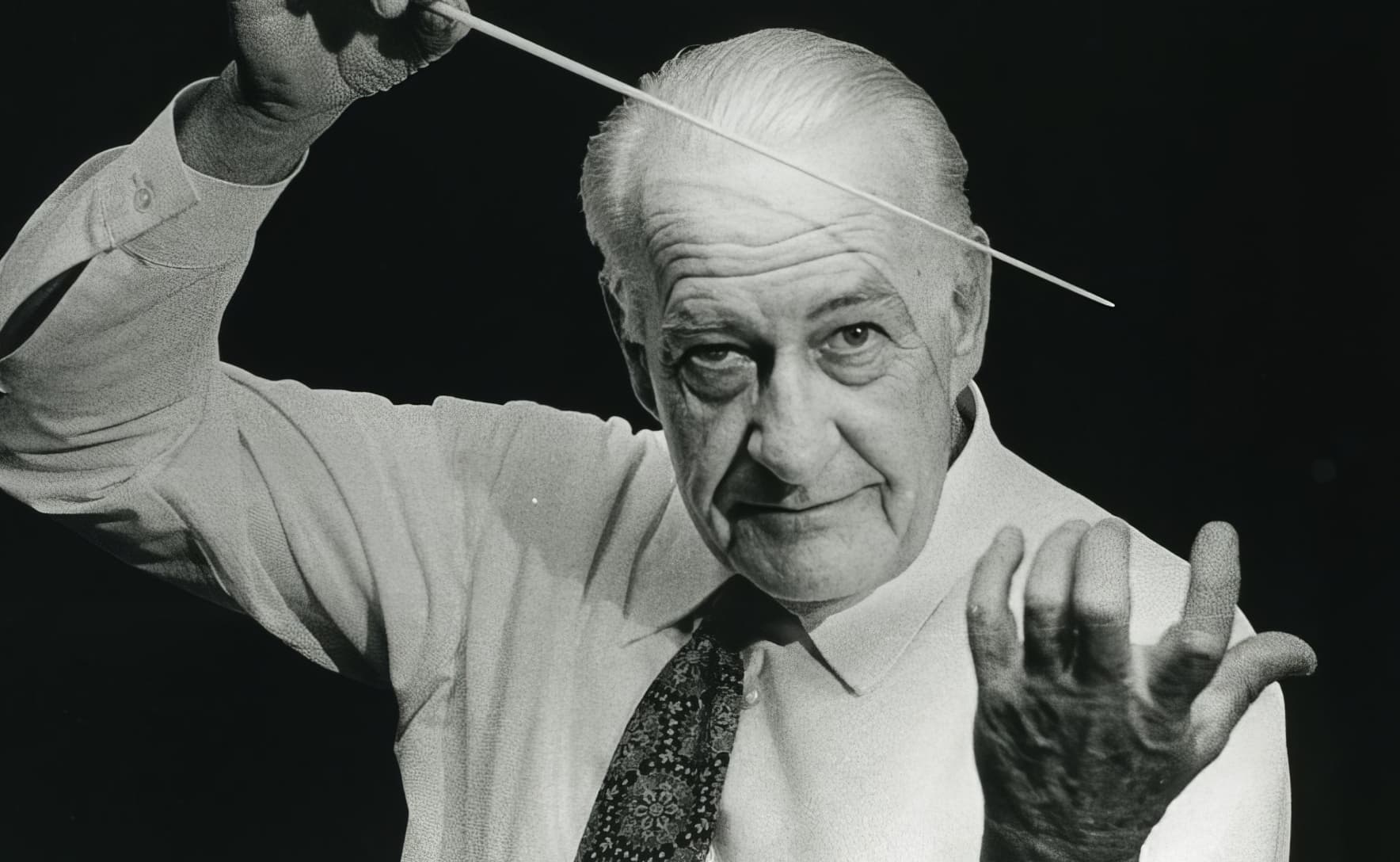
Remembering Ernie: the man behind Llewellyn Hall
As Llewellyn Hall marks its 50th anniversary, Emeritus Professor Larry Sitsky reflects on the musician and friend for whom the hall is named.
Article by:

Cecilia Millar-Rakisits
Contributing writer
Ernest Llewellyn, conductor, violinist and concertmaster, has come to be celebrated as a grand institutional figure. But to Emeritus Professor Larry Sitsky, Ernest is fondly remembered as his friend and fellow collaborator, Ernie.
For 50 years, musicians have performed, audiences have gathered, and graduation ceremonies have been held in what is now one of the most significant concert halls in Canberra: Llewellyn Hall.
At 92, Larry has had a phenomenal career as a pianist, composer, teacher and scholar. Through his work he has undoubtedly made his mark on the Australian music scene and touched countless lives. But what is evident when speaking to him, is how much Ernie touched his life.
An unexpected beginning
Larry came to Canberra in 1966 to work alongside Ernie at the newly established Canberra School of Music.
He was teaching in Brisbane when a recording of him accompanying another musician hoping to land a job at the School was sent to Ernie, the School’s founding director.
“Ernie said, ‘Thank you for sending all that. By the way, who’s the pianist on your tape?’” Larry recalls. “That’s how I got the invitation to come here.”
Ernie flew Larry and his wife, Magda, to Canberra, showed them around the young city, sharing with them his plans for the then Canberra School of Music. Larry joined as Head of Keyboard Studies, becoming part of a core group of musicians that Ernie had chosen to help bring his vision of high-level performance and musical practice to life.
“He handpicked the foundation staff. He never put on airs. That’s how he gathered people, it was all on a personal level.”

A down-to-earth man
Born in 1915 in Kurri Kurri, a small town in the Hunter Region of New South Wales, into a coal-mining family, Ernie’s beginnings were humble. But by age seven, he was learning the violin, soon going on to win prizes at musical competitions.
Ernie went on to become one of Australia’s leading musicians, serving as Concertmaster for the Sydney Symphony Orchestra and performing as a soloist, chamber musician and conductor.
Despite his success and achievements, Larry remembers a man who remained firmly rooted in his beginnings.
“Ernie was very down to earth,” he says.
“He had a farm outside Mittagong, and quite often on the weekend he would drive there to plant things and look after the cattle.”
Over time, the two men’s relationship extended well beyond the Canberra School of Music. Ernie and his wife Ruth often welcomed Larry and Magda into their home, and Magda and Ruth developed a close friendship of their own. The four spent a lot of time together over the years, not simply as musical colleagues and their spouses, but as friends.
Larry also remembers Ernie as someone with an occasionally daring personality.
On a drive to Mittagong one day, Ernie overtook a slow-moving car on a two-lane road, apparently without being able to see if another car was coming in the other direction.
“I said, ‘Ernie, how did you know there was no one coming in the other lane?’” Larry recalls.
“He said, ‘Oh, I’ve got a sixth sense about such things.’ And I thought, mate, I’m never getting into a car with you again.”
And he never did.

A violin tucked under his arm
Larry admits that he and Ernie did not always agree, as is so often the case for creatives with set visions of how their art should be delivered. Both were strong-minded musicians, and their different backgrounds shaped their varying ideas about how music should be taught or how an institution should be run.
But when they stepped onto the stage together, any differences fell away.
“I was happiest with Ernie when he had a violin tucked under his arm and I was following him onto the platform,” Larry says.
“Playing with him, I felt very comfortable. He was a big-tone, romantic-style player, and he wanted someone who had a big temperament and would support his sound.”
For all of Ernie’s responsibilities as director, Larry believes music remained the place where he felt most at home.

‘There seemed to be no limit’
Ernie’s ambitions for music in Canberra were bold. After studying in New York at the Juilliard School in the 1950s, he returned to Australia with a vision for a centre of musical education and performance worthy of the national capital.
“His dream was to have a Juilliard of the Southern Hemisphere here in Canberra,” Larry says.
In its early years, the Canberra School of Music operated from temporary premises in Manuka. The city was still small, under 100,000 people, but Larry remembers a strong sense of optimism and possibility.
“When we started, there seemed to be no actual limit to what could happen in Canberra,” he says.
“Since we were in the nation’s capital, we could establish something that would be a kind of model for the rest of the country.”
That vision eventually became the purpose-built music building that opened on 24 September 1976. Its auditorium was renamed Llewellyn Hall in Ernie’s honour in 1980, when he retired as Director of the Canberra School of Music.

Larry was among the first pianists to perform on its stage. After years of playing in spaces he felt were not designed for music, the difference was immediate.
“I loved the reverberation time because the sound has space to grow and blossom in the hall itself. It was lovely to play in. It always has been.”
Fifty years after the hall opened, Larry’s memories bring its namesake to centre stage. Not as a distant institutional figure, but as Ernie: the down-to-earth, ambitious, and sometimes daring man, with a violin tucked under his arm, and his friend following him to the piano.
In the decades since, generations of musicians have followed them onto that stage – learning, rehearsing and performing in the space Ernie dreamt into being.
Every year, a new cohort of students becomes part of the musical community he set out to create: one built through collaboration, friendship and the shared experience of stepping onto that stage.
Ernie Llewellyn. Photo: ANU Archives
You may also like
One historian, centuries of gossip and a fresh look at Ancient Rome
What did ordinary Romans really think of their rulers? Professor Caillan Davenport’s new book draws on juicy rumours and gossip to reveal the answer.
Forget potato scallops and potato cakes – the Australian National Dictionary is on the hunt for Australia’s hidden regional words
From dardy to turbo chook, ANU is calling on Australians to uncover the colourful local words and phrases that make our regional vocabulary unique.

New national survey asks Australians to help map the nation’s languages
A new national survey is inviting multilingual Australians to help researchers build a clearer picture of the languages spoken and signed across the country.