
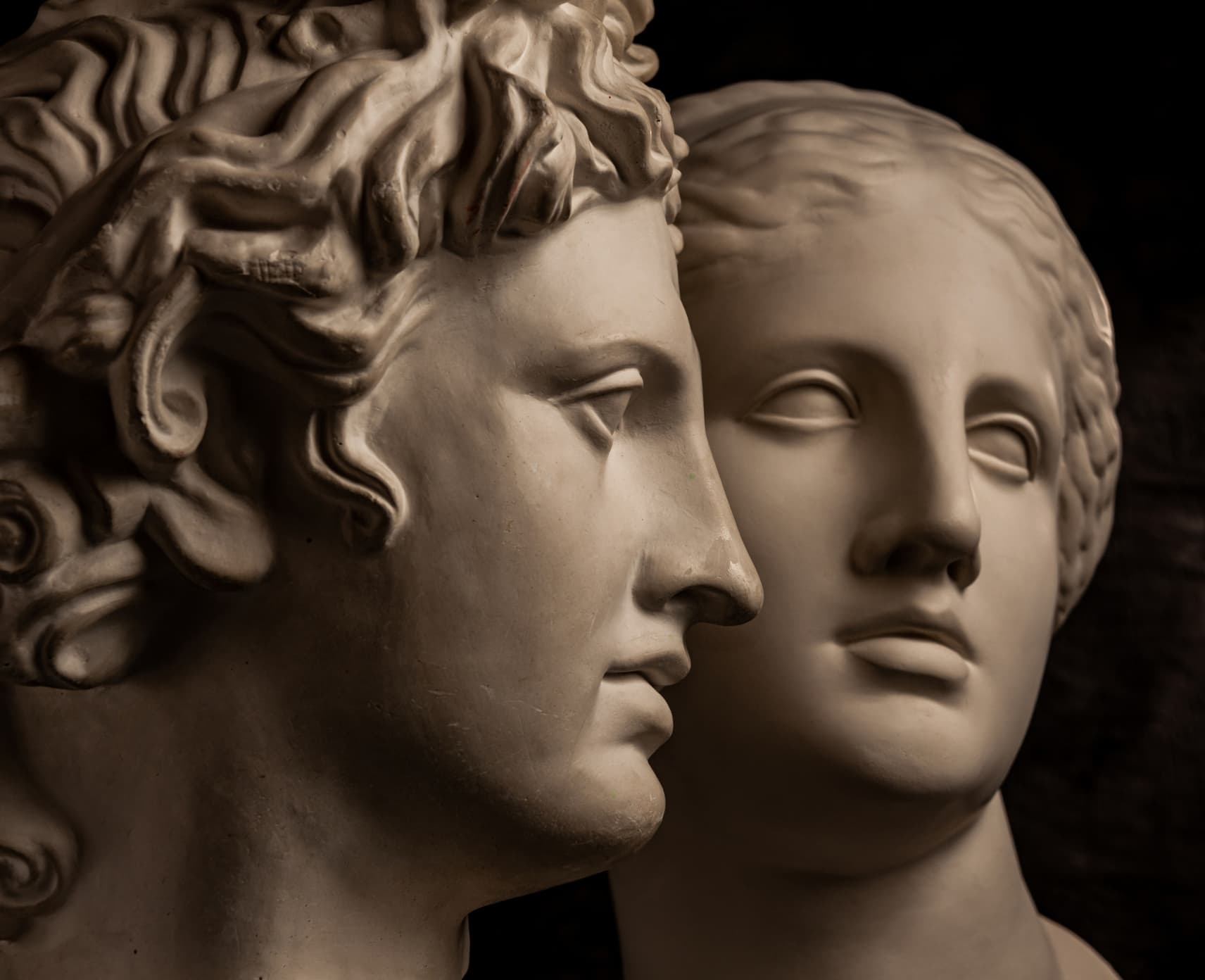
One historian, centuries of gossip and a fresh look at Ancient Rome
What did ordinary Romans really think of their rulers? Professor Caillan Davenport’s new book draws on juicy rumours and gossip to reveal the answer.
Article by:

Luis Perez
Contributing writer
Imagine an emperor secretly dressing as a woman to perform on stage before a large crowd. Or, more scandalously, finding himself at the centre of a love triangle involving his friend’s wife.
This isn’t the plot of a new Netflix period drama, but the actual stories of rumour and gossip that circulated through the taverns, markets and crowded streets of ancient Rome thousands of years ago.
Just as we today obsess over celebrities’ break-ups and dating news, everyday Romans gossiped about their emperors with equal enthusiasm.
“Gossip and rumour are often dismissed as flights of fancy. But as frivolous as they may seem, they are an important form of evidence that reveals what people cared about at the time,” says ANU historian Caillan Davenport.

His new book, Behind Caesar’s Back: Rumor, Gossip, and the Making of the Roman Emperors, explores what the populace thought about the men who governed their world, from Augustus, Rome’s first emperor, to the reign of Heraclius 700 years later.
Drawing on an extraordinary range of historical evidence such as letters, public chants and graffiti, Davenport brings to life the hopes, fears and opinions of those who inhabited the ancient Mediterranean world.
A juicy, dangerous game
Many will remember Commodus – the tyrannical emperor brought to life by Joaquin Phoenix in Gladiator.
According to Davenport, rumour has it the real historical character wanted to dress up as Hercules and fire arrows at spectators in the Colosseum.
“Because of this, people didn’t want to go there,” he says. “The outlandish behaviour of Roman emperors was not something to be dismissed. They actually caused real fear in the populace.”
Through his book’s research, Davenport is able to uncover what truly kept everyday Romans up at night.
“Rumours often tapped into human safety and security,” he says.
“Stories circulated about emperors’ premature deaths or succession crises. Such rumours were linked to the idea of civil war, with all the disruption that entailed: armies marching across the countryside, ports blockaded and people’s sons being sent off to fight.
“All things that affected ordinary people.”
A different strain of rumour relied on ridicule and satire. Among them, the salacious claim that a young Emperor Augustus had been the receiving partner in a sexual encounter with a powerful general.
“Sexual rumours would go into quite a lot of detail: who people had sex with and in what positions,” Davenport says.
“On the one hand, this was a way of cutting them down to size when they were represented as gods. On the other, it reflected people’s assessment of their fitness to rule.”
By stripping emperors of their virility, smears – which were often spread by senators and rivals – laid bare the brutally personal nature of Roman political culture.
And despite its modern reputation as a predominantly female pastime, men gossiped just as enthusiastically as women.
“Barbershops, taverns and other male-coded spaces were a particular haven for gossip in the ancient world,” says Davenport. “It was not necessarily something done by the stereotypical fishwife.”
Emperors, aware of what was being said behind their backs, responded in very different ways.
“Some would rebut their critics through pamphlets. Others would send in the army to cut down the populace. It really depended on their temperament,” Davenport says.
“It was, without a doubt, a dangerous game.”

The science behind gossip and rumour
Studying the whispers that surrounded Rome’s emperors led Davenport to consider the deeper significance of seemingly trivial acts such as rumouring and gossiping.
“It led me into anthropological and sociological studies that have demonstrated the important role rumour and gossip play in revealing human mentalities,” he says.
Those studies also showed Davenport the difference between the two.
“Rumour is about unverified news that emerge when people don’t have the full facts or when they don’t trust the information they’re getting,” he says.
“It’s a way to make sense of what’s happening and help people plan for the future.”
Gossip serves a different purpose. Rather than filling gaps in knowledge, it is a way of evaluating those around us – positively or negatively.
“It’s something that can make people bond when they’re at a pub or getting a haircut. But also establishes community expectations about appropriate behaviour,” says Davenport.
A cautionary tale
In AD 39, ancient sources claim Caligula ordered the construction of an extraordinary monument: a three-mile bridge made from ships stretching across the Bay of Naples between Baiae and Puteoli.
Once it was completed, the Emperor staged an elaborate procession across it, riding over the bay while wearing – some claim – the breastplate of Alexander the Great in an unhinged display of power and authority.
The feat was less an engineering necessity than an exercise in political theatre. As Davenport notes, Caligula had no military triumph to celebrate.
“It was all about the pageantry of power. We can laugh at some of these stories, because they seem absurd. But a lot of modern political performance is also absurd,” he says.
A few months ago, amid extreme political polarisation and a war with Iran, Donald Trump celebrated America’s 250th birthday by building a 92ft-tall steel arena at the White House lawn to host an Ultimate Fighting Championship (UFC) event.
“Fifteen years ago, it would have been inconceivable for an American president to behave like that. Yet every day we see more outlandish things. Modern politics has made me rethink the ancient world,” says Davenport.
Both in antiquity and today, leaders have always given their subjects something to talk about. While it is impossible to read the mind of an emperor or a president, Davenport’s work is proof that we can read something just as revealing: the mind of society itself.
“What we gossip about is a barometer of the way society is going – a representation of our values,” he says.
“People who gossip about Donald Trump positively do it because what he says resonates with them.
“If something that should be unacceptable is actually becoming acceptable in some quarters, that’s a sign that society’s values are changing.”
Chasing whispers across time
The ability to reach across two millennia and reconstruct how ordinary people thought, talked and understood the world is not a skill many possess.
For Davenport, it began with trips to castles and cathedrals while growing up in England. History was very much his childhood obsession.
“I always wanted to learn Latin so I could read Magna Carta in the originals,” he says.
That ambition turned out to be essential. Without a command of the language of ancient Rome, Davenport could never have read the inscriptions and papyri that form the backbone of Behind Caesar’s Back.
The research and writing spanned twelve years and some of the most significant chapters of his life, including getting married and having kids.
It also required painstaking detective work and an extraordinary amount of patience to complete.
“I could spend most of the day reading the pages of sermons and letter collections without finding anything of interest,” Davenport says.
What kept him going was something that has long fascinated him as an historian: not what happened, but why.
“I’m less interested in appreciating stories for their aesthetic value. I always want to know the reasons and causes,” he says.
The rumours and gossip of the ancient world are entertaining, often bizarre and occasionally hilarious, but the ANU scholar sees them as something more than that.
“There’s a serious side to them that helps us decode what mattered to people,” Davenport says.
“They also show us that politics didn’t only happen behind palace walls. Those at the bottom of the social hierarchy had political thoughts and opinions too.”
Image: Ded Pixto/Adobe Stock
Related tags:
You may also like
Forget potato scallops and potato cakes – the Australian National Dictionary is on the hunt for Australia’s hidden regional words
From dardy to turbo chook, ANU is calling on Australians to uncover the colourful local words and phrases that make our regional vocabulary unique.

New national survey asks Australians to help map the nation’s languages
A new national survey is inviting multilingual Australians to help researchers build a clearer picture of the languages spoken and signed across the country.

Is AI conscious or just very good at sounding human?
Artificial Intelligence (AI) systems can now hold conversations that feel remarkably human. Professor Colin Klein says that feeling reveals more about us than it does about the machines.