
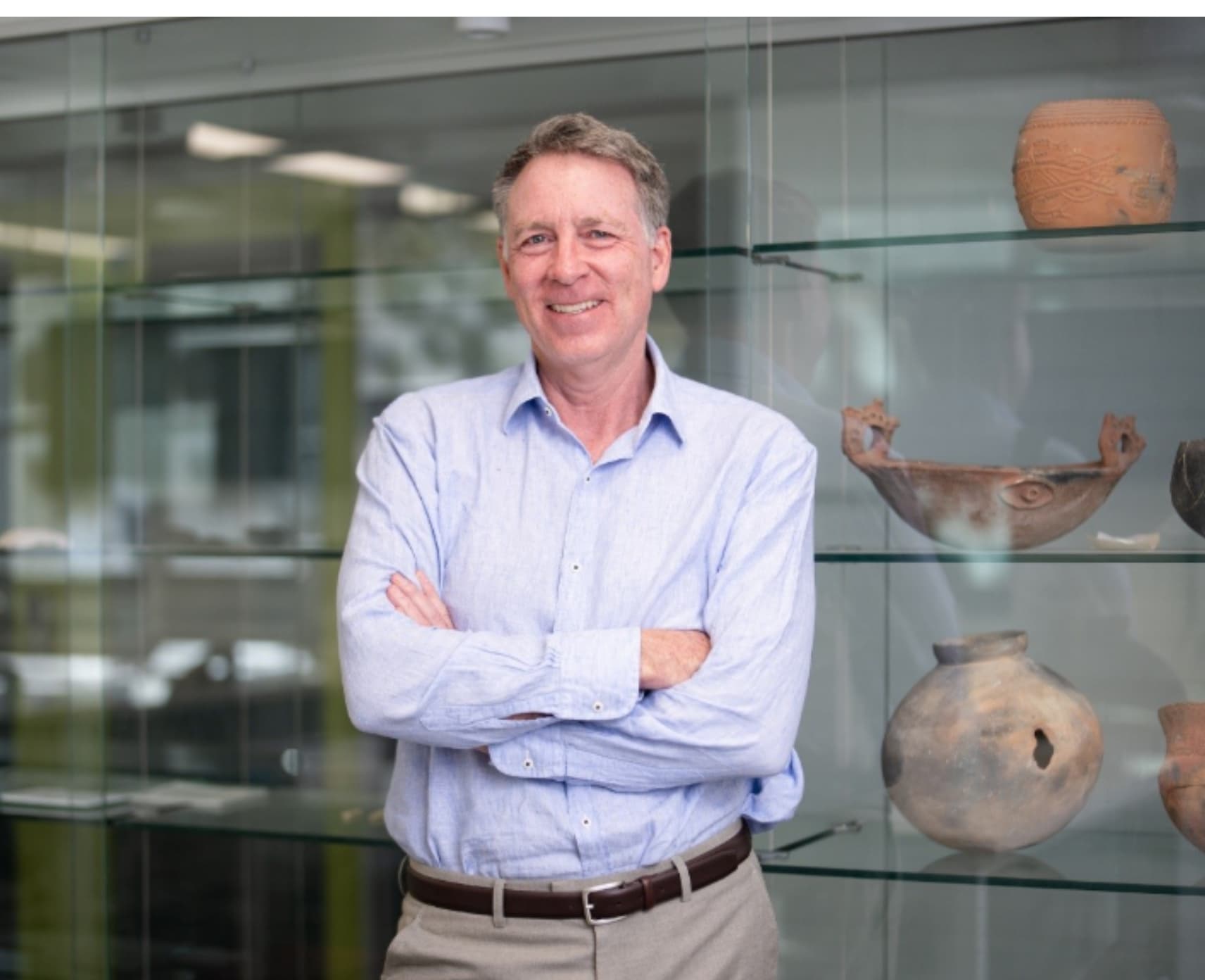
The archaeologist unearthing a new chapter in the history of Southeast Asia
Professor Dougald O’Reilly’s new book breathes life into the prehistoric pasts of Myanmar, Malaysia, Indonesia, Cambodia, Thailand and Vietnam.
Article by:

Luis Perez
Contributing writer
Few people get to live out their childhood dreams. Professor Dougald O’Reilly is among the lucky ones.
It became clear during one of the hardest moments of his life, while packing up his family home in Toronto after his mother’s passing.
Among the boxes and keepsakes, O’Reilly came across a drawing he had made as a five-year-old.
“It was a self-portrait of me with a little shovel digging at the Sphinx,” he says.
For the now Professor of Archaeology at The Australian National University (ANU), this was a poignant reminder of how his parents had nurtured his fascination with history.
“I remember my dad used to go to flea markets and find old native American arrowheads for me,” he says.
The kid digging holes in his mother’s backyard eventually grew into one of Australia’s leading archaeologists specialising on Southeast Asia.
Over decades, O’Reilly has worked at breathtaking sites across the region, including inside the walls of Angkor Wat – the world’s largest religious monument – and in the mysterious Plain of Jars.
He says his job is far removed from the fedora-and-whip stereotype popularised by Hollywood. But not without its dangers.
Many sites across Cambodia, Laos and Vietnam remain scarred by war – with unexploded landmines and ordnance strewn across forests, fields and villages.
“Some are nearly impossible to detect,” he says. “Archaeologists need to be cognisant of these dangers and rely very heavily on local knowledge.”
In the early 2000s, while excavating in northwestern Cambodia, O’Reilly found the remains of a young boy believed to be a victim of the Khmer Rouge.
“He still had his clothes on and was wrapped in a mat,” he says.
“The remains were reported to the Documentation Center of Cambodia, which records atrocities committed under the regime.”
Archaeology has brought O’Reilly face-to-face not only with ancient history, but with the still-open wounds of the recent past.
After a lifetime of fieldwork, he has now distilled decades of research into his new book, Empires of the Southern Ocean, which offers an account of the poorly understood prehistoric societies of mainland and insular Southeast Asia.
In reconstructing the rise and fall of these forgotten civilisations, he is shedding light on a region that has long shaped Australia’s place in the world.
Decolonising history
It doesn’t take a history geek to recognise great civilisations such as ancient Greece or Egypt.
But far fewer people are familiar with the prehistories of places like Myanmar, Thailand, Laos or Cambodia.
“How Southeast Asia was populated, and how those societies became more complex through time and developed their own characteristics, is something that is really only being teased out in the last 60 years,” O’Reilly says.
For a long time, it was believed early Southeast Asian societies evolved under India’s colonial dominance, with their political systems and cultures viewed as imported rather than locally developed.
In his new book, O’Reilly challenges this theory.
“There is no doubt Southeast Asia was profoundly impacted by India’s culture, language, laws and arts,” he says.
“But the idea that this was imposed is a fallacy. Archaeological research demonstrates Southeast Asian peoples were already culturally complex by the time they came into contact with South Asia.
“Rather than imposed, they adopted the things they wanted from India to enhance their own positions politically.”

Piecing together how societies were politically organised thousands of years ago, long before written records, is no simple task.
Much of what we know comes from the dead.
By excavating burial sites and comparing graves across large areas, archaeologists can trace patterns of wealth and power.
“If people were buried with a large number of goods, they probably held authority or a special place in that society,” O’Reilly says.
Mortuary assemblages and other clues such as differences in house sizes have helped O’Reilly argue many prehistoric Southeast Asian societies had developed into complex chiefdoms before Indian and Chinese traders arrived.
When those outside forces eventually entered the scene, local elites did not simply yield to them.
They used Hinduism and Buddhism to legitimise their power, ultimately evolving into more sophisticated, state level societies with connections to global trade and diplomatic networks.
“We’ve found incredible artefacts in the region such as coins with Marcus Aurelius’s head on them. This provides amazing evidence of globalised trade in the old world and highlights Southeast Asia as a key stopping point along major trade routes such as the Silk Road,” he says.
The book is a must read for anyone seeking to make sense of the region today.
“You can’t understand the present without understanding how it came to be formed. A lot can be learned from how these robust societies weathered cultural, climatic and economic changes to become integrated over time,” he says.

Keeping history in safe hands
Humanity has often been its own worst archivist.
In 2000, ruthless looters descended on one of Cambodia’s most important prehistoric burial grounds, Phum Snay.
Snatching its rich ceramics, iron weapons and gold jewellery, the damage was irreparable, having a vicious ripple effect across the country.
“Rural Cambodia is quite impoverished, and people began to look under their own houses, and in their own agricultural fields for similar burials, which sparked off a massive frenzy of looting,” O’Reilly explains.
“Local people were selling what they found to dealers from across the border in Thailand, with artefacts ending up on the black market in Bangkok.”
O’Reilly, who was living in Cambodia at the time while working for UNESCO at the Royal University of Fine Arts, could not stand by.
Alarmed by the destruction of the archaeological record, he founded Heritage Watch.
This non-for-profit organisation has since played a key role in raising awareness about the importance of preserving Cambodia’s cultural heritage, helping spur the creation of a heritage police force and promoting responsible tourism.
Today, despite ongoing fundraising challenges, its work continues through Heritage for Kids, a program aimed at educating young students.
“The program includes education packs containing a lesson plan used by teachers to highlight the issues of environmental degradation and heritage destruction and the importance of these resources to the country,” O’Reilly says.
“I would love to see it integrated into the national curriculum in Cambodia and spread to other parts of Southeast Asia.”
O’Reilly, who has fought tirelessly to keep historical artefacts out of the wrong hands, thinks the solution lies with the next generations.
“Kids are our future. If they understand our message, we can reduce the impact of heritage loss around the world,” he says.
Photo: Crystal Li/ANU

Related tags:
You may also like
Remembering Ernie: the man behind Llewellyn Hall
As Llewellyn Hall marks its 50th anniversary, Emeritus Professor Larry Sitsky reflects on the musician and friend for whom the hall is named.
One historian, centuries of gossip and a fresh look at Ancient Rome
What did ordinary Romans really think of their rulers? Professor Caillan Davenport’s new book draws on juicy rumours and gossip to reveal the answer.
Forget potato scallops and potato cakes – the Australian National Dictionary is on the hunt for Australia’s hidden regional words
From dardy to turbo chook, ANU is calling on Australians to uncover the colourful local words and phrases that make our regional vocabulary unique.