
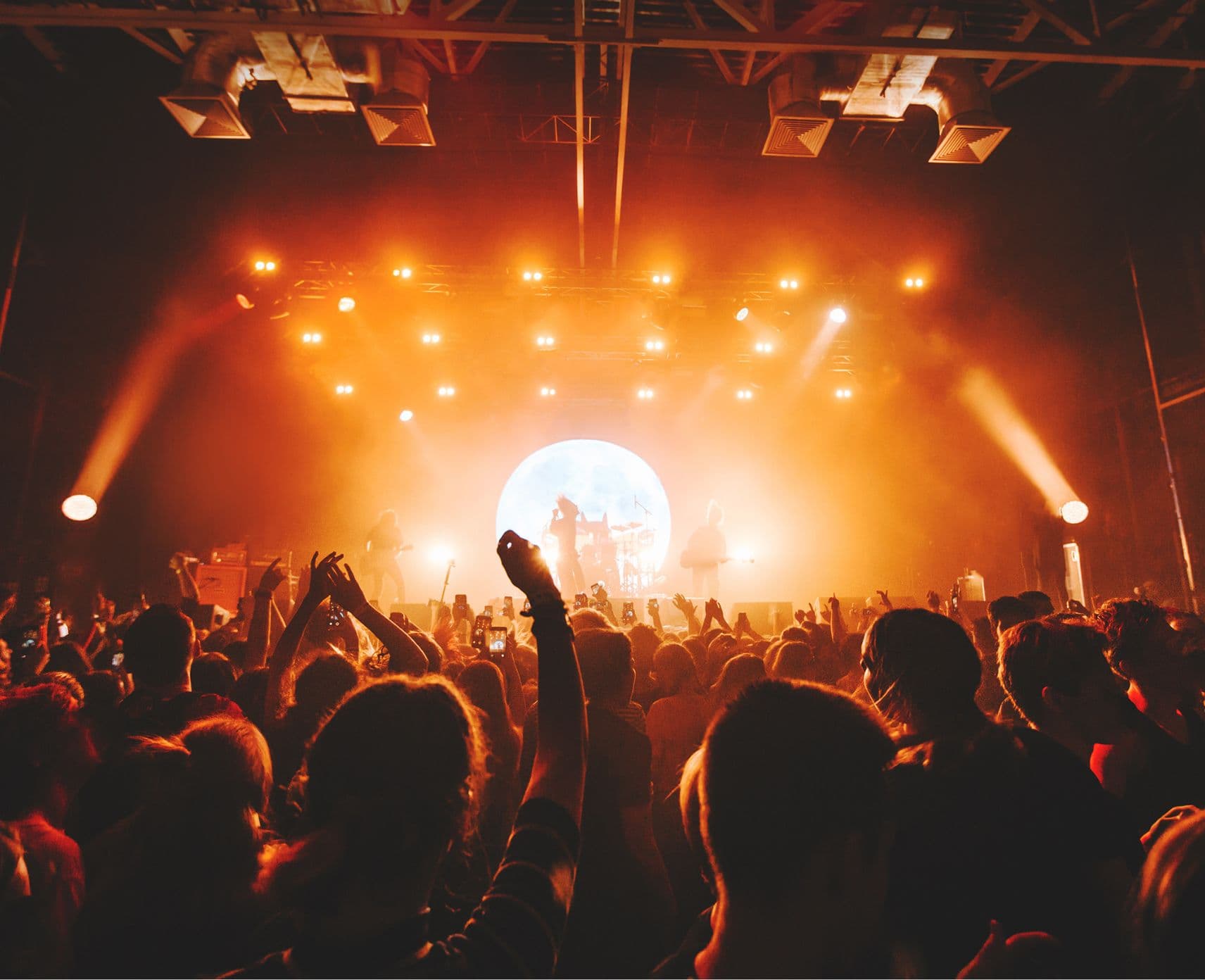
Pop concerts aren’t always safe for our ears. This researcher has a solution
The way we enjoy music can be unsafe and cause irreversible hearing damage. Dr Jos Mulder is leading the charge to prevent it.
Article by:

Luis Perez
Contributing writer
“Come, Mr DJ, won’t you turn the music up?”
When Barbadian superstar Rihanna released Pon de Replay two decades ago, the hit took over dancefloors worldwide, romanticising music so loud you could feel the bass through your sneakers.
Twenty years on, Bad Gal RiRi may have turned the page, but clubs haven’t turned down the volume – and our ears are paying the price.
Approximately 40 per cent of people aged 12 to 35 in high- and middle-income countries are today exposed to damaging sound levels in entertainment venues.
According to Dr Jos Mulder, a music and wellbeing researcher at the Australian National University (ANU) School of Music, the volume in most live music settings – such as concert halls, pubs, arenas – often exceeds safe levels, making attendees vulnerable to hearing loss.
“Humans can experience acute trauma from loud sound in a single exposure,” Mulder says.
“This is unlikely to happen in the entertainment context, but the problem is when we are exposed to dosages of loud sound for several hours, as is typical of a night out.
“When too much sound energy reaches the tiny hair cells in our cochlea for too long, they can get damaged and our ability to hear the frequencies we rely on for human speech decreases.
“At the moment, it is unlikely that pop concerts will be completely safe for our ears. We should not spend more than fifteen minutes in those environments without hearing protection, but people often spend multiple hours or even entire days,’ he says.
“Particularly for young adults, the risk emerges when the hours of exposure add up across the week through activities such as gaming with headphones, clubbing or working out in gyms where the music is cranked.”

Think twice before cranking it up
An estimated 1.35 billion young people are at risk of experiencing hearing loss worldwide, and the consequences are no laughing matter.
“Tinnitus, the ringing noise in your ears, is a very common issue. Many people experience it after a night out and for some it never stops,” says Mulder.
“Also, researchers from the US have recently discovered that hearing damage can be an early indicator of cognitive decline and diseases such as dementia – the number one cause of death in Australia.
“Living with hearing loss causes many people to withdraw from social life as it becomes hard to maintain a conversation.”
But hearing damage isn’t always obvious.
“If you struggle to follow a conversation in a noisy pub, you tend to blame the venue, not your ears,” Mulder says.
“It takes a very long time for people to go to an audiologist, and even when they do, some types of hearing damage aren’t detected easily in a standard test.
“It’s already a reality that a lot of people at a strikingly young age are having a hard time distinguishing between ‘d’ and ‘t’ or ‘p’ and ‘b’.”
A world-first solution
Mulder – a sound engineer-turned-researcher – has spent a decade trying to help tackle the pervasive risks of dangerously loud sound.
With an international, interdisciplinary team, he has recently launched HELA (Healthy Ears, Limited Annoyance), an initiative providing low-cost, online certifications to help those working in the live music industry implement safe listening practices aligned with World Health Organisation (WHO) standards.
“If you are a chef working in a restaurant you need all sorts of certificates to ensure you don’t give a thousand people food poisoning. Before HELA, there was no equivalent thing in the live music industry. Anyone trusted by the artist could show up and crank up the music,” says Mulder.
HELA is already protecting millions after being rolled out across major UK venues, including Wembley Stadium.
For the ANU researcher, this initiative is more than just turning down the decibels.
“It’s about smart sound management that benefits audiences, artists, and surrounding communities alike; education presented in a digestible way and learning how to prevent your hearing from being destroyed while doing something you love,” he says.
“There are two versions: one for general awareness to educate event staff, such as bar and security workers, and a more advanced one for audio engineers and technical managers.
“All the revenue we generate from this initiative goes back to support more research in this space.”
Once all staff have completed the training, a venue is entitled to display a HELA certified badge. This year, world-renowned rock band Biffy Clyro became the first international tour to achieve this.

Hearing health down under
In Australia, sound levels are not up to par with WHO standards and vary from state to state.
Buoyed by HELA’s success in the UK, Mulder wants to rewrite the rules down under.
“Most Australian stakeholders know that change is needed but have no idea how to realise it,” he says.
“After the Covid crisis, all the progress we had in this space fell by the wayside. Many venues are close to bankruptcy, squeezed by low revenue and rising insurance costs. Others have outdated equipment that can’t deliver accurate coverage at lower sound levels.
“When I approach politicians, they’re reluctant to place further demands on an industry still recovering from crisis.”
Mulder hopes safe listening standards will one day be met by major stadiums such as Marvel or Accor and promoted, as sustainability credentials are, before fans commit to buying a ticket.
Building awareness and getting everyone on board will take time, but progress is underway, with a HELA roll-out now being discussed in New South Wales.
Protect yourself from ‘stupid loud’
A 2025 report by Creative Australia revealed that almost half of the population attended at least one live music event in the past 12 months.
Whether indoors or out, no one is ever entirely safe from what Mulder calls “stupid loud” – sound levels that are excessively high for no reason.
While initiatives like HELA could take a decade to be fully implemented in Australia, there are easy ways to start reducing the risk today.
Above all: wearing ear protection.
Yes, old-fashioned earplugs may not be your first priority for your curated festival outfit, but your future self will thank you.
Mulder recommends reusable plugs over the traditional single-use or ‘yellow foamies’, which are often worn incorrectly and can easily pop out.
“We don’t want to create a new environmental disaster,” he says.
“Reusable plugs aren’t that expensive and can include acoustic filters that let you hear the frequencies to really enjoy the music. Some are so small they’re almost invisible.”

In countries like Switzerland and France, venues are required to provide ear protection at cost. In Australia, while far from ubiquitous, earplugs can sometimes be available on site – and usually at a modest price – making it well worth checking before a show starts.
At all times, Mulder recommends watching out for fatigue, the clearest warning sign of hearing damage.
“Using headphones is fine,” he says, “just not eight hours a day. And if you know you’re going out on Friday night, maybe give the headphones a rest during the day.”
“My last piece of advice would be to go see an audiologist regardless of your age. Getting a benchmark now will help you in the future”.
You can register to obtain a HELA certificate here: https://helainitiative.com/register
Top image: Taya Ovod/shutterstock.com
Featured experts

You may also like
Remembering Ernie: the man behind Llewellyn Hall
As Llewellyn Hall marks its 50th anniversary, Emeritus Professor Larry Sitsky reflects on the musician and friend for whom the hall is named.

One historian, centuries of gossip and a fresh look at Ancient Rome
What did ordinary Romans really think of their rulers? Professor Caillan Davenport’s new book draws on juicy rumours and gossip to reveal the answer.
Forget potato scallops and potato cakes – the Australian National Dictionary is on the hunt for Australia’s hidden regional words
From dardy to turbo chook, ANU is calling on Australians to uncover the colourful local words and phrases that make our regional vocabulary unique.