
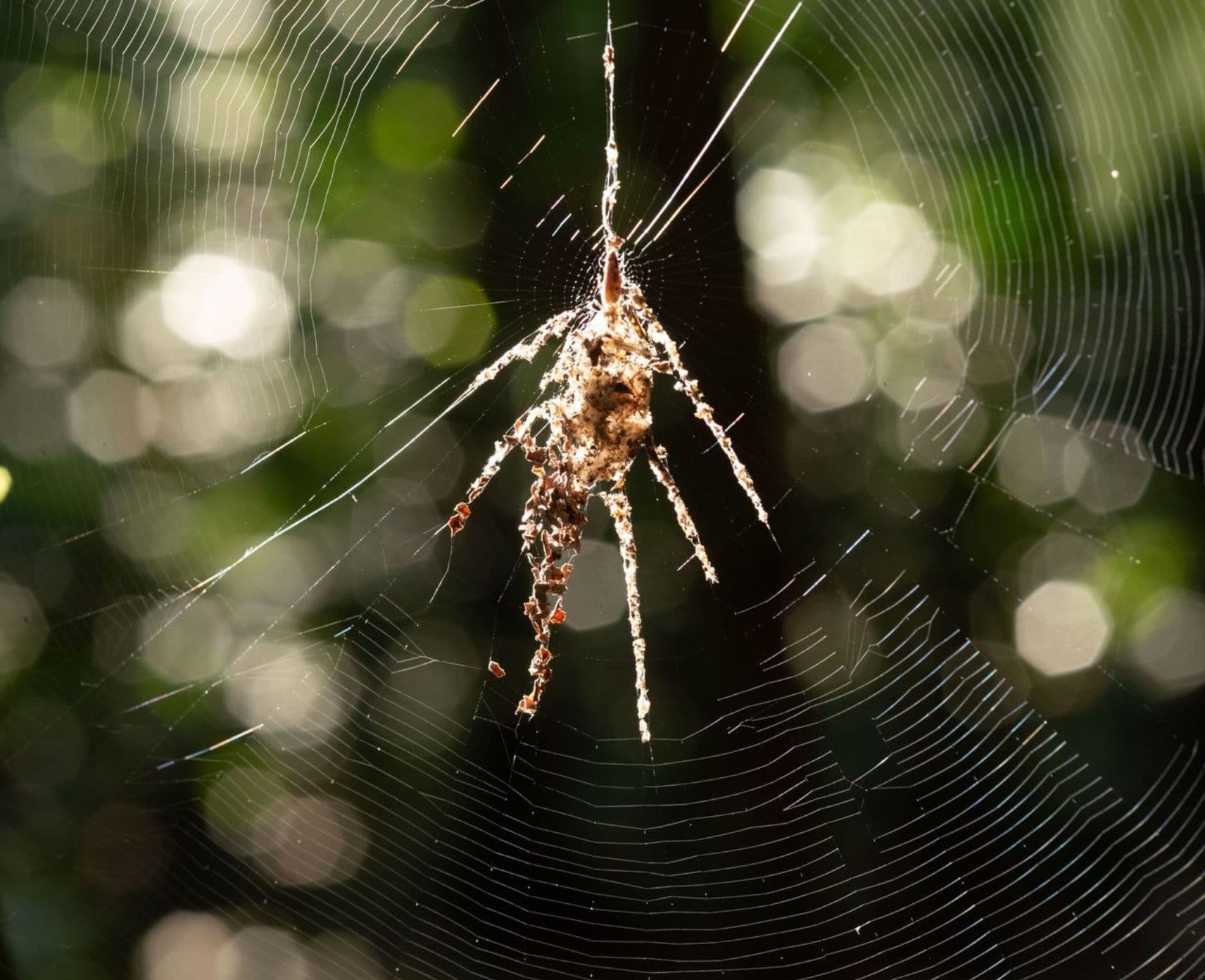
Tropical spiders build giant doppelgängers to survive
The extraordinary anti-predator strategy of two tiny, orb-weaving spider species has been uncovered by scientists from The Australian National University (ANU) and the University of Florida.
Several of the paper’s co-authors first reported on the possible discovery of a new species of spider over a decade ago, following a chance encounter in the Amazon rainforest in Peru. Now, the unusual behaviour of the Peruvian species and a second orb-weaving species from the Philippines has been scientifically recorded for the first time.
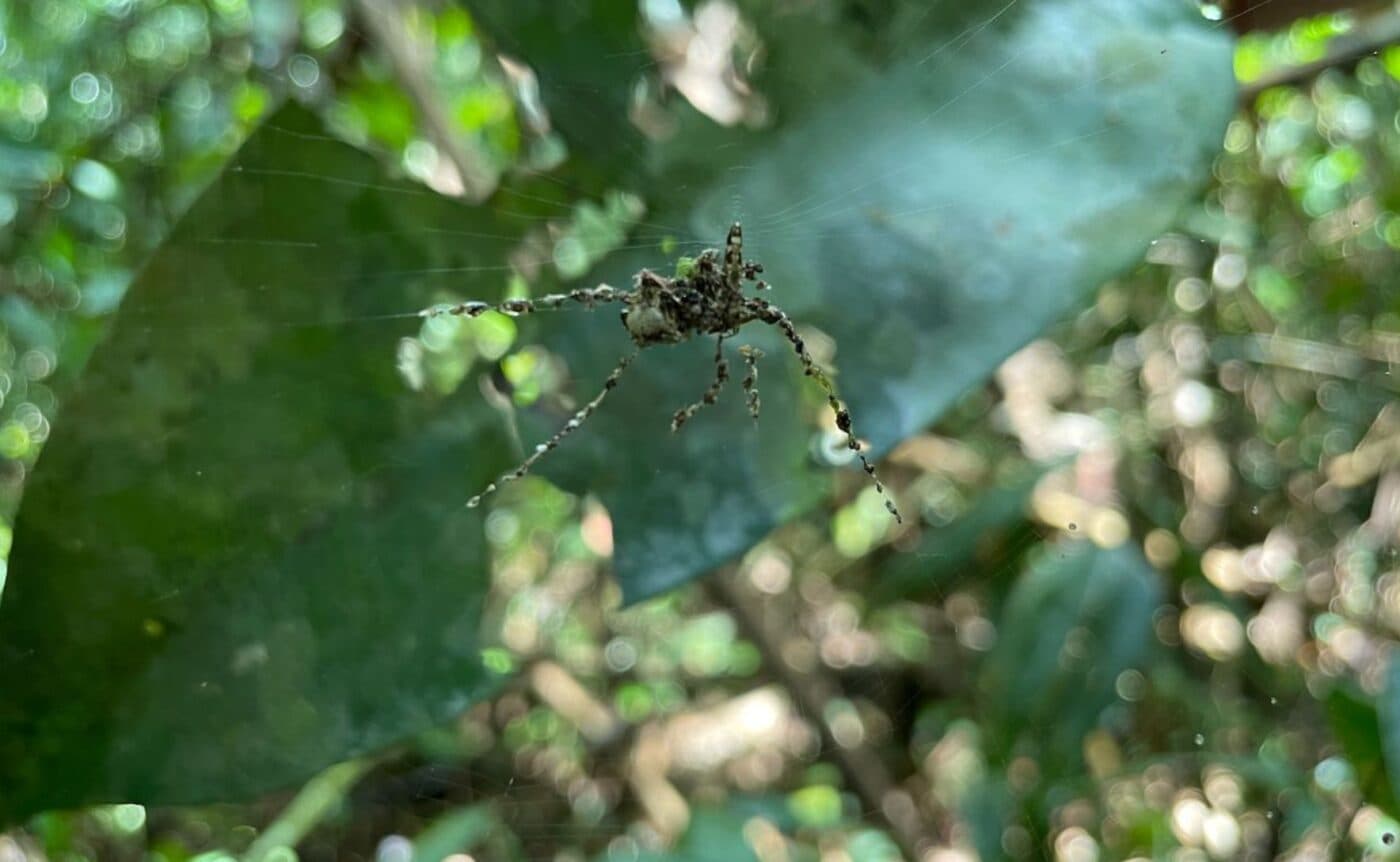
According to lead author of the study, Dr George Olah from ANU, the tiny, vulnerable spiders turn their web into a “theatre of deception” to trick would-be attackers.
“They don’t just decorate their webs – they meticulously arrange detritus, prey carcases and silk into a structure that’s not only larger than their own body, but clearly resembles the silhouette of a bigger, menacing spider,” Dr Olah said.
Researchers believe the “decoy spider” serves a dual purpose. It may mimic a larger predator that birds, lizards, and other enemies would prefer to avoid, while also creating a diversion, drawing an attack away from the smaller, real spider.
“This behaviour is not just a quirky biological observation; it illustrates a fundamental evolutionary trade-off in the spider world,” co-author Dr Lawrence Reeves from the University of Florida said.
“Unlike many orb-weavers that build a physical retreat to hide, these Cyclosa species appear to invest their time and resources into building an expendable visual defence instead.”
The remarkable behaviour of the spiders was recently captured on film by the study’s co-authors and features in a multi Emmy Award-winning documentary series, The Secret Lives of Animals.
“It might be the case that particularly strong selection within both these groups has resulted in them developing an increasingly complex visual defence,” Dr Olah said.
“Future studies could help shed further light on this – for example, comparing the survival rates of spiders with and without the “decoy spider”.
The findings are published in Ecology and Evolution. A video abstract is available on YouTube.
Top image: Richard Kirby

Contact the media team
You may also like

Codebreakers tackle cancer drug resistance with machine learning
Dr Eli Niktab is building a genome atlas to tackle chemotherapy resistance – and is attracting significant global funding.

Ultra-precise ANU coatings help power the next generation of gravitational wave detectors
ANU researchers have developed ultra-precise optical coatings for LIGO’s specialised beamsplitters, helping improve the observatory’s ability to detect faint gravitational waves from across the universe.

Bake your PhD: Can you have your doctorate and eat it too?
The tastiest annual tradition has returned in 2026.