
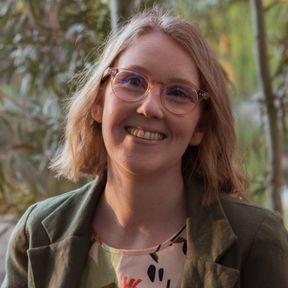
“My entire life has been an apprenticeship for advancing rights for my people,” says Minda Murray, a proud Yorta Yorta and Duduroa woman and PhD candidate at The Australian National University (ANU).
Murray, who also works for the ANU Centre for Indigenous Policy Research, is just one of many First Nations people and allies from across Australia who joined the Walk for Truth this year to call for a national commitment to truth-telling.
“I want to continue carrying the flame from my ancestors, who always resisted colonisation,” she says.

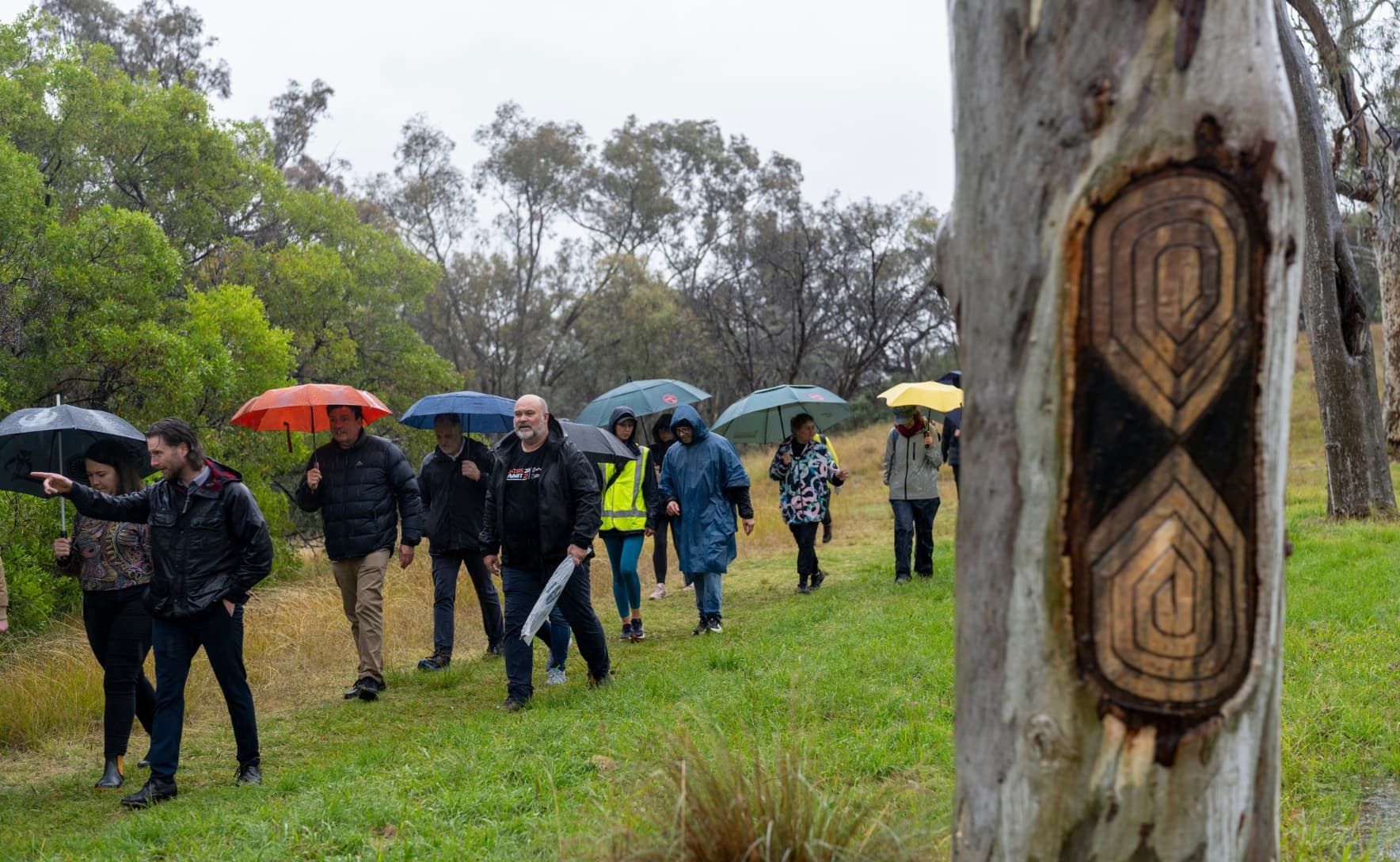
For five weeks, the Walk for Truth journeyed around 890 kilometres taking the message for truth-telling all the way from the Victorian Parliament in Naarm to Federal Parliament House on Ngunnawal and Ngambri Country.
As the group reached the ANU campus the day before Reconciliation Day, Dr Aunty Matilda House-Williams OAM provided a smoking ceremony and Welcome to Country.
“Truth-telling builds understanding, healing and a stronger future for everybody,” Aunty Matilda told the community in her address.
Messages from Country
Through the light fog of University Avenue, Murray walked with the group, flanked by both her parents, and alongside her friend of many years Travis Lovett, the founder of the Walk for Truth movement.
Lovett, a Kerrupmara Gunditjmara man and Executive Director of the University of Melbourne’s Centre for Truth Telling and Dialogue, has walked every leg, with many friends, family and supporters.
With him, Lovett carried message sticks from each Country that the walk journeyed through. One of those is from Murray’s own family.
“My cousin, Johnny Murray, he made the message stick from my Country, Duduroa Country,” Murray says.
“On that message stick, he’s engraved the story of our people, the trees, the mountains of the Victorian Northeast region.”
“When we hand that over at Parliament and call for truth telling, that’s our people’s call for recognition, for truth, for healing. That’s us imploring the Federal Government to match the Victorian State Government and to walk with our people for a better future together.”


Images: Minda Murray and ANU
It’s another connection that makes this an emotional moment for Murray; and a joining of many worlds – her old friends, her family, and her university.
“My PhD is about self-determination and partnering with Dja Dja Wurrung, helping to tell their truths and their resistance. And to celebrate them as people is a core part of why I’m here at this institution,” she explains.
“So, to have the Walk for Truth come through ANU and just epitomises all of that is just so important.”
Interim Vice-Chancellor Professor Rebekah Brown echoed this sentiment.
“Truth-telling is ongoing work – grounded in listening, relationships and action,” Professor Brown said at the Walk for Truth event.
“At ANU, the advancement of Australia’s Indigenous peoples is core to our mission, and today strengthened our resolve to walk forward together.”
Walking for hope and change
The Walk for Truth hopes to put First Nations people on the political agenda, after the unsuccessful Voice Referendum.
“When we talk about truths, we don’t want to take away from anybody else’s truth,” Murray says.
“But it is really important to recognise the past injustices and the suffering that our people have gone through in the process of colonisation.”


Interim Vice-Chancellor Professor Rebekah Brown and Travis Lovett. Photo: Jamie Kidston/ANU
She likens the process of truth-telling to the Japanese art of kintsugi, where broken ceramics are pieced back together with gold lacquer.
“That’s the journey. And the fact that it’s got a golden crack through it draws attention to the fact that it was broken but healed, and now it’s a thing of beauty.
“I feel that’s what we’re doing in the Walk for Truth, in that we’re healing those old wounds, but also calling for truth-telling from the leadership of our country.”
Among the heavy weight of the stories that have been told, among the suffering and the injustice, remains hope.
“We all fail when we lose hope,’ Murray adds.
“Hope is the central thing to the reason we all do anything, really. We all hope to walk forward together.
“We just need leadership to be at the forefront of it to keep things going, not just for aspirational statements, policies and media releases.
“We want action, we want change.”
Top image credit: Jamie Kidston/ANU
Related tags:
You may also like
Waluwin Mayiny – Waluwin Ngurambang: Healthy people, healthy Country
Paul Girrawah House is giving a voice to the trees on the ANU campus.
Landscape-scale cultural burning study expands
It’s one of the first landscape-scale trials of cultural burning on travelling stock reserves (TSRs) in NSW in history.
Changing the story of medical research for Aboriginal and Torres Strait Islander peoples
The National Centre for Indigenous Genomics is working with Indigenous communities on the ethical and respectful use of the stories held within DNA.